Key Findings
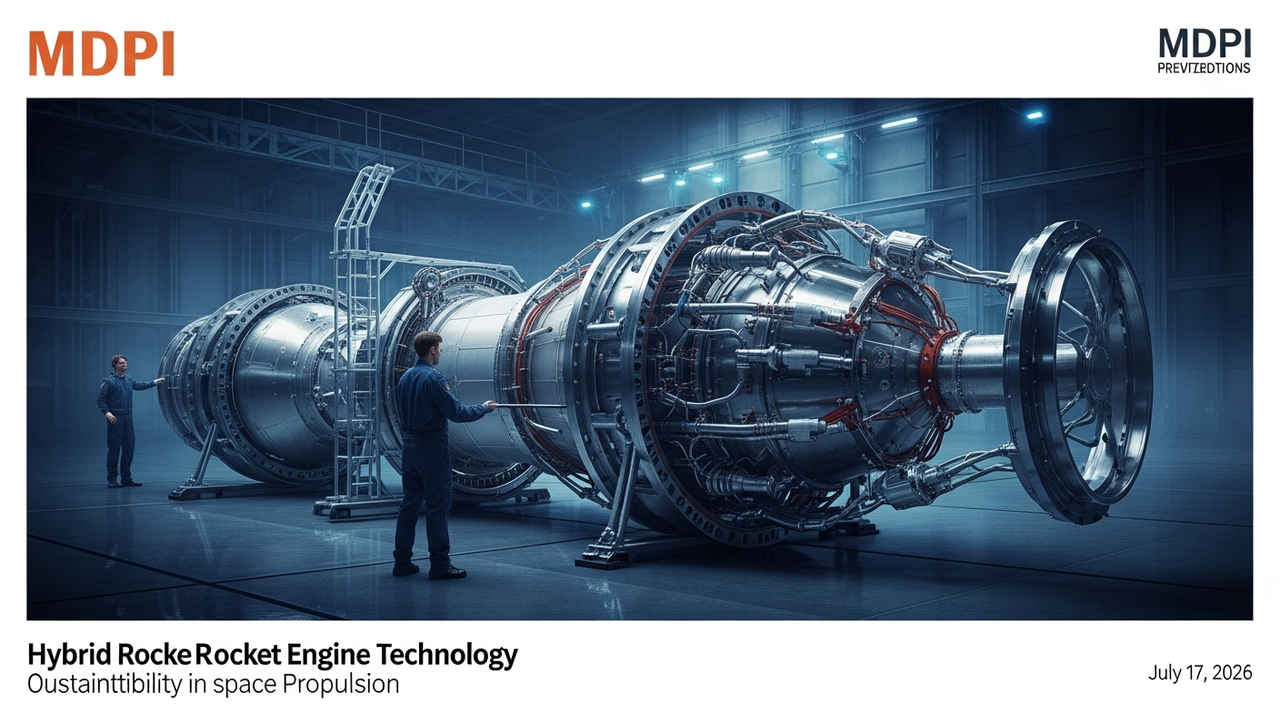
The paper ‘Technological Advancements of Hybrid Rocket Engines for Sustainable and Competitive In-Space Propulsion Applications,’ published in MDPI’s Engineering Proceedings, comprehensively analyzes recent technological trends in hybrid rocket engines and highlights their contribution to sustainability and commercial competitiveness. The research provides deep insights into how pioneering prototypes, such as the 3D-printed ABS ‘green’ CubeSat hybrid thruster mentioned in NASA’s 2026 Small Spacecraft Technology Report, are poised to shape the future of space propulsion systems. This marks a significant step towards realizing cleaner, safer, and more cost-effective space missions.
Technical Details
Hybrid rocket engines combine solid fuel with a liquid oxidizer, offering the simplicity of solid rockets and the thrust controllability of liquid rockets. This study particularly focuses on the impact of advancements in 3D printing technology on hybrid rocket design and manufacturing. Utilizing thermoplastic polymers like ABS as fuel significantly reduces manufacturing costs and allows for the optimization of complex nozzle geometries and fuel grain designs. Furthermore, these fuels offer enhanced safety and lower toxicity compared to conventional solid propellants, positioning them as ‘green’ alternatives. The paper details analyses of thruster performance improvements, combustion stability, re-ignition capabilities, and scalability, demonstrating that these technical challenges are increasingly being overcome.
Background & Context
In recent years, the space industry has faced immense pressure to reduce the cost of space access and meet the escalating demand for small satellites. Conventional liquid rocket engines are complex and expensive, while solid rocket engines lack thrust modulation. Hybrid rocket engines have emerged as a promising alternative, gaining attention for their safe storage, ease of operation, and minimal environmental impact. This technology is expanding its application range to include CubeSat deployment, orbital maneuvers, debris avoidance, and propulsion systems for space probes. With growing international interest in sustainable space utilization, the shift towards green propellants is a crucial trend across the industry.
Strategic Significance & Outlook
The continuous technological progress in hybrid rocket engines holds the potential to revolutionize space mission design and operations. Particularly, the synergy with 3D printing technology will enable on-demand manufacturing of customized propulsion systems, shortening development cycles and further reducing costs. This technology is expected to facilitate a wide range of new space applications, including commercial space travel, deep-space exploration, in-orbit servicing, and space debris removal. It is anticipated that the development of more efficient and reliable hybrid engines will progress, potentially making them a mainstream choice for space propulsion systems. This makes the field a compelling area for investors to monitor, given its long-term potential for transforming space access and operations.
Source: https://doi.org/10.3390/engproc2026142009
Get our weekly technology intelligence — free
Receive an infographic that lets you judge at a glance whether each field’s analysis report is worth reading.
Subscribe Free — Weekly Tech Intelligence
By subscribing, you’ll receive Troy-Technical’s weekly technology intelligence newsletter.
- Your email and selected fields are used only to deliver the newsletter.
- We never share your information with third parties.
- You can unsubscribe anytime via the link in each email.
See our Privacy Policy for details.
Takes about a minute · Unsubscribe anytime






Comments