


Key Findings
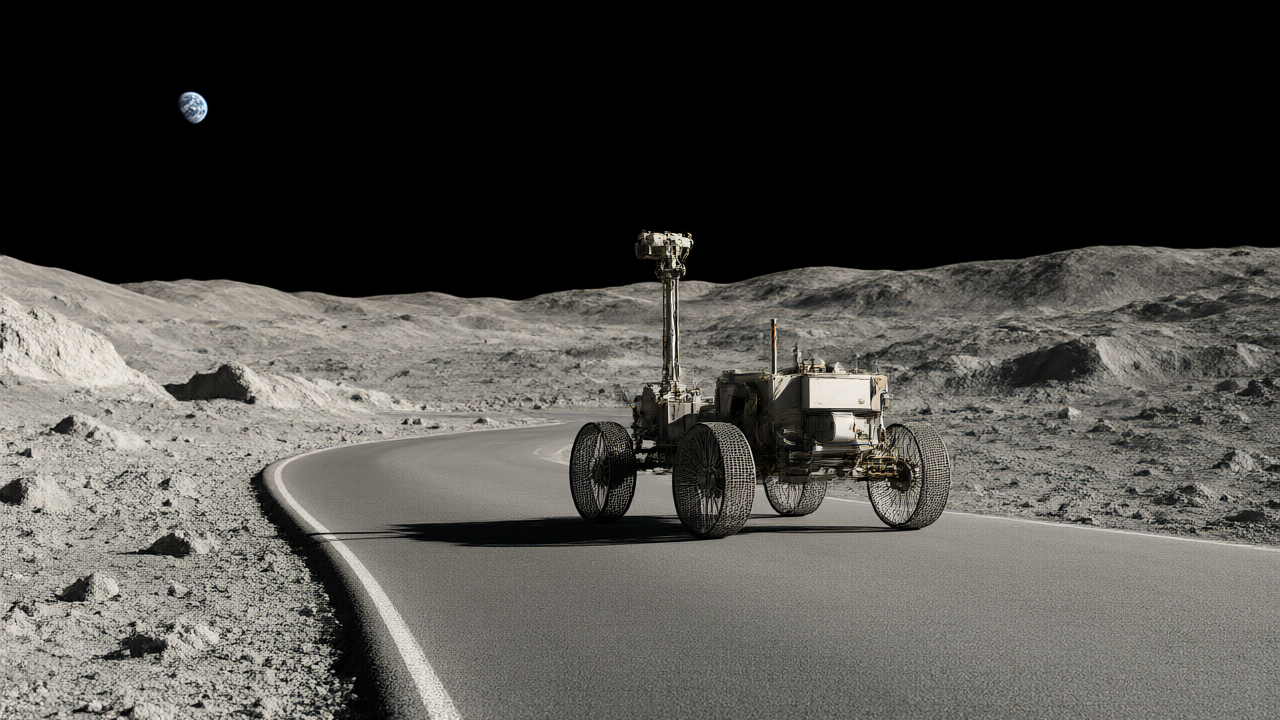
Space Mobility has developed a lunar infrastructure system consisting of interlocking tiles manufactured on-site from lunar regolith. The system introduces “Mechanical Gravity,” which restores a rover’s driving capability to approximately 99% of its Earth performance, compared to roughly 25% on bare regolith. The company has filed a provisional patent application as of September 2026 covering 185 claims and is currently conducting ground validation.
Technical Details
The system addresses the low-traction environment of the Moon, where a 3.6 metric ton rover traveling at 32 km/h on bare regolith requires approximately 70 meters to stop and has a turning radius of about 139 meters. The Space Mobility road utilizes the following technical features:
- Mechanical Gravity: A recessed guide channel in each tile houses a sled tethered to the vehicle, holding the vehicle down and on line.
- ISRU Manufacturing: Tiles are produced from lunar regolith; the company focuses on the geometry of tabs, sockets, and mold profiles.
- Integrated Infrastructure: Road tiles contain conduits for power and communications.
- Navigation: The guide channel provides a fixed path for autonomous vehicles, removing the need for lighting or navigation signals.
With a channel brake, the stopping distance for a 3.6 metric ton rover at 32 km/h is reduced to approximately 4.5 m.
Background and Context
The technology aligns with NASA’s accelerated Artemis schedule, which targets astronauts on the lunar surface in 2028. The system addresses gaps identified in NASA’s 2026 Civil Space Shortfalls list, specifically regarding landing pads, site preparation, load-bearing structures, and crew mobility. Space Mobility has partnered with two U.S. universities specializing in aerospace engineering and space resources to accelerate research.
Significance and Outlook
The manufacturing process used for road tiles can be adapted to create landing pad segments, habitat foundations, and shielding blocks. The company’s roadmap targets the completion of ground validation in 2027, the deployment of the first demonstration tile in 2028, and full lunar highway production for a permanent Moon base between 2030 and 2032.
Get our weekly technology intelligence — free
Receive an infographic that lets you judge at a glance whether each field’s analysis report is worth reading.
Subscribe Free — Weekly Tech Intelligence
By subscribing, you’ll receive Troy-Technical’s weekly technology intelligence newsletter.
- Your email and selected fields are used only to deliver the newsletter.
- We never share your information with third parties.
- You can unsubscribe anytime via the link in each email.
See our Privacy Policy for details.
Takes about a minute · Unsubscribe anytime