


Key Findings
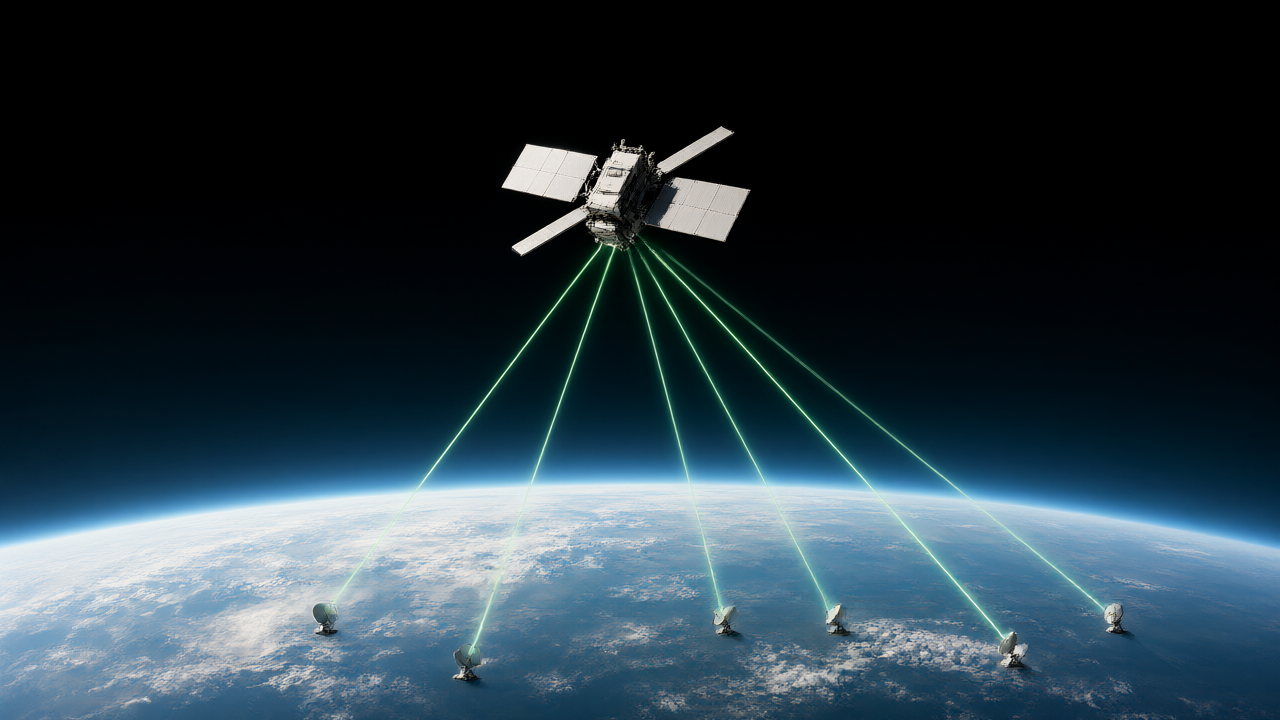
In-orbit demonstrations conducted in May 2026 confirmed that MIMO (multiple-input multiple-output) technology significantly expands communication capacity on the feeder link from a low-Earth-orbit (LEO) satellite to a ground base station. Compared to conventional SISO (single-input single-output) transmission, the 2×2 MIMO configuration achieved an average transmission capacity of approximately 1.94x, while the 3×3 configuration reached approximately 2.67x.
Technical Details
The demonstration utilized the “LEOMI” LEO satellite MIMO/IoT transmission device. To overcome challenges associated with constant channel changes, signal arrival time variances, and Doppler shifts, NTT and JAXA integrated three specific technologies:
- Time-frequency asynchronous interference compensation
- Channel modeling
- Control-carrier-less MIMO demodulation
Additionally, the partners tested satellite sensing using LPWA signals in the 920 MHz band. They successfully separated and demodulated overlapping waveforms transmitted simultaneously from two different ground locations to the satellite, proving that compact, power-efficient terminals can communicate on the same frequency concurrently.
Background and Context
The Small Demonstration Satellite-4 was launched on December 14, 2025, and began regular operations in March 2026. The results of these experiments will be presented at the “NTT R&D FORUM 2026” from November 18 to 25 as part of the “NTT C89” space business brand. Over the next year, further experiments with varying antenna numbers across different satellite passes will be conducted to statistically evaluate capacity effects.
Significance and Outlook
This technology is a core component of NTT’s “Space Integrated Computing Network” concept. By improving spectral efficiency, the system can support higher transmission speeds for radar data and high-definition imagery, benefiting disaster prediction, ocean observation, and weather accuracy. Furthermore, because satellite sensing bypasses ground base stations, it enables low-cost IoT deployment for environmental monitoring and infrastructure inspection in remote mountainous or oceanic regions.
Source: https://finance.biggo.com/news/cc76f437-986e-4635-9863-2c955b16961a
Get our weekly technology intelligence — free
Receive an infographic that lets you judge at a glance whether each field’s analysis report is worth reading.
Subscribe Free — Weekly Tech Intelligence
By subscribing, you’ll receive Troy-Technical’s weekly technology intelligence newsletter.
- Your email and selected fields are used only to deliver the newsletter.
- We never share your information with third parties.
- You can unsubscribe anytime via the link in each email.
See our Privacy Policy for details.
Takes about a minute · Unsubscribe anytime