Key Findings
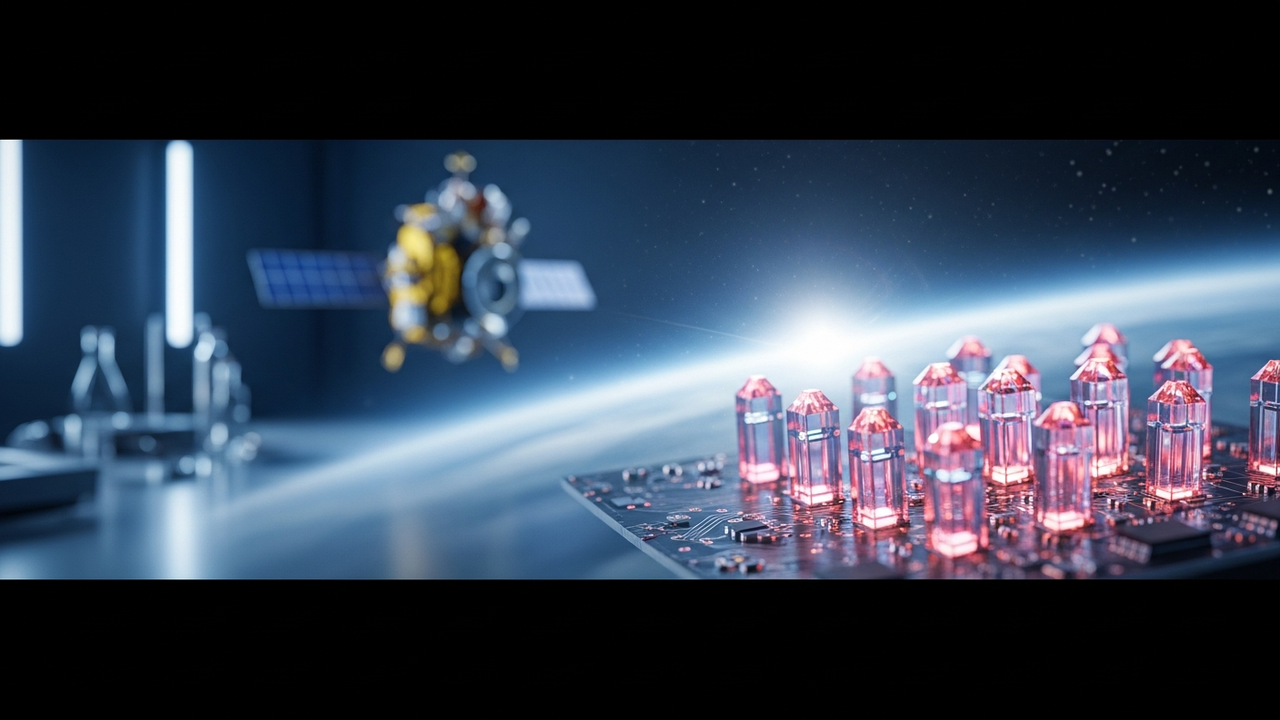
A study published on July 16, 2026, in ACS Applied Electronic Materials, titled ‘Hardness of Infrared Nanocrystal-Based Photodiode to Irradiations for Space Applications,’ experimentally demonstrated that infrared nanocrystal-based photodiodes possess excellent resilience against the harsh radiation environment of space. Through detailed analysis utilizing X-ray photoelectron spectroscopy (XPS) and depth profiling, a direct correlation was established between radiation-induced photoelectric degradation and nanoscale chemical and structural modifications. This finding substantiates the significant promise of colloidal nanocrystals as reliable sensor materials for space applications.
Technical Details
In this research, photodiodes fabricated with infrared nanocrystals (specifically lead sulfide (PbS) nanocrystals) were exposed to high-energy radiation, such as electron beams and gamma rays, and their subsequent changes in electrical properties were meticulously evaluated. The study confirmed that the degradation of key optoelectronic properties, including photocurrent, dark current, and response speed, was suppressed. To elucidate the underlying mechanisms, changes in elemental composition and bonding states via XPS, along with the depth distribution of radiation damage through depth profiling, were investigated. The results suggested that the unique electronic structure of nanocrystals and their surface passivation layers contribute to high radiation hardness by effectively ‘self-healing’ or ‘isolating’ radiation damage. This indicates the potential to enhance radiation tolerance by optimizing the material’s nanostructure.
Background & Context
Space is an extremely harsh environment, characterized by high-energy radiation from Earth’s radiation belts, solar flares, and galactic cosmic rays. Electronic components on spacecraft and satellites, particularly sensors and photodetectors, are constantly exposed to risks of performance degradation and failure due to this radiation. Conventional semiconductor devices require specialized shielding or design modifications to ensure radiation hardness, which often leads to increased mass and cost. Consequently, there has been a pressing need for the development of new materials that are intrinsically radiation-tolerant. Infrared detectors are widely used in various space applications, including Earth observation, space telescopes, planetary exploration, and missile early warning systems, making improvements in their reliability a critical imperative.
Strategic Significance & Outlook
These research findings will profoundly influence the design of photodetectors for next-generation space telescopes, Earth observation satellites, communication satellites, and deep-space probes. The introduction of radiation-hardened nanocrystal photodiodes is expected to extend satellite lifespan, enhance reliability, and reduce mission costs. Furthermore, if the weight of radiation shielding can be reduced, it would allow for increased payload mass or greater design flexibility for the overall satellite system. Future efforts will likely focus on optimizing manufacturing processes for mass production of this technology and conducting long-term performance evaluations under various radiation environments. This holds the potential to bring significant competitive advantages in the space industry, especially in the space sensor market, driving innovation in electronic components.
Source: https://pubs.acs.org/doi/10.1021/acsaelm.6c00756
Get our weekly technology intelligence — free
Receive an infographic that lets you judge at a glance whether each field’s analysis report is worth reading.
Subscribe Free — Weekly Tech Intelligence
By subscribing, you’ll receive Troy-Technical’s weekly technology intelligence newsletter.
- Your email and selected fields are used only to deliver the newsletter.
- We never share your information with third parties.
- You can unsubscribe anytime via the link in each email.
See our Privacy Policy for details.
Takes about a minute · Unsubscribe anytime








Comments