


Key Findings
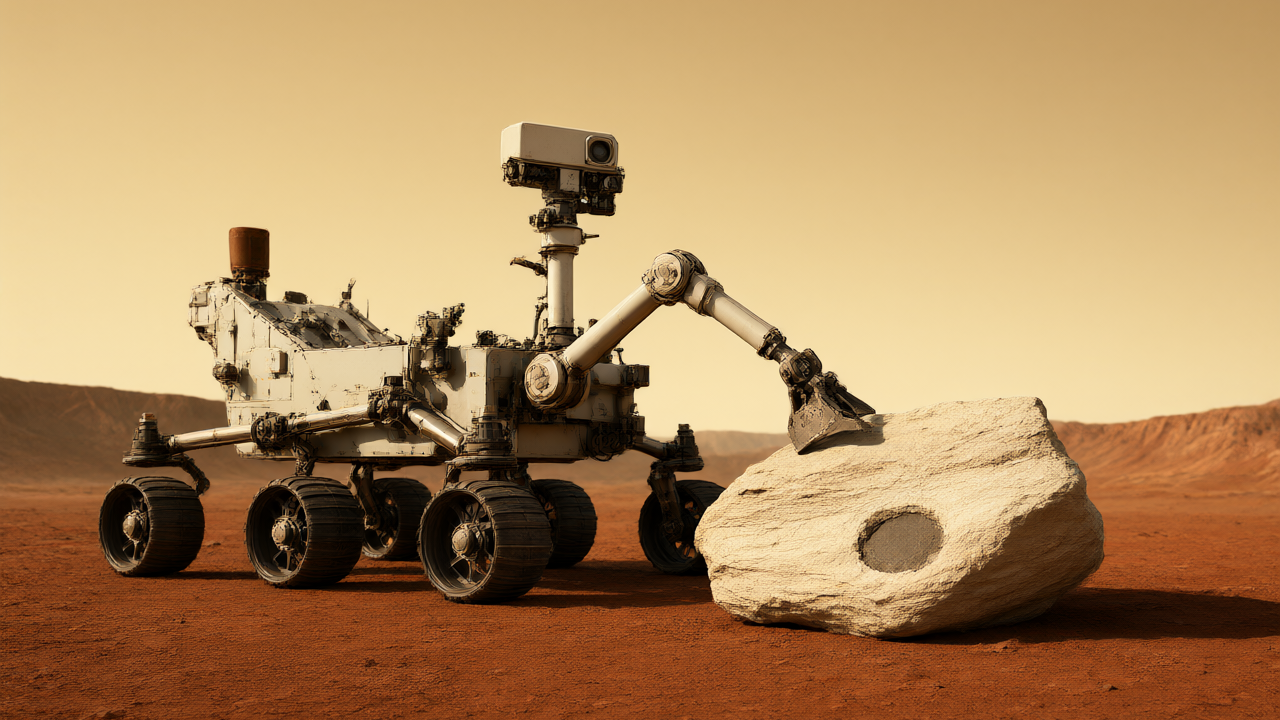
NASA’s Perseverance rover has confirmed the presence of organic carbon in two ancient Martian rocks located in the Bright Angel formation. This discovery follows a September 2025 announcement regarding a potential biosignature. Notably, the organic carbon was detected at a depth of only a few microns below the surface—a distance smaller than the thickness of a sheet of paper—marking the shallowest detection of macromolecular carbon reported on Mars to date.
Technical Details
Researchers utilized the Scanning Habitable Environments with Raman & Luminescence for Organics & Chemicals (SHERLOC) instrument, mounted on the rover’s robotic arm, to analyze the samples. The instrument employs Raman spectroscopy, using laser light to map minerals and organic compounds without damaging the rock. The analysis identified macromolecular carbon (MMC), which consists of large, interconnected networks of carbon atoms. The MMC was found within ancient sediments alongside sulfate and carbonate minerals, suggesting organic material may have entered or formed within the rocks during at least two separate geological periods.
Background and Context
The Bright Angel formation consists of mudstones created billions of years ago when sediment settled at the bottom of a river channel flowing into Jezero crater. The survival of MMC so close to the surface is unusual, as Martian radiation, sunlight, and chemical oxidants typically destroy organic molecules. Researchers suggest the material survived either due to its own chemical durability or because it was shielded by iron-rich soil or minerals such as clays.
Significance and Outlook
The discovery indicates that organic carbon was not isolated to a single region; the Bright Angel sample was collected more than 2,000 miles from Gale Crater, where the Curiosity rover previously detected organic compounds. While MMC can be produced through non-biological chemical processes and does not definitively prove past life, its widespread presence suggests that the chemical ingredients for life were common across the Martian landscape. Determining if these rocks contain fossilized microorganisms remains beyond the current capabilities of the rovers.
Source: https://www.sciencedaily.com/releases/2026/11/261111005908.htm
Get our weekly technology intelligence — free
Receive an infographic that lets you judge at a glance whether each field’s analysis report is worth reading.
Subscribe Free — Weekly Tech Intelligence
By subscribing, you’ll receive Troy-Technical’s weekly technology intelligence newsletter.
- Your email and selected fields are used only to deliver the newsletter.
- We never share your information with third parties.
- You can unsubscribe anytime via the link in each email.
See our Privacy Policy for details.
Takes about a minute · Unsubscribe anytime