Key Findings
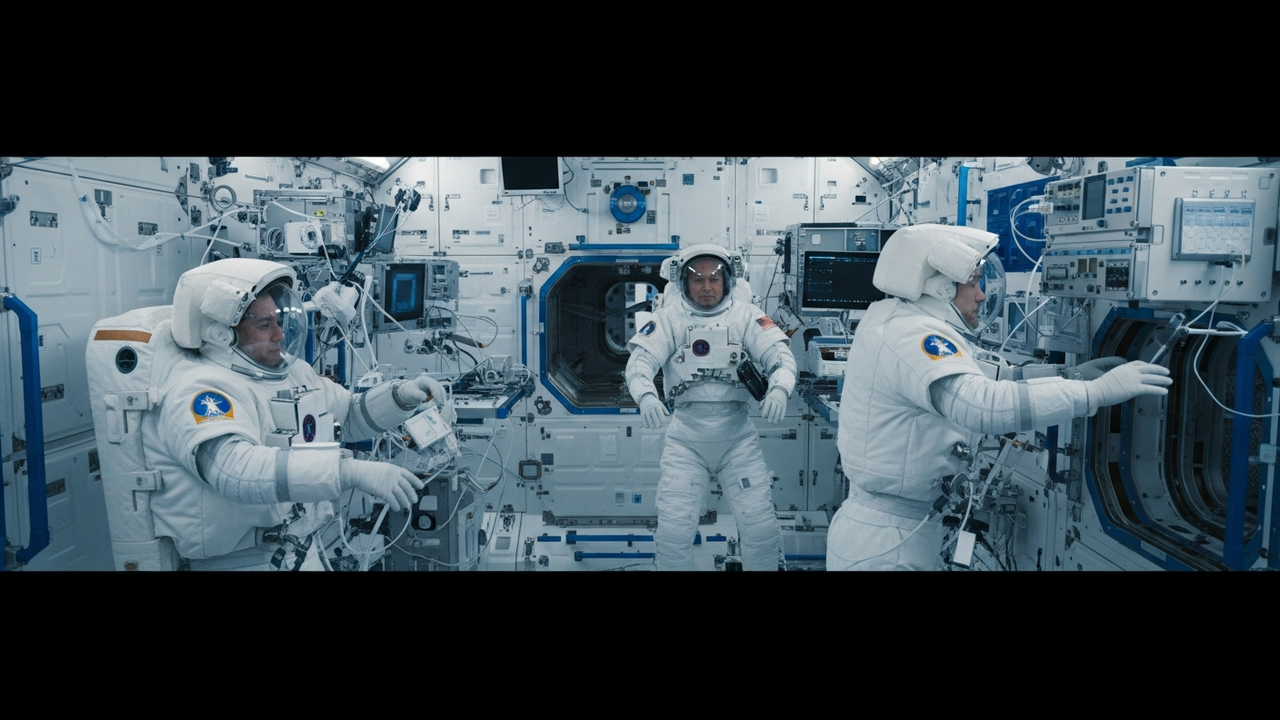
The NASA Spaceline Current Awareness List #1,208, published on July 20, 2026, highlighted research conducted on the China Space Station. According to this study, kinematic signatures observed during reaching movements in spaceflight provide strong evidence that humans underestimate their own body mass in a microgravity environment. This discovery significantly refines our understanding of astronaut motor control, particularly the mechanisms of adaptation to microgravity, and offers crucial insights that will impact future training and support system designs for long-duration space missions.
Technical / Clinical Details
The research meticulously analyzed kinematic data—such as velocity, acceleration, and trajectory of arm and hand movements—as astronauts reached for targets in microgravity. By comparing these observations with similar experiments conducted on Earth, the study demonstrated that in microgravity, astronauts unconsciously adjust their movements as if their bodies were lighter than on Earth. Specifically, patterns like slower initial movement velocities and extended deceleration phases clearly indicated a distortion in the perception of mass influencing motor control. This provides direct evidence of how fundamental sensorimotor processes, such as body schema and graviception, are reorganized under microgravity conditions.
Background & Context
Long-duration spaceflight imposes various physiological changes on astronauts, with alterations in the sensorimotor system being a prominent one. Changes in the perception of body mass and moment of inertia can directly affect the safety and precision of tasks performed inside spacecraft and during Extravehicular Activities (EVAs). While the impact of microgravity on postural control and locomotion has been well-documented, concrete kinematic evidence regarding the effect of body mass perception on motor control has been scarce. The data from the China Space Station provides invaluable insights into these perceptual and motor adaptations, addressing a critical knowledge gap.
Strategic Significance & Outlook
The results of this study will be instrumental in developing more effective training protocols for astronauts to adapt to microgravity environments. For instance, specific motor training exercises or simulated gravity environments using virtual reality (VR) technology might be introduced to compensate for distorted body mass perception. Furthermore, with future lunar and Mars missions anticipating operations in partial gravity, continued research into body mass perception and motor control adaptation across various gravity levels becomes essential. This research is expected to contribute to optimizing spacecraft interface designs and robotic operation assistance systems, thereby enhancing astronaut performance and safety. For investors, it signals emerging market opportunities in astronaut health and training support, space medicine technologies, and human factors engineering for space missions.
Get our weekly technology intelligence — free
Receive an infographic that lets you judge at a glance whether each field’s analysis report is worth reading.
Subscribe Free — Weekly Tech Intelligence
By subscribing, you’ll receive Troy-Technical’s weekly technology intelligence newsletter.
- Your email and selected fields are used only to deliver the newsletter.
- We never share your information with third parties.
- You can unsubscribe anytime via the link in each email.
See our Privacy Policy for details.
Takes about a minute · Unsubscribe anytime





Comments