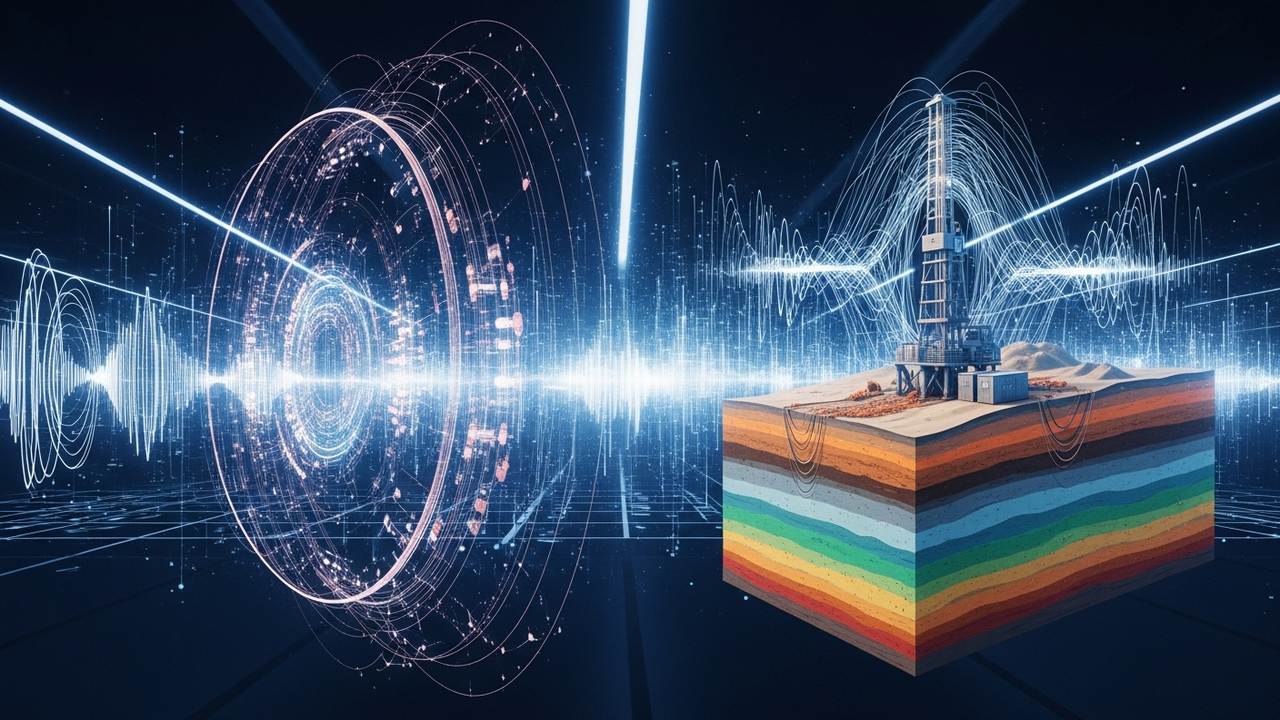
The Computational Bottleneck in Energy Exploration and Quantum Solutions
The discovery and extraction of hydrocarbon resources rely heavily on seismic imaging, a technique that involves generating and analyzing massive datasets to infer subsurface geological structures. Processing these complex seismic data volumes demands extraordinary computational power, often requiring months or even years on conventional supercomputers for high-fidelity simulations of wave propagation. This computational intensity drives up exploration costs and limits the speed and accuracy of decision-making. The energy industry is actively seeking new computational paradigms to overcome these challenges, and quantum computing has emerged as a promising candidate. Its potential for exponential speedups in optimization and simulation problems offers a compelling path to revolutionize tasks that are intractable for classical machines.
Joint Project Scope: Quantum Algorithms for Seismic Imaging
The collaborative project between Quantinuum and bp focuses on developing and implementing quantum algorithms tailored for seismic data analysis. Specifically, the initiative aims to simulate the propagation of acoustic and elastic waves through complex underground formations with unprecedented accuracy. By harnessing quantum phenomena like superposition and entanglement, quantum computers could potentially process vast geological models and execute simulations far more rapidly than classical methods. This project combines Quantinuum’s cutting-edge quantum hardware, particularly its trapped-ion quantum computing platform, with bp’s deep domain expertise in energy exploration and geophysical modeling. Initial phases will likely involve proof-of-concept demonstrations and small-scale simulations through which the efficacy and scalability of quantum algorithms will be validated.
Transformative Impact on Exploration Efficiency and Sustainability
Should this quantum project prove successful, it could profoundly transform the energy exploration landscape. Reduced computational times would significantly shorten the overall lead time for exploration campaigns, enabling quicker decision-making and potentially faster time-to-market for new resources. More accurate subsurface models could also dramatically improve drilling success rates, minimizing the need for unproductive exploratory wells, thereby lowering costs and reducing environmental footprint. Beyond traditional exploration, quantum computing holds promise for broader sustainability challenges within the energy sector, such as optimizing carbon capture and storage (CCS) technologies or designing more efficient configurations for renewable energy grids. This partnership between Quantinuum and bp serves as a critical case study demonstrating the tangible value proposition of quantum technology for industrial applications.









Comments