Key Findings
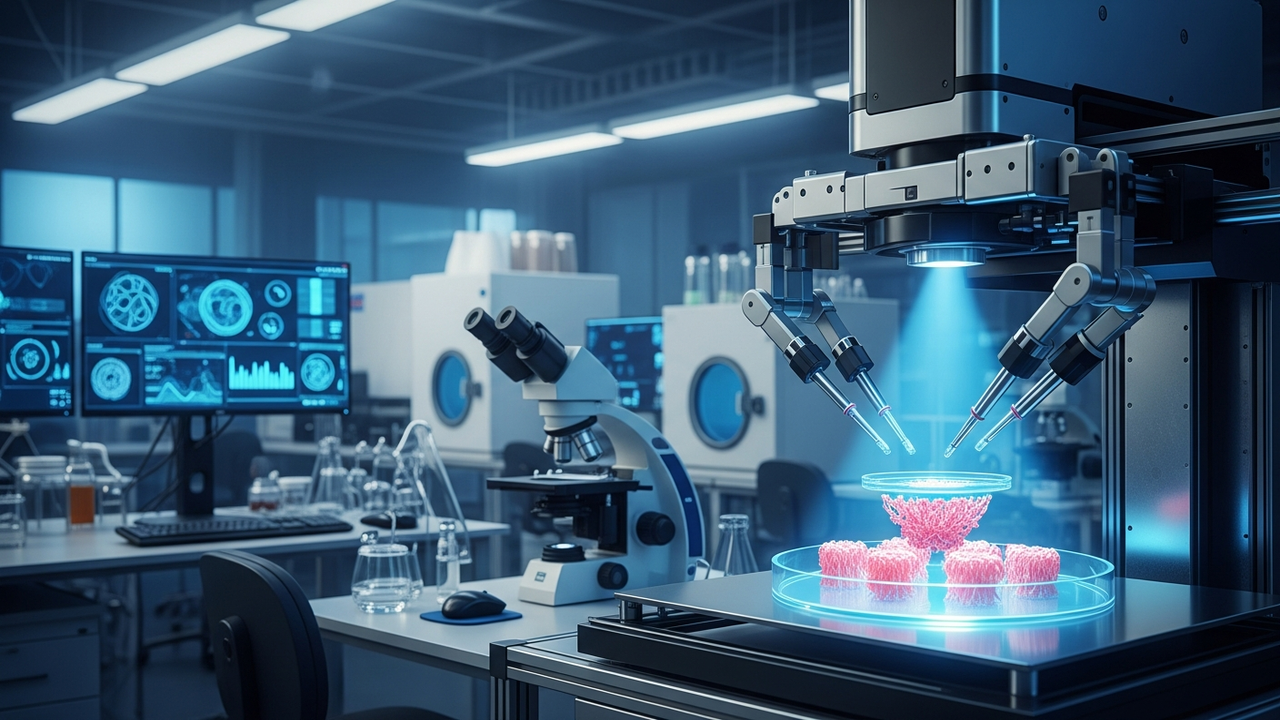
CELLINK’s 3D bioprinting technology is revolutionizing the future of cell culture, dramatically accelerating research and development in the fields of cultivated meat, tissue engineering, and regenerative medicine. This technology, particularly through its integration with organoid platforms, has enabled the fabrication of unprecedentedly reproducible and scalable three-dimensional tissue structures for critical applications in drug discovery, toxicology screening, and pharmaceutical development.
Technical / Clinical Details
- Core of 3D Bioprinting: CELLINK’s platform combines various cell types with bio-inks (biocompatible materials) to precisely deposit layers, constructing complex 3D structures. This methodology allows for a more faithful replication of the microenvironments found within native tissues and organs, providing a superior model for biological study.
- Integration with Organoid Technology: While conventional organoids possess self-assembly capabilities, they have inherent limitations in terms of size, shape, functional complexity, and reproducibility. By combining 3D bioprinting with organoid culture, researchers can now precisely control organoid growth, introduce vascular structures, and orchestrate the arrangement of multiple cell types, thereby producing more complex and functionally robust ‘mini-organs.’
- Reproducibility and Scalability: The automated bioprinting process enables the mass production of standardized tissue structures with high reproducibility, surpassing the capabilities of manual culture techniques. This is a critical factor for establishing reliable high-throughput drug screening platforms and for the industrial-scale manufacturing of future cell therapy products.
- Applications in Drug Discovery and Toxicology:
- Disease-Specific 3D Models: Bioprinted organoids derived from patient iPSCs can provide highly accurate models to replicate specific disease mechanisms, offering a more relevant platform for understanding human pathologies.
- High-Throughput Screening: Large quantities of uniform organoids facilitate efficient evaluation of candidate drug efficacy and toxicity, thereby accelerating the identification of lead compounds.
- Alternative to Animal Testing: By providing more physiologically relevant in vitro human models, this technology contributes to reducing animal experimentation, yielding both ethical and economic benefits.
- Applications in Regenerative Medicine: Advances are being made in improving vascularization and developing bioprinted scaffolds for larger, transplantable organs, paving the way for future organ regeneration and tissue repair therapies.
Background & Context
Modern pharmaceutical development faces challenges of high clinical trial failure rates and astronomical costs. A significant contributing factor has been the inability of traditional 2D cell cultures and animal models to adequately replicate complex human physiological responses. The convergence of organoid technology and 3D bioprinting addresses this gap, offering more accurate disease models and efficient screening tools that are fundamentally transforming the drug discovery process. This field is globally recognized as a crucial pillar for the realization of personalized medicine.
Strategic Significance & Outlook
The advancements in CELLINK’s 3D bioprinting technology promise to revolutionize the drug discovery and regenerative medicine sectors. In the future, bioprinted organoids will be utilized for more complex evaluations of pharmacokinetics, drug interactions, and the construction of personalized patient models. Furthermore, as bioprinting technologies mature for larger, complex tissues integrated with vasculature and innervation, the prospect of manufacturing functional organ replacements and in vivo tissue regeneration applications will come into view. The continuous development of this technology is indispensable for accelerating innovation in the healthcare industry and delivering improved therapies to patients worldwide.
Source: https://atcg.in/cellink-3d-bioprinting-advancing-the-future-of-cell-culture/



Comments