COMPANY PROFILE / CELL CULTURE TECHNOLOGY
AGC Biologics
A CDMO built through acquisitions by glass and chemicals maker AGC, taking contract work on antibodies and cell therapies alike
AGC Biologics is a subsidiary of AGC Inc., the Japanese glass and chemicals maker, and a CDMO that develops and manufactures other companies' medicines under contract. It has no drugs of its own. It works in both contract manufacturing of biologics, such as antibodies made in animal cells, and contract gene and cell therapy work, making viral vectors for CAR-T and the cells themselves. Its parent's Life Science business, however, posted an operating loss of ¥22.3 billion in the year to December 2025, and has withdrawn from two sites in Colorado in the U.S. Using only AGC's statutory disclosures and AGC Biologics' official announcements, this profile sets out how much is being invested and in what, who the company works with, and where it is trying to rebuild.
- AGC Biologics in 30 seconds, and where it stands in cell culture
- The logo and how the name is written
- Where the company sits in the cell culture landscape
- Scale (with the parent, AGC, kept brief)
- Resources committed to cell culture
- What it has done so far
- What comes next
- What the company is aiming for in cell culture
- Map of cell culture partnerships
- Technologies, products and services
- The risks this company carries
- Glossary, references and claim-to-source audit
1. AGC Biologics in 30 seconds, and where it stands in cell culture
Washington, U.S.As stated on the company's official website
(contract manufacturing)Both animal cell culture for antibodies and the like, and cell therapy
and EuropeSeattle / Copenhagen / Heidelberg / Milan / Chiba / Yokohama
Operating loss ¥22.3 billionYear to December 2025. Includes contract synthetic pharma and agrochemicals
Yokohama (from July 2025)Withdrawn from Longmont, Colorado
to start in 2027Investment of about ¥50 billion (AGC disclosure)
Companies involved in cell culture fall into three broad types: contract development and manufacturing organisations (CDMOs), suppliers of equipment and media, and developers of cell therapies. AGC Biologics is a CDMO with no secondary type. It does not develop or sell drugs of its own; it takes on manufacturing for pharmaceutical companies and biotech ventures Sourced. And it is involved in both meanings of "cell culture": growing animal cells to produce biologics such as antibodies (Copenhagen, Seattle, Chiba and Yokohama), and gene and cell therapy, making the cells themselves or the viral vectors that carry genes into cells (Milan and Yokohama). AGC's Annual Securities Report states plainly that biologics CDMO work using animal cells accounts for half of Life Science revenue, and that winning orders in animal cells is a challenge Sourced.
2. The logo and how the name is written

The AGC Biologics logo is a trademark of the company. We have not recreated it with generated imagery;
the image taken from the official website is placed here as img/agc_biologics_logo.svg.
"Your friendly CDMO expert", shown with the logo, is the company's tagline.
A note on names: the parent is AGC Inc. (formerly Asahi Glass), whose main businesses are glass, chemicals and electronic materials. AGC Biologics is not a single legal entity; the name is used collectively for companies including AGC Biologics, Inc. in the U.S., AGC Biologics A/S in Denmark, AGC Biologics GmbH in Germany and AGC Biologics S.p.A. in Italy. In AGC's Annual Securities Report they fall within the "Life Science" segment.
Official site: https://www.agcbio.com/about3. Where the company sits in the cell culture landscape
The warning at the bottom of the left-hand box, "loses money if plants sit idle", is no abstraction for AGC Biologics. In the year to December 2024 AGC booked impairment losses totalling ¥118,495 million in the Life Science segment, mostly at the AGC Biologics companies in the U.S., Denmark and Italy. Among the reasons AGC gave were "a delayed recovery from weak demand caused by reduced funding flowing into biotech ventures" and "a significant decline in the outlook for future orders and expected utilisation" (our translation from the Japanese) Sourced. It is a case of the CDMO model's weak point showing up directly in the numbers.
4. Scale (with the parent, AGC, kept brief)
AGC Biologics is not listed, and revenue and profit for AGC Biologics alone are not published Not yet confirmed. What can be confirmed are the figures for the "Life Science" segment in the parent AGC's disclosures. Note that these also include contract manufacturing of synthetic pharmaceuticals and agrochemicals (in Spain and Japan).
| Parent: AGC Inc. | Details |
|---|---|
| Head office | 1-5-1 Marunouchi, Chiyoda-ku, Tokyo |
| Listing | Tokyo Stock Exchange Prime Market (securities code 5201) |
| Consolidated revenue | ¥2,058.8 billion (year to Dec 2025) / ¥2,067.6 billion (year to Dec 2024) |
| Consolidated employees | 52,896 (31 December 2025; Life Science 2,967) |
| Life Science segment (¥ billion) | Year to Dec 2024 | Year to Dec 2025 | H1 2026 | Year to Dec 2026, company forecast |
|---|---|---|---|---|
| Revenue | 141.2 | 133.1 | 72.3 | 160.0 |
| Operating profit | −21.2 | −22.3 | −6.1 | −5.0 |
The table above covers the whole Life Science segment, including the synthetic pharmaceutical and agrochemical CDMO. Material AGC presented in September 2025 shows that of 2024 revenue, biologics CDMO accounted for about 70% and synthetic pharma and agrochemical CDMO for about 30% Sourced. The Annual Securities Report says that biologics CDMO using animal cells accounts for half of Life Science revenue. But revenue from cell therapy (gene and cell therapy), revenue and profit for AGC Biologics as a whole, and revenue by site are not published Not yet confirmed. This article makes no estimate of the form "AGC Biologics has revenue of X hundred million dollars".
5. Resources committed to cell culture
As in every profile in this series, we check four kinds of resource (people, money, external investments and acquisitions, and ties with universities) and show whether each could be confirmed from primary sources.
| Type of resource | Details | Status |
|---|---|---|
| People | 2,967 employees in the Life Science segment (plus 163 temporary staff, 31 December 2025). 466 employees at AGC Biologics, Inc. in the U.S. (Seattle and elsewhere). A dedicated cell and gene therapy organisation, the Cell and Gene Technologies Division, was set up in April 2025 (with Milan at its core). Headcount for AGC Biologics as a whole, and dedicated cell therapy headcount, are not disclosed | Partly confirmed |
| Money (R&D) | Life Science R&D of ¥1,088 million (year to December 2025). The breakdown for cell culture and cell therapy is not disclosed | Confirmed |
| Money (capital expenditure) | Life Science capital expenditure of ¥28,140 million (year to December 2025, including expansion of biologics CDMO facilities in Japan). Plan for 2026 of ¥33.0 billion. Investment in the new Yokohama site of about ¥50 billion | Confirmed |
| External investments and acquisitions | Acquisitions of Biomeva, Germany (2016), CMC Biologics (U.S. and Denmark, 2017), Molecular Medicine, Italy (2020), a drug substance plant in Boulder, U.S. (2020) and a gene therapy plant in Longmont, U.S. (2021). No investments in start-ups are mentioned in the disclosures or official announcements | Acquisitions confirmed / investments not confirmed |
| University and research ties | Contracted by Okayama University to build a cell line for a therapeutic candidate and to manufacture it for clinical use (July 2025). This is a service contract, not joint research. No joint research with universities on cell culture technology is mentioned | Contract confirmed / joint research not confirmed |
| Public support | The company says the Yokohama site was part of the biomanufacturing investments made by Japan's Ministry of Economy, Trade and Industry (METI) in 2022. The amount of support is not stated in the release | Partly confirmed |
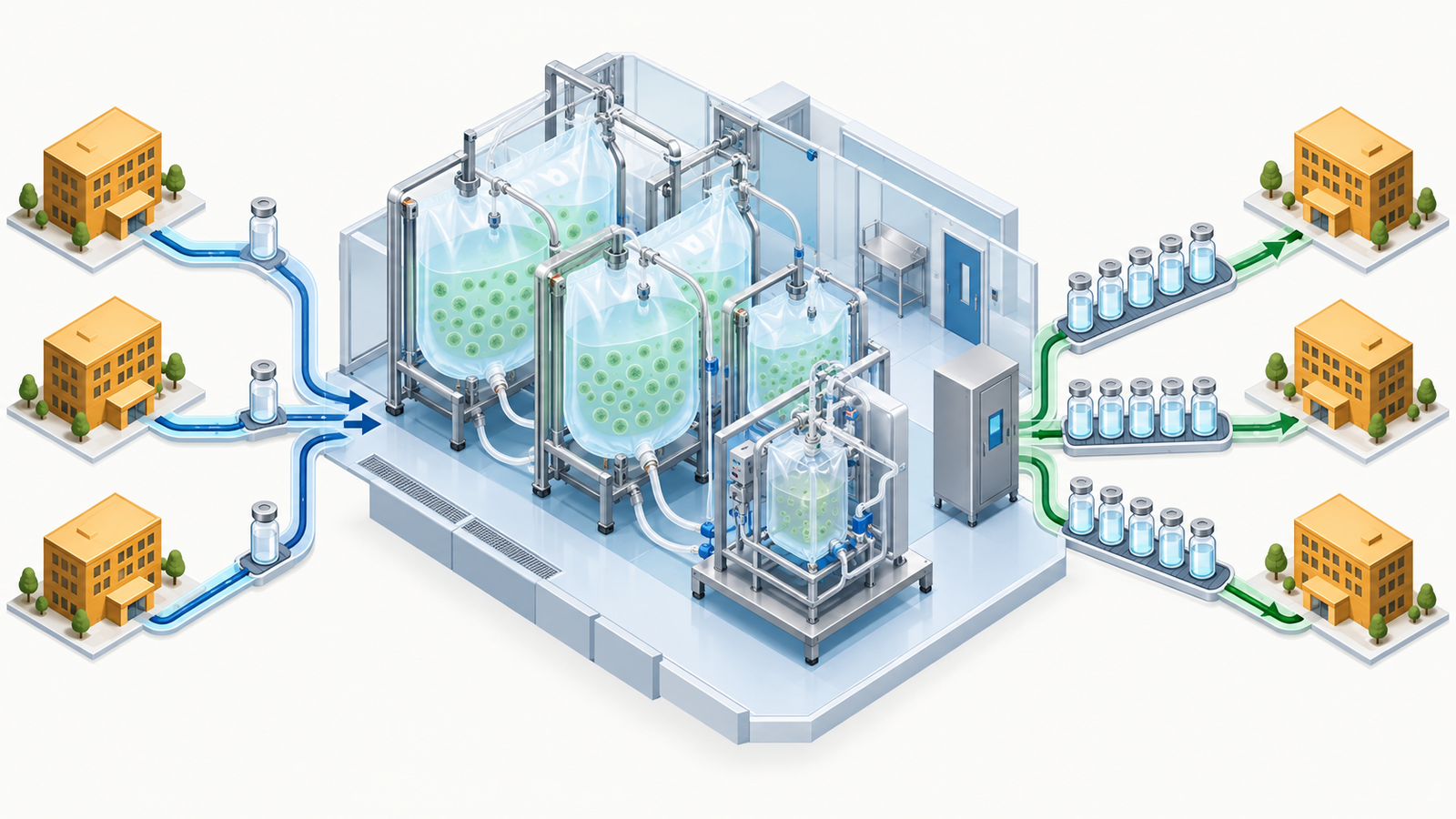
In 2025 AGC decided to withdraw from production in large stainless-steel bioreactors (SUS) at its Boulder site in the U.S. and to concentrate on its strength, single-use bag bioreactors (SUB) Sourced. AGC's material frames SUBs as suited to small and mid-sized drugs at 500 to 2,000 L scale, and SUS as suited to large-volume drugs made in several tanks of more than 20,000 L each. In a SUB, the inside of the bioreactor is a disposable bag made of multilayer film, so cleaning and sterilisation, and their validation, are no longer needed, and products can be switched quickly. On the other hand, the cells and medium are now in direct contact with plastic film, so the process takes on materials constraints: leachables and extractables from the film, the strength of the bag, and an upper limit on vessel size Not yet confirmed.
The new Yokohama site uses two 5,000 L single-use bioreactors from Thermo Fisher Scientific and four 2,000 L single-use bioreactors from Cytiva, so the bioreactors themselves are bought in Sourced. AGC, a glass and fluorochemicals company, is evidently competing in this field on its ability to run manufacturing rather than on materials.
6. What it has done so far
| When | What happened | Why it matters |
|---|---|---|
| 2000 | AGC enters contract protein manufacturing in earnest | The starting point was contract work on protein drugs made in microbes |
| 2016 | Acquires Biomeva of Germany (now AGC Biologics GmbH, Heidelberg) | Start of the biologics CDMO business in Europe |
| 2017 | Acquires CMC Biologics (now AGC Biologics, Inc., Seattle and Copenhagen) | Gains the core of its contract antibody work in animal cells |
| 2020 | New animal cell facility at the Chiba plant | Start of contract animal cell culture in Japan |
| 2020 | Acquires Molecular Medicine of Italy (now AGC Biologics S.p.A., Milan). In the same year, also acquires a drug substance plant in Boulder, U.S. | Entry into contract gene and cell therapy |
| 2021 | Acquires a gene therapy plant in Longmont, U.S. | A U.S. gene and cell therapy site (later exited) |
| 2023 | AGC creates a Life Science Company | Becomes a separate in-house company |
| 2024 | Impairment losses totalling ¥118,495 million at the AGC Biologics companies in the U.S., Denmark and Italy (Life Science subtotal) | Expected returns on the acquisitions and expansions fell sharply |
| March / November 2024 | The Milan site receives U.S. FDA approval for commercial manufacture of vectors for Orchard Therapeutics' HSC gene therapy and for Autolus Therapeutics' CAR-T therapy "AUCATZYL" | A commercial track record in vectors for cell therapy |
| December 2024 | Groundbreaking of the new Yokohama site | A second site in Japan |
| April 2025 | Dedicated cell and gene therapy division created. Adoption of Thermo Fisher's 5,000 L single-use bioreactors for Yokohama announced | Cell therapy becomes a separate business division |
| 1 July 2025 | Cell therapy process development and clinical manufacturing services begin at the AGC Yokohama Technical Center, covering iPS cells, mesenchymal stem cells, haematopoietic stem cells and CAR-T | Able to take on cell therapy work in Asia |
| July 2025 | The European Commission approves AUCATZYL, the Milan site's tenth product approval from the EMA and FDA | A growing commercial track record |
| 2025 | Decision to withdraw from the two Colorado sites (Boulder and Longmont). Impairment of ¥7,724 million at the Boulder site | Giving up large stainless-steel tanks and the Colorado cell therapy site |
| December 2025 | Partnership with ATUM, introducing the Leap-In expression system for cell line development | Strengthening early development |
| 28 July 2026 | Multi-year commercial manufacturing contract with a major pharmaceutical company (unnamed) at the Yokohama site: five products, at least 35 batches a year, total value expected to reach hundreds of millions of dollars | Half of the animal cell capacity filled before the site opens |
| H1 2026 | Closure of the Colorado sites and job cuts completed; sale process continuing | AGC says it aims to complete the sale during 2026 |
7. What comes next
from 2027Construction due to finish in December 2026, per a company release
18,000 L in totalTwo 5,000 L plus four 2,000 L. Six clean rooms for cell therapy
forecast of ¥5.0 billionRevenue forecast of ¥160.0 billion (company plan)
The new Yokohama site is planned to handle three things: biologics made in animal cells, cell therapy and mRNA Sourced. AGC's material describes its animal cell bioreactor capacity as among the largest for a CDMO in Japan, but notes that this is the company's own estimate. At the August 2026 results briefing, asked about the long-term Yokohama contract, AGC answered that "this contract alone will not bring the site to full operation, but it will raise utilisation to nearly half" (our translation from the Japanese).
None of the following appears in the primary sources Not yet confirmed.
The revenue and order backlog of the cell therapy (gene and cell therapy) business; the processing capacity of the Yokohama cell therapy facilities; the customer name and total contract value of the long-term Yokohama contract (announced only as "expected to reach hundreds of millions of dollars"); the buyer and sale price of the Colorado sites; and the headcount of AGC Biologics as a whole. The company's claim in a release to have the second largest single-use capacity in the world is a ranking based on a third-party database (BDO Group's bioTRAK), and in line with this article's policy of not using research-firm estimates, it is not used as a figure.
8. What the company is aiming for in cell culture
This section goes beyond what the company says directly. It sets out inferences that can be drawn from primary sources, each with its basis.
| What can be read | Primary evidence behind it | Category |
|---|---|---|
| It is trying to become a company that takes on many small and mid-sized products rather than large-volume production | The policy of withdrawing from large SUS sites and concentrating on SUBs. AGC's material says the market for small and mid-sized drugs, which suits SUB technology, is growing fast | Inference |
| The centre of future growth is shifting to Japan (Yokohama) | The main item of Life Science capital expenditure is "expansion of biologics CDMO facilities in Japan". Yokohama is an investment of about ¥50 billion and won a large contract before opening | Inference |
| It is selling on geopolitics | The release on the long-term Yokohama contract stresses the "largest global network of single-use manufacturing capacity by volume outside of China" and growing demand for "geopolitically stable supply chains" | Sourced |
| In cell therapy it is transplanting Milan's experience to Yokohama | The release announcing cell therapy services in Yokohama states that the specialist Milan site will support the Yokohama start-up | Sourced |
| Cell therapy is more a field for building a track record and reputation than a profit pillar for the company as a whole | AGC describes gene and cell therapy as maintaining a stable track record and quality, while its explanations of results centre on animal cells and synthetic pharma and agrochemicals. Cell therapy revenue is not disclosed | Inference |
On Life Science, AGC's Annual Securities Report says that "microbial and gene and cell therapy, as well as the synthetic pharmaceutical and agrochemical CDMO, maintained stable quality and track records", while for animal cells it says separately that "winning orders is a challenge" (our translation from the Japanese) Sourced. The problem, in other words, is orders, not technology, and the large 2024 impairment was likewise attributed to "a significant decline in the outlook for future orders and expected utilisation". Against that background, the long-term Yokohama contract securing half of the animal cell capacity before the site opens can be read as a move by AGC to dispel early any worry that the new plant would sit empty. This article's view is that the company's turnaround comes down to whether a new plant in Japan can win back the confidence of customers lost in Colorado Not yet confirmed.
9. Map of cell culture partnerships
10. Technologies, products and services
On its official website AGC Biologics lists protein therapeutics made in animal cells and microbes, plasmid DNA, mRNA, viral vectors and genetically modified cell therapies Sourced. Those related to cell culture are summarised below.
| Service | Sites | What primary sources say |
|---|---|---|
| Antibodies and other products from animal cells | Seattle / Copenhagen / Chiba / Yokohama (from 2027) | Cell line development uses its own CHEF1 expression system (the company cites more than 55 molecules and five commercial products), and since December 2025 ATUM's Leap-In expression system has also been offered. Manufacturing is mainly in single-use bioreactors |
| Cell therapy | Milan / Yokohama | Process development and manufacture of autologous and allogeneic cell therapies. In Yokohama the target technologies are iPS cells, mesenchymal stem cells, haematopoietic stem cells and CAR-T. The new Yokohama site has six clean rooms for cell therapy |
| Viral vectors | Milan | Its own platforms: ProntoLVV for lentiviral vectors and BravoAAV for AAV. Vector manufacturing suites up to 2,000 L scale. A stated target of vector costs of less than €1,000 per CAR-T patient |
| Commercial track record | Milan | Ten product approvals from the EMA and FDA (as of July 2025). The company says it supplies around a third of the ex vivo gene therapy products approved for commercialisation |
In ex vivo gene-modified cell therapies such as CAR-T, lentiviral vectors are used to insert genes into cells taken from the patient. The cells themselves are made in small lots, patient by patient, but the vector is a raw material that can be made in batches serving many patients. The commercial track record of AGC Biologics' Milan site, with Autolus, Adaptimmune and Quell in Fig. 2, is all in vector manufacturing Sourced. In other words, the company has built its commercial record less in the step of growing the cells for cell therapy than in growing cells to make the upstream material. The target of "less than €1,000 per patient" can be read as the company itself acknowledging that the vector is a material that drives the cost of cell therapy Not yet confirmed.
11. The risks this company carries
| Risk | Substance | Category |
|---|---|---|
| Orders not coming back | AGC itself writes that winning orders in animal cells is a challenge. At its results briefing it said that orders already secured cover "roughly half" of planned revenue for 2027 | Sourced |
| Further impairment | The Annual Securities Report states that there are indications of impairment at AGC Biologics A/S in Denmark (no impairment was recognised in the test at the end of 2025) | Sourced |
| Profitability target pushed back | The target for returning Life Science to profit has moved from the original 2026 to 2027 | Sourced |
| Customers' funding environment | Reduced funding flowing into biotech ventures was one of the reasons given for the 2024 impairment. Results move with customers' ability to raise money | Sourced |
| Starting up Yokohama | Half of the animal cell capacity is filled by one company's long-term contract. Delays in the start-up, or the outcome of that customer's regulatory reviews, feed straight into Yokohama's utilisation | Inference |
| Delay in selling Colorado | The sale process is continuing. AGC says a delay would not affect revenue and would not have a large effect on operating profit | Sourced |
12. Glossary
- CDMO
- A company that develops manufacturing methods for medicines and manufactures them under contract. See our explainer on CDMOs for more.
- Animal cell culture
- A method of having mammalian cells produce complex proteins such as antibodies. CHO cells are the typical example.
- Single-use (SUB)
- A bioreactor whose inside is a disposable plastic bag. See our explainer on single-use systems for more.
- Stainless-steel bioreactor (SUS)
- A metal bioreactor that is cleaned, sterilised and reused. Suited to scaling up to tens of thousands of litres.
- Lentiviral vector
- A virus modified to carry genes into cells. Used to make CAR-T cells.
- CAR-T cells
- T cells genetically modified to attack cancer. See our explainer on CAR-T cells for more.
- GMP
- Good Manufacturing Practice, the standards for manufacturing and quality control of medicines. See our explainer on GMP for more.
- Impairment loss
- A write-down of the book value of equipment, or of goodwill from an acquisition, when it is judged that future earnings will not recover it.
13. References
- AGC Inc. Annual Securities Report for the year ended December 2025 (in Japanese; filed 24 March 2026). History (the acquisitions), Life Science revenue and operating profit, headcount, R&D, capital expenditure, the 2026 capital expenditure plan, impairment losses, business risks and issues to be addressed. https://ssl4.eir-parts.net/doc/5201/yuho_pdf/S100XSTU/00.pdf
- AGC Inc. Results presentation for the year ended December 2025 (in Japanese; 6 February 2026). Segment forecasts for the year ending December 2026, and the expectation that Life Science will return to profit in 2027 or later. https://ssl4.eir-parts.net/doc/5201/tdnet/2751531/00.pdf
- AGC Inc. Results presentation for Q2 of the year ending December 2026 (in Japanese; 4 August 2026). H1 2026 Life Science results, closure and sale process of the Colorado sites, progress at the Yokohama site and the long-term manufacturing contract. https://ssl4.eir-parts.net/doc/5201/tdnet/2861935/00.pdf
- AGC Inc. Main questions and answers from the Q2 results briefing for the year ending December 2026 (in Japanese; 4 August 2026). The long-term Yokohama contract and utilisation, orders for next year, and the outlook for the Colorado sale. https://ssl4.eir-parts.net/doc/5201/ir_material_for_fiscal_ym/210205/00.pdf
- AGC Inc. Semi-Annual Report for the year ending December 2026 (in Japanese; filed 6 August 2026). H1 2026 Life Science revenue and operating profit and the reasons for the change. https://ssl4.eir-parts.net/doc/5201/yuho_pdf/S100YUFX/00.pdf
- AGC Inc. Q&A on the current state of the Life Science business (in Japanese; 29 September 2025). Withdrawal from the Colorado sites, concentration on SUBs, revenue mix, the history of the business, and the investment and equipment at Yokohama. https://www.agc.com/ir/library/bizbriefing/pdf/2025_0929life.pdf
- AGC Inc. AGC Integrated Report 2026 (in Japanese). How the structural reform of the biologics CDMO business came about, and the message from the president of the Life Science Company. https://www.agc.com/sustainability/pdf/agc_report_2026.pdf
- AGC Biologics Official website, "About" (company profile, head office and modalities covered). Source of the logo image. https://www.agcbio.com/about
- AGC Biologics Official website, "Facilities" (list of the six sites). https://www.agcbio.com/facilities
- AGC Biologics Press release "AGC Biologics Lands Commercial Manufacturing Agreement for Yokohama Site Worth Hundreds of Millions of Dollars" (28 July 2026). https://www.agcbio.com/news/agc-biologics-lands-commercial-manufacturing-agreement-for-yokohama-site-worth-hundreds-of-millions-of-dollars
- AGC Biologics Press release "AGC Biologics Expands Cell Therapy Development Operations to Asia to Serve Growing Market Need" (25 June 2025). https://www.agcbio.com/news/agc-biologics-expands-cell-therapy-development-operations-in-asia
- AGC Biologics Press release "AGC Biologics Launches New Dedicated Cell and Gene Business Division" (2 April 2025). https://www.agcbio.com/news/cell-therapy-gene-therapy-business-division-agc-biologics-cdmo-services
- AGC Biologics Press release "AGC Biologics Strengthens Single-Use Technology Network, Adds 5,000 L Vessels from Thermo Scientific to New Yokohama, Japan Facility" (7 April 2025). https://www.agcbio.com/news/yokohama-japan-thermo-scientific-5000-liter-single-use-bioreactors-japan-cdmo
- AGC Biologics Press release "AGC Biologics Announces Leadership Updates Amid Groundbreaking of New Yokohama Site" (22 December 2024). https://www.agcbio.com/news/agc-biologics-announces-leadership-updates-at-both-japanese-sites
- AGC Biologics Press release "AGC Biologics to Manufacture LVV for CAR-T Therapy Approved by FDA for Autolus Therapeutics' AUCATZYL" (11 December 2024). Also refers to the March 2024 FDA approval for Orchard Therapeutics. https://www.agcbio.com/news/agc-biologics-to-manufacture-lvv-for-car-t-therapy-approved-by-fda-for-autolus-therapeutics
- AGC Biologics Press release "European Commission Approves CAR-T Therapy With Lentiviral Vectors Manufactured by AGC Biologics" (31 July 2025). https://www.agcbio.com/news/european-commission-approves-car-t-therapy-with-lentiviral-vectors-manufactured-by-agc-biologics
- AGC Biologics Press release "AGC Biologics' Milan Site to Prepare Lentiviral Vector Commercial Manufacturing for Adaptimmune's Lete-Cel Product" (16 January 2025). https://www.agcbio.com/news/agc-biologics-partners-with-adaptimmune-for-lvv-commercial-product
- AGC Biologics Press release "AGC Biologics Partners with Quell Therapeutics to Advance T-Regulatory Cell Therapies for Immune Disorders" (15 May 2025). https://www.agcbio.com/news/agc-biologics-partners-with-quell-therapeutics-cell-therapy-cdmo-alliance-ind-submission-preparedness
- AGC Biologics Press release "Pandorum Partners with AGC Biologics to Support Clinical Manufacturing of Exosome-Based Kuragenx" (9 January 2025). https://www.agcbio.com/news/agc-biologics-partners-with-pandorum-exosome-cell-therapy-manufacturing
- AGC Biologics Press release "From Seattle to Chiba: Okayama University Taps AGC Biologics' Global Pathway for New Therapeutic" (July 2025). https://www.agcbio.com/news/from-seattle-to-chiba-okayama-university-taps-agc-biologics-global-pathway-for-new-therapeutic
- AGC Biologics Press release "AGC Biologics Partners with ATUM to Accelerate Timelines for Cell Line Development" (2 December 2025). https://www.agcbio.com/news/agc-biologics-partners-with-atum-to-accelerate-timelines-for-cell-line-development
- AGC Biologics Press release "AGC Biologics Expands to Fill-Finish in U.S. Through Strategic Partnership with Pyramid Pharma Services" (30 June 2026). https://www.agcbio.com/news/agc-biologics-expands-to-fill-finish-in-u.s.-through-strategic-partnership-with-pyramid-pharma-services
14. Claim-to-source audit
| Claim in the article | Category | Source |
|---|---|---|
| AGC Biologics is a CDMO headquartered in Seattle that takes on protein therapeutics, cell and gene therapies and mRNA | Sourced | Reference 8 https://www.agcbio.com/about |
| Its six manufacturing sites are Seattle, Copenhagen, Heidelberg, Milan, Chiba and Yokohama | Sourced | Reference 9 https://www.agcbio.com/facilities |
| AGC's head office, listing, consolidated revenue, consolidated headcount and 2,967 Life Science employees | Sourced | Reference 1 https://ssl4.eir-parts.net/doc/5201/yuho_pdf/S100XSTU/00.pdf |
| Life Science revenue of ¥141.2 billion and ¥133.1 billion, operating losses of ¥21.2 billion and ¥22.3 billion | Sourced | Reference 1 https://ssl4.eir-parts.net/doc/5201/yuho_pdf/S100XSTU/00.pdf |
| H1 2026 revenue of ¥72.3 billion, operating loss of ¥6.1 billion, and the reasons for the improvement | Sourced | Reference 5 https://ssl4.eir-parts.net/doc/5201/yuho_pdf/S100YUFX/00.pdf |
| Forecast for the year to December 2026 (revenue ¥160.0 billion, operating loss ¥5.0 billion) and the expectation of a return to profit in 2027 or later | Sourced | Reference 2 https://ssl4.eir-parts.net/doc/5201/tdnet/2751531/00.pdf |
| Biologics CDMO using animal cells accounts for half of revenue, and winning orders is a challenge | Sourced | Reference 1 https://ssl4.eir-parts.net/doc/5201/yuho_pdf/S100XSTU/00.pdf |
| 2024 revenue mix (biologics CDMO about 70%, synthetic pharma and agrochemical CDMO about 30%) | Sourced | Reference 6 https://www.agc.com/ir/library/bizbriefing/pdf/2025_0929life.pdf |
| R&D of ¥1,088 million, capital expenditure of ¥28,140 million, and a 2026 plan of ¥33.0 billion | Sourced | Reference 1 https://ssl4.eir-parts.net/doc/5201/yuho_pdf/S100XSTU/00.pdf |
| 466 employees at AGC Biologics, Inc. (Seattle and elsewhere) | Sourced | Reference 1 https://ssl4.eir-parts.net/doc/5201/yuho_pdf/S100XSTU/00.pdf |
| The 2016 to 2021 acquisitions, entry into contract protein work in 2000, and the Chiba animal cell facility in 2020 | Sourced | References 1 and 6 https://www.agc.com/ir/library/bizbriefing/pdf/2025_0929life.pdf |
| 2024 impairment losses (Life Science subtotal ¥118,495 million) and the reasons; ¥7,724 million impairment at the Boulder site in 2025 | Sourced | Reference 1 https://ssl4.eir-parts.net/doc/5201/yuho_pdf/S100XSTU/00.pdf |
| Indications of impairment at the Danish subsidiary, with no impairment recognised in the test at the end of 2025 | Sourced | Reference 1 https://ssl4.eir-parts.net/doc/5201/yuho_pdf/S100XSTU/00.pdf |
| Withdrawal from the two Colorado sites, the shift from large SUS to SUBs, and the scale each suits | Sourced | Reference 6 https://www.agc.com/ir/library/bizbriefing/pdf/2025_0929life.pdf |
| Investment of about ¥50 billion in the new Yokohama site, and "among the largest for a CDMO in Japan" (company estimate) | Sourced | Reference 6 https://www.agc.com/ir/library/bizbriefing/pdf/2025_0929life.pdf |
| Colorado closure and job cuts completed, sale process continuing, long-term Yokohama contract signed, and GMP commercial production from 2027 | Sourced | Reference 3 https://ssl4.eir-parts.net/doc/5201/tdnet/2861935/00.pdf |
| The long-term Yokohama contract raises utilisation to nearly half; orders secured cover about half of next year's plan; the Colorado sale is to be completed within the year | Sourced | Reference 4 https://ssl4.eir-parts.net/doc/5201/ir_material_for_fiscal_ym/210205/00.pdf |
| How the structural reform came about (delay of the new Copenhagen plant, manufacturing problems at the U.S. sites, the sharp fall in vaccine demand) | Sourced | Reference 7 https://www.agc.com/sustainability/pdf/agc_report_2026.pdf |
| Terms of the long-term Yokohama contract (five products, at least 35 batches a year, hundreds of millions of dollars, half the animal cell capacity), 18,000 L of single-use capacity, six cell therapy clean rooms, and METI's 2022 investment | Sourced | Reference 10 https://www.agcbio.com/news/agc-biologics-lands-commercial-manufacturing-agreement-for-yokohama-site-worth-hundreds-of-millions-of-dollars |
| Start of cell therapy services in Yokohama on 1 July 2025 and the target technologies (iPS cells, mesenchymal stem cells, haematopoietic stem cells, CAR-T); the target of less than €1,000 per patient | Sourced | Reference 11 https://www.agcbio.com/news/agc-biologics-expands-cell-therapy-development-operations-in-asia |
| Creation of the dedicated cell and gene therapy division, the scale of the Milan site and vector manufacturing up to 2,000 L | Sourced | Reference 12 https://www.agcbio.com/news/cell-therapy-gene-therapy-business-division-agc-biologics-cdmo-services |
| Adoption of two Thermo Fisher 5,000 L single-use bioreactors | Sourced | Reference 13 https://www.agcbio.com/news/yokohama-japan-thermo-scientific-5000-liter-single-use-bioreactors-japan-cdmo |
| Groundbreaking of the new Yokohama site (December 2024) | Sourced | Reference 14 https://www.agcbio.com/news/agc-biologics-announces-leadership-updates-at-both-japanese-sites |
| FDA approval of vectors for AUCATZYL, the March 2024 FDA approval for Orchard, and supply of about a third of ex vivo gene therapies | Sourced | Reference 15 https://www.agcbio.com/news/agc-biologics-to-manufacture-lvv-for-car-t-therapy-approved-by-fda-for-autolus-therapeutics |
| European Commission approval of AUCATZYL and the Milan site's tenth product approval | Sourced | Reference 16 https://www.agcbio.com/news/european-commission-approves-car-t-therapy-with-lentiviral-vectors-manufactured-by-agc-biologics |
| Contract vector work for Adaptimmune (lete-cel) | Sourced | Reference 17 https://www.agcbio.com/news/agc-biologics-partners-with-adaptimmune-for-lvv-commercial-product |
| Contract vector work for Quell Therapeutics (regulatory T-cell therapy) | Sourced | Reference 18 https://www.agcbio.com/news/agc-biologics-partners-with-quell-therapeutics-cell-therapy-cdmo-alliance-ind-submission-preparedness |
| Contract clinical manufacture for Pandorum (an exosome-based product) | Sourced | Reference 19 https://www.agcbio.com/news/agc-biologics-partners-with-pandorum-exosome-cell-therapy-manufacturing |
| Contract from Okayama University (cell line development with CHEF1 and manufacture in Chiba) and the CHEF1 track record | Sourced | Reference 20 https://www.agcbio.com/news/from-seattle-to-chiba-okayama-university-taps-agc-biologics-global-pathway-for-new-therapeutic |
| Partnership with ATUM (introduction of the Leap-In expression system) | Sourced | Reference 21 https://www.agcbio.com/news/agc-biologics-partners-with-atum-to-accelerate-timelines-for-cell-line-development |
| Fill-finish partnership with Pyramid Pharma Services | Sourced | Reference 22 https://www.agcbio.com/news/agc-biologics-expands-to-fill-finish-in-u.s.-through-strategic-partnership-with-pyramid-pharma-services |
| The three types of cell culture company (CDMO / supplier / cell therapy) | Our calculation | Our own classification. Companies shown are examples from the 20 in this series |
| Revenue, profit and headcount of AGC Biologics alone; revenue of the cell therapy business | Not yet confirmed | None is disclosed, and this article makes no estimate https://ssl4.eir-parts.net/doc/5201/yuho_pdf/S100XSTU/00.pdf |
| Customer name and total value of the long-term Yokohama contract; buyer and price for the Colorado sites | Not yet confirmed | Not in references 3, 4 or 10, and this article makes no estimate https://www.agcbio.com/news/agc-biologics-lands-commercial-manufacturing-agreement-for-yokohama-site-worth-hundreds-of-millions-of-dollars |
| The ranking of second largest in the world by single-use capacity | Not yet confirmed | Not used in this article because it is based on a third-party database (bioTRAK) https://www.agcbio.com/news/yokohama-japan-thermo-scientific-5000-liter-single-use-bioreactors-japan-cdmo |
| Investments in start-ups and joint research with universities | Not yet confirmed | Not in references 1, 6 or 8. This article does not conclude that none exists https://ssl4.eir-parts.net/doc/5201/yuho_pdf/S100XSTU/00.pdf |
| The reading that it is trying to become a company taking on many small and mid-sized products | Inference | This article's interpretation of the policy of concentrating on SUBs |
| The reading that the centre of growth is shifting to Japan (Yokohama) | Inference | This article's interpretation of the capital expenditure and the Yokohama contract |
| The reading that cell therapy is a field for building a track record and reputation rather than a profit pillar | Inference | This article's interpretation of the emphasis in results explanations and the non-disclosure of cell therapy revenue |
| The risk that Yokohama's utilisation depends heavily on one company's contract | Inference | This article's interpretation of the announcement that the long-term contract takes half the animal cell capacity |
| Materials constraints of SUBs (leachables, bag strength, vessel size limit) and the view that vectors drive the cost of cell therapy | Not yet confirmed | Technical commentary by this article, not company statements |
Last updated 24 September 2026 / Troy Technical
Every figure in this article comes from AGC Inc.'s statutory filings, results presentations and integrated report, and from AGC Biologics' official announcements. No research-firm estimates or press-based figures have been used. Passages marked "Inference" are this article's interpretation of primary sources, not statements made by the company.