COMPANY PROFILE / CELL CULTURE TECHNOLOGY
Allogene Therapeutics
More than eight years chasing off-the-shelf CAR-T for any patient: how far a developer with its own plant is from a first approval
Allogene Therapeutics is a clinical-stage company listed on Nasdaq that develops CAR-T cells made from healthy donors' cells that can be given to other people (allogeneic CAR-T). Unlike existing CAR-T therapies, which are made from each patient's own cells, it aims for an "off-the-shelf" product that can be made in advance and kept in storage. It has its own cGMP manufacturing plant, Cell Forge 1, in Newark, California, but as of September 2026 it has no approved product and no revenue Sourced. Using only its statutory filings with the U.S. SEC (10-K, 10-Q and 8-K) as primary sources, this profile sets out what a company on the side that "turns cells into the product" is putting into cell culture and manufacturing, and where it is heading.
- Allogene in 30 seconds, and where it stands in cell culture
- The logo and how the name is written
- Where the company sits in the cell culture landscape
- Scale (a developer with no revenue)
- Resources committed to cell culture
- What it has done so far
- What comes next
- What the company is aiming for in cell culture
- Map of partnerships
- Technologies and product candidates
- The risks this company carries
- Glossary, references and claim-to-source audit
1. Allogene in 30 seconds, and where it stands in cell culture
California, U.S.210 East Grand Avenue
(allogeneic CAR-T)No culture business such as antibody production
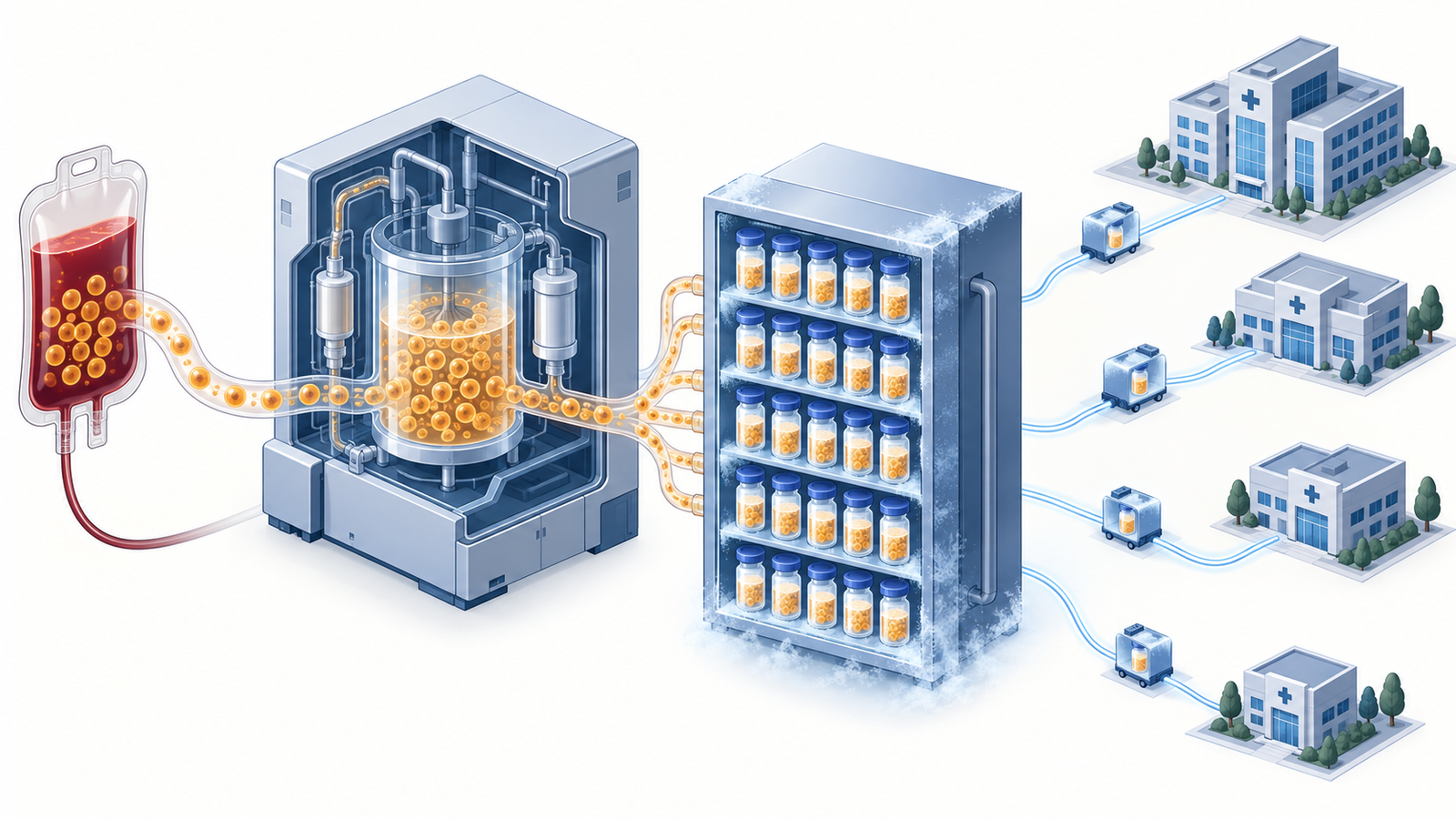
Companies involved in cell culture fall into three broad types: contract development and manufacturing organisations (CDMOs), suppliers of equipment, consumables and media, and developers of cell and regenerative therapies. Allogene is a cell therapy developer: it is trying to turn cultured cells themselves into medicines. It does not make drugs for other companies, and its own plant, Cell Forge 1, is dedicated to making its own clinical trial material Sourced. Its defining feature is that it is allogeneic, making doses for many patients at once from a healthy donor's cells, rather than autologous, collecting cells from each patient to make that patient's dose. From a cell culture point of view, that is purely a manufacturing question: how many patients' worth of product one culture run can yield.
2. The logo and how the name is written

The Allogene Therapeutics logo is a registered trademark of the company. We have not recreated it with generated imagery;
the logo image used in the header of the official website is placed here as img/allogene_therapeutics_logo.png.
A note on names: "Allogene" appears to come from "allogeneic", meaning derived from another person (this is our interpretation, not the company's explanation). Product candidates carry names such as cema-cel (cemacabtagene ansegedleucel, formerly ALLO-501A), ALLO-316 and ALLO-329. The leadership changed on 1 July 2026, when Zachary Roberts succeeded David Chang as President and CEO.
https://allogene.com/3. Where the company sits in the cell culture landscape
According to the 10-K, manufacturing of the company's allogeneic CAR-T has three stages: (1) collection and gene transfer, (2) gene editing, and (3) purification, formulation and storage. White blood cells are collected from healthy donors, stimulated to grow, and given the CAR gene with a viral vector; gene editing then disrupts the T cell receptor (TCRα) to prevent graft-versus-host disease (GvHD), in which donor cells attack the patient's body Sourced. Cancer candidates are edited with Cellectis' TALEN, and ALLO-329, for autoimmune disease, with Arbor Biotechnologies' CRISPR.
4. Scale (a developer with no revenue)
Allogene sells no products and has zero revenue (collaboration revenue was also zero in 2025) Sourced. Its size is therefore measured by R&D spending, losses, cash on hand and headcount.
| US$ million | 2021 | 2022 | 2023 | 2024 | 2025 |
|---|---|---|---|---|---|
| Revenue (collaboration revenue) | 114.1 | 0.2 | 0.1 | 0.0 | 0 |
| R&D expense | 220.2 | 256.4 | 242.9 | 192.3 | 150.2 |
| General and administrative expense | 74.1 | 79.3 | 71.7 | 65.2 | 56.8 |
| Net loss | 182.1 | 340.4 | 327.3 | 257.6 | 190.9 |
| Capital expenditure (purchases of property and equipment) | 21.4 | 5.2 | 1.5 | 0.7 | 0.4 |
Source: SEC EDGAR XBRL (each year's 10-K). The breakdown of the US$114.1 million of revenue in 2021 was not checked in the filings we consulted. It is not revenue from product sales.
| Latest measures | Value | As of |
|---|---|---|
| Cash on hand (cash, cash equivalents and investments) | US$423.6 million | 30 June 2026 |
| Accumulated deficit | About US$2.1 billion (US$2,096 million) | 30 June 2026 |
| R&D expense / net loss, January to June 2026 | US$62.7 million / US$85.3 million | Same period a year earlier: US$90.4 million / US$110.7 million |
| Employees (of whom R&D and technical operations) | 152 (59) | 2 March 2026 |
| Cash runway stated by the company | Into the first quarter of 2029 | Includes net proceeds of the April 2026 public offering |
R&D spending fell about 41%, from a peak of US$256.4 million in 2022 to US$150.2 million in 2025, and capital expenditure fell from US$66 million in 2020, when Cell Forge 1 was being built, to US$0.4 million in 2025 Our calculation. Doubling the net loss of US$85.3 million for January to June 2026 gives an annualised figure of about US$170 million; dividing cash on hand by that gives about 2.5 years, broadly consistent with the company's guidance of cash lasting into the first quarter of 2029 Our calculation (only a rough guide, since the loss includes non-cash expenses).
5. Resources committed to cell culture
As with every profile in this series, the table covers people, money, outside investments and acquisitions, and ties with universities and research institutes, showing whether each could be confirmed from primary sources.
| Aspect | What primary sources confirm | Status |
|---|---|---|
| People (dedicated organisation, sites, headcount) | Of 152 employees, 59 in R&D and technical operations (March 2026). In May 2025 about 28% of staff (61 people) were cut, mainly in manufacturing. The 10-Q says that after the April 2026 interim analysis and share offering, hiring increased for manufacturing, clinical development and BLA preparation. Dedicated manufacturing headcount is not disclosed | Partly confirmed |
| Money (capital expenditure, R&D) | R&D expense of US$150.2 million (2025), of which US$75.5 million internal and US$74.6 million external; of the external amount, US$23.4 million was for cema-cel. The Cell Forge 1 plant is a leased facility of about 118,000 square feet (initial term of 15 years and 8 months). The total cost of building the plant is not stated in the 10-K | R&D confirmed; plant total not confirmed |
| Outside investments and acquisitions | 2018: acquired allogeneic CAR-T assets from Pfizer (the company's starting point). 2023: invested US$2 million in Antion Biosciences preferred stock (also receiving warrants for a further US$3 million). In May 2026 it gave up part of its stake in Overland Therapeutics (a former joint venture) for no consideration, leaving about 3% | Confirmed |
| Universities and research institutes | A five-year strategic collaboration with MD Anderson Cancer Center (October 2020; extended by one year in August 2025; funding commitment of up to US$15 million). A grant of up to US$9.2 million (changed from an initial US$15 million) from the California Institute for Regenerative Medicine (CIRM) for clinical development of ALLO-316 | Confirmed |
In 2019 Allogene leased a building of about 118,000 square feet (about 11,000 m², Our calculation) and built Cell Forge 1, with capital expenditure reaching US$66 million in 2020. Then in May 2025 it narrowed its manufacturing activities and cut manufacturing staff Sourced. The 10-K says it holds enough clinical trial material in inventory to complete its three ongoing clinical trials. Because allogeneic CAR-T can yield doses for many patients from one culture run and be stored frozen, trials can continue even with the plant idle, as long as inventory has been built up first, a property autologous CAR-T does not have. The flip side is that on approval, moving to commercial production will mean restarting a manufacturing operation that has been scaled back. The company itself writes that it cannot yet estimate the cost of commercial manufacturing.
6. What it has done so far
| When | What happened | Why it matters |
|---|---|---|
| November 2017 | Incorporated in Delaware. Founded by executives who led the development and approval of the CAR-T therapy Yescarta at Kite Pharma (now part of Gilead) | Autologous CAR-T veterans take on allogeneic |
| April 2018 | Acquired allogeneic CAR-T assets from Pfizer (including agreements with Cellectis and Servier) | Gains rights to TALEN gene editing and CD19 |
| February 2019 | Leased a building of about 118,000 square feet in Newark for a manufacturing plant | Investment in in-house manufacturing |
| November 2019 | Collaboration with Notch Therapeutics (now Roche) on iPS cell-derived T cell and NK cell technology | Most of the targets were returned in January 2024 |
| October 2020 | Five-year strategic collaboration with MD Anderson | Joint clinical and preclinical research |
| December 2020 | Licence to a joint venture covering China and other territories (later Overland Therapeutics) | The licence was terminated in May 2026 |
| January 2022 | Collaboration with Antion Biosciences on miRNA-based gene silencing technology (miCAR) | Next-generation cell engineering |
| June 2024 | Started ALPHA3, the pivotal Phase 2 trial of cema-cel (consolidation after first-line treatment of large B-cell lymphoma) | A new trial design that enrols only MRD-positive patients |
| October 2024 | ALLO-316 (renal cell carcinoma) received FDA RMAT designation | Progress in solid tumours |
| January to April 2025 | FDA cleared the investigational new drug application for ALLO-329 (autoimmune disease), and granted Fast Track designation in three diseases | Expansion beyond cancer |
| May 2025 | Scaled back manufacturing activities and cut about 28% of staff | Money concentrated on clinical trials |
| August 2025 | Closed the ALPHA3 arm using the anti-CD52 antibody ALLO-647 (one death was attributed to ALLO-647); only standard FC lymphodepletion remains | Change to the lymphodepletion design |
| April 2026 | ALPHA3 interim futility analysis: MRD conversion rate of 58.3% (7/12) in the cema-cel arm against 16.7% (2/12) in the observation arm. A public share offering followed (net proceeds of about US$187.9 million) | The trial continues, and the cash runway lengthens |
| July 2026 | cema-cel received FDA RMAT and Fast Track designations for the ALPHA3 development programme. Zachary Roberts became CEO | Regulatory advantages on the way to an approval filing |
7. What comes next
registrational design with FDASeeking a partner
The company says that if ALPHA3 is positive it will seek approval of cema-cel through a Biologics License Application (BLA). The trial runs at more than 80 sites in the U.S., Canada, South Korea and Australia, and expansion into the European Union is being prepared Sourced. On manufacturing, the 10-Q says that since April 2026 it has increased hiring for manufacturing, clinical development and BLA preparation.
None of the following appears in the 10-K, 10-Q or 8-Ks Not yet confirmed.
Cell Forge 1's annual production capacity (how many patients it can supply); how many patients' worth of trial material one manufacturing run yields; the cost of commercial manufacturing (the company itself says it cannot yet estimate it); the timing and price of commercialisation; and the partner for ALLO-316 and the start of its registrational trial. Press reports and research-firm estimates are not used in this article.
8. What the company is aiming for in cell culture
This section goes beyond what the company says directly. It sets out inferences that can be drawn from primary sources, each with its basis.
| What can be read | Primary evidence behind it | Category |
|---|---|---|
| Turning CAR-T from a drug made for each patient at the hospital into one shipped from inventory | The 10-K's description of an "off-the-shelf" product that can treat patients faster, more reliably and at greater scale; the outpatient dosing at community cancer centres that the 10-K and 8-K emphasise for ALPHA3 | Sourced |
| It is sticking with owning manufacturing rather than relying on outsiders | The 10-K's strategy of having its own manufacturing to reduce reliance on CDMOs. The plant was kept after the cutbacks | Inference |
| It is concentrating on a single candidate (cema-cel) for its first approval | In 2025 external R&D spending, cema-cel (US$23.4 million) is the only programme named. A partner is being sought for ALLO-316 | Inference |
| In future it aims for cells that can be given without lymphodepletion (chemotherapy) | The Dagger technology is described as designed to reduce or eliminate the need for standard lymphodepletion. ALLO-329 is being tested in an arm without lymphodepletion | Sourced |
| It sees autoimmune disease as a large second pillar | ALLO-329 is described in connection with scalability and meeting market demand | Inference |
The patients in ALPHA3 appear to be in remission after first-line treatment but still have cancer DNA in their blood (minimal residual disease, or MRD). To give these patients CAR-T without waiting for relapse, the therapy has to be available to give as soon as MRD is detected. Autologous CAR-T takes time, because the patient's cells must be collected before manufacturing can start; an allogeneic, off-the-shelf product can be shipped straight from inventory. The April 2026 8-K reports that 10 of the 12 patients given cema-cel were managed entirely as outpatients after dosing Sourced. From this, our reading is that the company is after more than extra efficacy: it wants a new way of distributing cell medicines, held in stock and usable outside academic hospitals Not yet confirmed.
9. Map of partnerships
10. Technologies and product candidates
| Product candidate | Target and indication | Stage (as of the June 2026 10-Q) | Regulatory designations |
|---|---|---|---|
| cema-cel (formerly ALLO-501A) | CD19 / consolidation after first-line treatment of large B-cell lymphoma (MRD-positive) | Pivotal Phase 2 ALPHA3, enrolling (more than 80 sites) | RMAT and Fast Track (July 2026, for the ALPHA3 development programme). The 10-K also mentions RMAT designation for cema-cel |
| ALLO-316 | CD70 / advanced or metastatic clear cell renal cell carcinoma | Expansion cohort (20 patients) of the Phase 1b TRAVERSE trial completed. Confirmed response rate of 25.0% (31.3% in high CD70 expressers) | RMAT (October 2024) |
| ALLO-329 | CD19 + CD70 / systemic lupus erythematosus, idiopathic inflammatory myopathies, systemic sclerosis | Phase 1 RESOLUTION (dose escalation), including an arm without lymphodepletion | Fast Track x3 (April 2025) |
| Others | BCMA, DLL3 and others | Preclinical | - |
The date of ALLO-329's Fast Track designations is given inconsistently: "27 April 2025" in the 10-K and "7 April 2025" in the 10-Q. This article says only "April 2025". Nothing has been approved, and the 10-K notes of the industry as a whole that no allogeneic T cell product has yet been approved by the FDA Sourced.
Cells from another person are removed by the patient's immune system (particularly activated T cells) as foreign. Until now, patients have been given strong chemotherapy as lymphodepletion to knock back their immune system, giving the CAR-T cells time to expand. Allogene's Dagger technology gives the CAR-T cells a second CAR aimed at CD70, so they attack the activated T cells (which express CD70) that come to remove them Sourced. In materials design terms, it is the idea of building resistance into the component itself instead of changing its surroundings (lymphodepletion). But because CD70 is expressed on activated T cells, the 10-K also lists the risk of CAR-T cells attacking each other during manufacturing or after dosing (fratricide), and notes that the technology itself is unproven. If lymphodepletion were no longer needed, the burden of treatment and the need for hospital stays would fall, making the most of the advantages of off-the-shelf CAR-T Not yet confirmed. See also our explainer on CAR-T cells.
11. The risks this company carries
| Risk | Substance | Category |
|---|---|---|
| No approval and no revenue | Revenue is zero and the accumulated deficit is about US$2.1 billion. The company says its cash will last into the first quarter of 2029, but the primary analysis needed for an approval filing is due in mid-2028 | Sourced |
| Dependence on a single trial | The first approval depends on ALPHA3. The interim analysis covered only 24 patients, and the primary endpoint, event-free survival, remains blinded | Sourced |
| Reliance on outside gene editing technology, and patent litigation | TALEN depends on Cellectis and Servier. In September 2025 Factor Bioscience sued Cellectis for patent infringement, naming Allogene as one of its licensees (Allogene is not a party) | Sourced |
| Dependence on a diagnostic | Patient selection in ALPHA3 depends on a research-use MRD test from Foresight (a Natera company). The company writes that delays in approval of the test could affect the trial and commercialisation | Sourced |
| Restarting manufacturing | Manufacturing was scaled back in 2025. The company itself says it cannot yet estimate the cost of commercial manufacturing, so ramping up manufacturing after approval will be a challenge | Inference |
| Dilution | More than 100 million shares were issued in April 2026. Continued fund-raising will dilute existing shareholders | Not yet confirmed |
| Leadership changes | The CEO changed in July 2026, and the CFO is due to step down in November 2026 (8-K) | Sourced |
12. Glossary
- Allogeneic / autologous
- Allogeneic therapies use another person's (a donor's) cells; autologous therapies use the patient's own cells.
- CAR-T cells
- T cells given the gene for a receptor (CAR) that recognises cancer or another target. See our explainer on CAR-T cells.
- GvHD (graft-versus-host disease)
- A condition in which transplanted immune cells from another person attack the patient's body. In allogeneic CAR-T it is prevented by disrupting the TCR.
- TALEN / CRISPR
- Gene editing tools that cut DNA at a chosen site to disrupt or insert genes.
- Lymphodepletion
- Treatment with chemotherapy or other agents before CAR-T dosing to reduce the patient's lymphocytes. FC is the combination of fludarabine and cyclophosphamide.
- MRD (minimal residual disease)
- Small amounts of remaining cancer that cannot be seen on imaging but can be detected by blood tests and similar methods.
- RMAT designation
- A designation the U.S. FDA gives to regenerative medicine and other advanced therapies. It brings benefits such as closer interaction during review, but the standard for approval does not change.
- cGMP
- Standards for manufacturing and quality control of medicines. See our explainer on GMP.
13. References
- Allogene Therapeutics Form 10-K for the fiscal year ended December 31, 2025 (filed with the U.S. SEC on 12 March 2026): business overview, manufacturing process, Cell Forge 1, collaboration agreements, employees, properties, R&D expense, net loss, cash on hand and risk factors. https://www.sec.gov/Archives/edgar/data/1737287/000162828026017242/allo-20251231.htm
- Allogene Therapeutics Form 10-Q for the quarterly period ended June 30, 2026 (filed with the U.S. SEC on 12 August 2026): pipeline progress, the 2026 RMAT and Fast Track designations, cash on hand and runway, workforce reduction and hiring, the CIRM grant and the public offering. https://www.sec.gov/Archives/edgar/data/1737287/000162828026056213/allo-20260630.htm
- Allogene Therapeutics Form 8-K (13 April 2026): results of the ALPHA3 interim futility analysis and next steps. https://www.sec.gov/Archives/edgar/data/1737287/000119312526151999/d49895d8k.htm
- Allogene Therapeutics Form 8-K (15 April 2026): underwriting agreement for the public offering. https://www.sec.gov/Archives/edgar/data/1737287/000119312526157140/d283634d8k.htm
- Allogene Therapeutics Form 8-K (13 May 2026): termination of the Overland licence and restructuring of the equity interest. https://www.sec.gov/Archives/edgar/data/1737287/000162828026034583/allo-20260512.htm
- Allogene Therapeutics Form 8-K (28 May 2026): change of CEO. https://www.sec.gov/Archives/edgar/data/1737287/000119312526245484/d65280d8k.htm
- Allogene Therapeutics Form 8-K (2 September 2026): planned departure of the CFO. https://www.sec.gov/Archives/edgar/data/1737287/000119312526379423/d522964d8k.htm
- Allogene Therapeutics Form 8-K (1 August 2025): FC chosen as the ALPHA3 lymphodepletion regimen and the ALLO-647 arm closed. https://www.sec.gov/Archives/edgar/data/1737287/000119312525171091/d75167d8k.htm
- Allogene Therapeutics Form 8-K (14 October 2025): Factor Bioscience's patent infringement suit against Cellectis. https://www.sec.gov/Archives/edgar/data/1737287/000162828025044828/allo-20250926.htm
- Allogene Therapeutics Form 8-K (25 February 2025): expansion of the collaboration with Foresight Diagnostics (funding of about US$37.3 million). https://www.sec.gov/Archives/edgar/data/1737287/000119312525035162/d926019d8k.htm
- Allogene Therapeutics Form 8-K (22 June 2026): results of the annual meeting of stockholders and shares outstanding. https://www.sec.gov/Archives/edgar/data/1737287/000162828026044618/allo-20260618.htm
- U.S. SEC EDGAR XBRL company facts API (CIK 0001737287): R&D expense, G&A expense, net loss, collaboration revenue and capital expenditure for 2021 to 2025. https://data.sec.gov/api/xbrl/companyfacts/CIK0001737287.json
- Allogene Therapeutics Official website (source of the logo image). https://allogene.com/
14. Claim-to-source audit
| Claim in the article | Category | Source |
|---|---|---|
| Incorporated in November 2017, head office address, and status as a clinical-stage developer of allogeneic T cell products | Sourced | Reference 1 https://www.sec.gov/Archives/edgar/data/1737287/000162828026017242/allo-20251231.htm |
| Cell Forge 1 is dedicated to making the company's own clinical trial material; lease of about 118,000 square feet with an initial term of 15 years and 8 months | Sourced | Reference 1 https://www.sec.gov/Archives/edgar/data/1737287/000162828026017242/allo-20251231.htm |
| The three manufacturing stages, disruption of TCRα, and the use of TALEN (cancer) and CRISPR (autoimmune disease) | Sourced | Reference 1 https://www.sec.gov/Archives/edgar/data/1737287/000162828026017242/allo-20251231.htm |
| 152 employees, 59 in R&D and technical operations, and the May 2025 reduction (61 people) | Sourced | Reference 1 https://www.sec.gov/Archives/edgar/data/1737287/000162828026017242/allo-20251231.htm |
| Breakdown of 2025 R&D expense (internal, external, cema-cel), net loss, and cash at the end of 2025 | Sourced | Reference 1 https://www.sec.gov/Archives/edgar/data/1737287/000162828026017242/allo-20251231.htm |
| The Pfizer asset acquisition and the terms of agreements with Cellectis, Servier, Arbor, Notch (Roche), MD Anderson, Antion and Overland | Sourced | Reference 1 https://www.sec.gov/Archives/edgar/data/1737287/000162828026017242/allo-20251231.htm |
| The strategy of in-house manufacturing to reduce reliance on CDMOs, the statement that commercial manufacturing costs cannot be estimated, the inventory of trial material, the Dagger design and fratricide risk, and the mention of community cancer centres | Sourced | Reference 1 https://www.sec.gov/Archives/edgar/data/1737287/000162828026017242/allo-20251231.htm |
| Date of ALLO-329's Fast Track designations (27 April in the 10-K, 7 April in the 10-Q) | Sourced | References 1 and 2 https://www.sec.gov/Archives/edgar/data/1737287/000162828026056213/allo-20260630.htm |
| Cash and accumulated deficit at the end of June 2026, R&D expense and net loss for January to June 2026, and the cash runway | Sourced | Reference 2 https://www.sec.gov/Archives/edgar/data/1737287/000162828026056213/allo-20260630.htm |
| Number and location of ALPHA3 sites, preparations for EU expansion, RMAT and Fast Track (July 2026), ALLO-316 results, the change to the CIRM grant, and hiring for BLA preparation | Sourced | Reference 2 https://www.sec.gov/Archives/edgar/data/1737287/000162828026056213/allo-20260630.htm |
| ALPHA3 interim analysis figures, number of patients managed as outpatients, enrolment completion at the end of 2027, EFS interim analysis in mid-2027 and primary analysis in mid-2028 | Sourced | Reference 3 https://www.sec.gov/Archives/edgar/data/1737287/000119312526151999/d49895d8k.htm |
| The public offering (US$2.00 per share) and net proceeds of about US$187.9 million | Sourced | References 2 and 4 https://www.sec.gov/Archives/edgar/data/1737287/000119312526157140/d283634d8k.htm |
| Termination of the Overland licence and the remaining stake of about 3% | Sourced | Reference 5 https://www.sec.gov/Archives/edgar/data/1737287/000162828026034583/allo-20260512.htm |
| Change of CEO (1 July 2026) | Sourced | Reference 6 https://www.sec.gov/Archives/edgar/data/1737287/000119312526245484/d65280d8k.htm |
| Planned departure of the CFO (6 November 2026) | Sourced | Reference 7 https://www.sec.gov/Archives/edgar/data/1737287/000119312526379423/d522964d8k.htm |
| Closure of the ALLO-647 arm and the death, and the move to FC lymphodepletion only | Sourced | Reference 8 https://www.sec.gov/Archives/edgar/data/1737287/000119312525171091/d75167d8k.htm |
| Factor Bioscience's suit against Cellectis | Sourced | Reference 9 https://www.sec.gov/Archives/edgar/data/1737287/000162828025044828/allo-20250926.htm |
| Expansion of the Foresight collaboration and funding of about US$37.3 million | Sourced | Reference 10 https://www.sec.gov/Archives/edgar/data/1737287/000119312525035162/d926019d8k.htm |
| R&D expense, G&A expense, net loss, collaboration revenue and capital expenditure for 2021 to 2025 | Sourced | Reference 12 https://data.sec.gov/api/xbrl/companyfacts/CIK0001737287.json |
| The three types of cell culture company, and classifying Allogene as a cell therapy developer | Our calculation | Our own classification. Companies shown are examples from the 20 in this series |
| The roughly 41% fall in R&D spending, the annualised loss and rough cash runway, and the conversion to about 11,000 m² | Our calculation | Our calculation from figures in references 1, 2 and 12 (1 square foot = 0.0929 m²) |
| Cell Forge 1's production capacity, the number of patients one run can supply, the timing and price of commercialisation, and the total cost of building the plant | Not yet confirmed | Not in the 10-K, 10-Q or 8-Ks. This article makes no estimate https://www.sec.gov/Archives/edgar/data/1737287/000162828026017242/allo-20251231.htm |
| The readings that the company is keeping in-house manufacturing, concentrating on cema-cel, seeing autoimmune disease as a second pillar, and aiming for an inventory-based distribution model | Inference | This article's interpretation of statements in references 1 to 3 |
| The risk that restarting manufacturing will be a challenge, and the origin of the company name | Inference | This article's interpretation of statements in references 1 and 2 |
Last updated 24 September 2026 / Troy Technical
Every figure in this article comes from statutory filings Allogene Therapeutics has made with the U.S. Securities and Exchange Commission (Forms 10-K, 10-Q and 8-K) and from the SEC's XBRL data. No research-firm estimates or press-based figures have been used. Passages marked "Inference" are this article's interpretation of primary sources, not statements made by the company.