COMPANY PROFILE / CELL CULTURE TECHNOLOGY
Nipro
A ¥660 billion medical device maker waits for full approval of Stemirac, its cell product for spinal cord injury
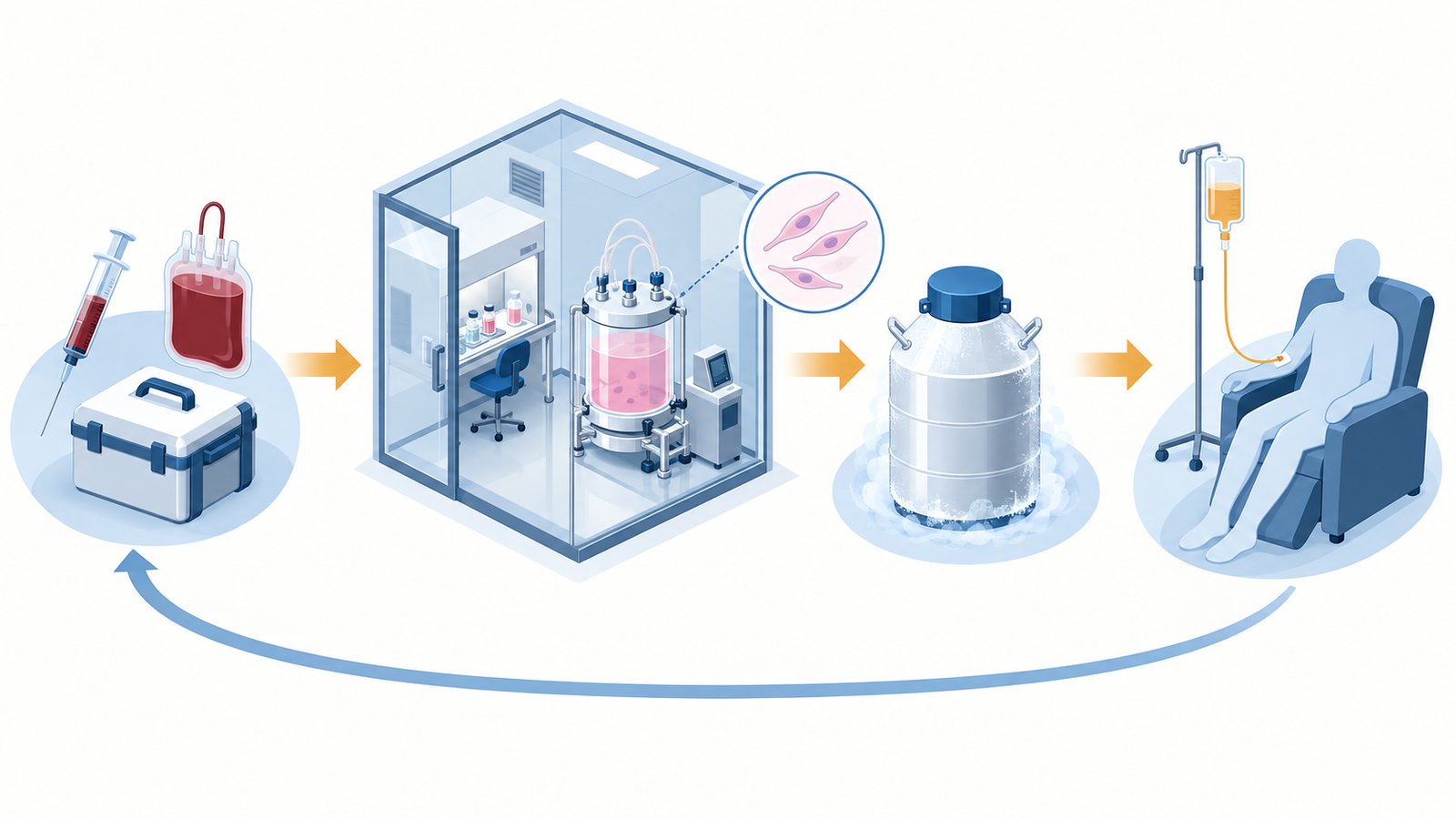
Nipro is a major medical device maker, producing dialysis equipment, syringes, pharmaceuticals and medical glass, and it is a slightly unexpected name in cell culture. Yet together with Sapporo Medical University it developed Stemirac, a regenerative medicine product in which stem cells from the patient's own bone marrow are grown outside the body and returned by intravenous drip, and on 28 December 2018 it obtained conditional and time-limited approval in Japan. With the seven-year time limit approaching, it applied for full approval on 14 November 2025. It also sells serum-free, chemically defined media and culture vessels for research. This profile keeps the medical device business to a minimum and uses primary sources to set out what the company is putting into its cell culture-related regenerative medicine business, and how far it has got.
- Nipro in 30 seconds, and where it stands in cell culture
- The logo and how the name is written
- Where the company sits in the cell culture landscape
- Scale (the medical device business in brief)
- Resources committed to cell culture
- What it has done so far
- What comes next
- What the company is aiming for in cell culture
- Map of cell culture partnerships
- Technologies, products and services
- The risks this company carries
- Glossary, references and claim-to-source audit
1. Nipro in 30 seconds, and where it stands in cell culture
Prime 8086Listed on the TSE First Section in December 1996
Media and vessels (secondary)The company as a whole is a medical device and pharmaceutical maker
(28 December 2018)Confirmed in the PMDA's list of approved products
Companies involved in cell culture can be divided into three types: contract development and manufacturing organisations (CDMOs), suppliers of equipment, consumables and media, and developers of cell and regenerative therapies. In cell culture, Nipro's main type is cell and regenerative therapy (it makes and sells an approved product under its own name, Stemirac), and its secondary type is supplier (research media, culture vessels and cryopreservation containers) Sourced. Of the two meanings of "cell culture", the company's work is concentrated on (2) regenerative medicine in which the cells themselves are the product, and the research culture materials for it. As for (1), producing biopharmaceuticals such as antibodies, it has obtained Japanese approval for biosimilars through a partnership with Samsung Bioepis of South Korea, but this is the commercialisation of in-licensed products; primary sources say nothing about Nipro carrying out the production culture.
2. The logo and how the name is written

The Nipro logo is a trademark of the company. We have not recreated it with generated imagery;
the logo image (SVG) used on the official website is placed here as img/nipro_logo.svg.
A note on names: the legal entity's English name is NIPRO CORPORATION. The regenerative medicine product is marketed as "Stemirac for Injection" (a registered trademark); its non-proprietary name is "human (autologous) bone marrow-derived mesenchymal stem cells". The research media are made by a consolidated subsidiary, Cell Science & Technology Institute, Inc. (Sendai), and sold by Nipro. It is a separate company from Nipro Pharma, the group's pharmaceutical manufacturing subsidiary.
Official site: https://www.nipro.co.jp/3. Where the company sits in the cell culture landscape
4. Scale (the medical device business in brief)
The medical device and pharmaceutical businesses themselves are not the subject here, so only their size is noted Sourced.
| Measure (consolidated) | Year to March 2025 | Year to March 2026 | Year to March 2027 (company forecast) |
|---|---|---|---|
| Revenue (¥ million) | 644,586 | 660,538 | 700,000 |
| Operating profit (¥ million) | 26,598 | 37,624 | 40,000 |
| R&D expenses (¥ million) | - | 26,817 | - |
| Employees | 39,168 | 38,593 | - |
Scale of the cell culture-related business (regenerative medicine)
| Measure | Value | Source and definition |
|---|---|---|
| Sales of regenerative medicine products (year to March 2025) | ¥540 million | Sales by product in the IR materials for the year to March 2026 |
| Sales of regenerative medicine products (year to March 2026) | ¥850 million (up 58.6%) | As above |
| Regenerative medicine business sales (first quarter of the year to March 2027) | ¥258 million (¥160 million a year earlier) | Segment note in the first-quarter results summary. Since April 2026 the regenerative medicine products business has been disclosed within "adjustments" |
| Regenerative medicine business profit (same period) | −¥1,551 million (−¥1,749 million a year earlier) | As above |
| Regenerative medicine facility (Tokyo CPF, Hamura, Tokyo) | Book value ¥18,058 million / 115 employees | "Major facilities" section of the annual securities report (31 March 2026) |
In the annual securities report for the year to March 2026, regenerative medicine is included in the "Medical-related" segment, and no separate segment figures are disclosed. From April 2026, sales and profit of the regenerative medicine business have been shown in a note within "adjustments"; in the first quarter of the year to March 2027 there was a loss of ¥1.55 billion on sales of ¥258 million Sourced. This is defined differently from the "regenerative medicine products" figure in the sales-by-product data in the IR materials (¥220 million in the same quarter), so the two should not be added together or compared. The company also notes that "part of the manufacturing cost of regenerative medicine has been transferred to R&D expenses".
5. Resources committed to cell culture
| Resource | What primary sources confirm | Confirmed? |
|---|---|---|
| People (organisation, sites, headcount) | An in-house Regenerative Medicine Division (headed by a managing director). 115 employees at the regenerative medicine manufacturing and research facilities of the Tokyo CPF (Hamura). The Regenerative Medicine Research Laboratories (Kusatsu, Shiga) have 578 staff together with the General Research Laboratories and the Pharmaceutical Research Laboratories; the number for regenerative medicine alone is not disclosed. A regenerative medicine R&D centre was opened in December 2016 | Partly confirmed |
| Money (R&D, capital expenditure) | Of consolidated R&D expenses of ¥26,817 million, ¥17,649 million was for the Medical-related and other businesses. R&D and capital expenditure for regenerative medicine alone are not disclosed. The book value of the Tokyo CPF is ¥18,058 million (including leased assets of ¥10,923 million) | Partly confirmed |
| Outside investments and acquisitions | The research media are made by the consolidated subsidiary Cell Science & Technology Institute (Sendai). When it became a subsidiary, and at what cost, could not be confirmed in primary sources | Partly confirmed |
| Universities and research institutes | Co-developed Stemirac and STR03 with Sapporo Medical University. The human hematopoietic stem cell medium "HemEx®-TypeH" builds on technology from Professor Satoshi Yamazaki and colleagues at the Institute of Medical Science, University of Tokyo | Confirmed |
"CiMS®-U", launched by Nipro in April 2026, is a chemically defined medium free of biologically derived components for mesenchymal stem cells; the company says it supports stable culture of umbilical cord-derived as well as adipose-derived mesenchymal stem cells Sourced. In cell culture, the fact that biologically derived components such as fetal bovine serum vary in composition from lot to lot is a major obstacle to reproducibility and quality control. Chemically defined media reduce that variation, and the risk of unknown contaminants, by defining every component chemically. "HemEx®-TypeH", for hematopoietic stem cells, is likewise said to use a polymer developed as a pharmaceutical excipient so that it can do without albumin and keep lot-to-lot differences down. A company that has long made syringes and infusion bags to pharmaceutical quality now says its media, too, are "made to the same quality as pharmaceuticals and medical devices"; that is a very medical-device-maker way of thinking. Our explainer on cell culture media covers the basics.
6. What it has done so far
| When | What happened | Why it matters |
|---|---|---|
| December 2016 | Opened a regenerative medicine R&D centre | A research base for regenerative medicine |
| March 2018 | Launched "CiMS", a medium for human mesenchymal stem cells | The starting point of the research media business |
| 28 December 2018 | Stemirac received conditional and time-limited approval (as a regenerative medicine product with SAKIGAKE designation, a Japanese fast-track scheme). Indication: improvement of neurological symptoms and functional impairment associated with traumatic spinal cord injury (ASIA Impairment Scale A, B or C) | The company describes it as the "world's first" regenerative medicine product for spinal cord injury |
| 20 February 2019 | The calculated price was reported to the Central Social Insurance Medical Council (Chuikyo), the body that advises the health ministry on insurance prices: ¥14,957,755 per treatment (cost-based method, with a 10% premium for SAKIGAKE designation) | Covered by Japan's public health insurance |
| FY2020 to FY2024 | The company's review of its previous medium-term plan found that the COVID-19 pandemic made treatment difficult, and the number of treating facilities and cases fell behind plan, so targets were missed | The company itself admits slow uptake |
| December 2023 | Announced "HemEx®-TypeH", a chemically defined medium for human hematopoietic stem cells (launched January 2024) | Commercialised technology from the University of Tokyo's Institute of Medical Science |
| October 2024 | Started a Phase II trial of "STR03", autologous bone marrow-derived mesenchymal stem cells, in ALS (106 patients planned, double-blind; announced on 24 July 2025 together with completion of the first patient's dosing) | Aims to widen indications with the same type of cell as Stemirac |
| May 2025 | The medium-term plan set out expectations of refiling by December 2025 and full approval in 2026 | Full approval built into the plan's assumptions |
| 14 November 2025 | Applied for full approval of Stemirac. The company says it verified efficacy and safety internally through a comparative use-results survey within the seven-year approval period | The procedure for moving on from conditional and time-limited approval |
| April 2026 | Launched the chemically defined medium "CiMS®-U". Changed how the regenerative medicine products business is disclosed | A better medium, and more visibility of regenerative medicine's profit and loss |
7. What comes next
full approvalFiled 14 November 2025. No announcement of approval found as of September 2026
+¥5.6 billionIncrease from FY2024 to FY2027, of which Stemirac accounts for +¥4.9 billion
spinal cord injuryAdvancing the STR03 Phase II trial and a company-sponsored trial of repeat dosing
The May 2025 medium-term plan says it "expects to obtain full (formal) approval in 2026". The same document's timeline, however, also shows "full approval obtained: January 2027", so the timing varies even within the document Not yet confirmed. Full approval of Stemirac did not appear in the PMDA's list of products approved in FY2026 (which, when we checked, covered approvals up to 17 July 2026). On the other hand, Stemirac is still included in the Ministry of Health, Labour and Welfare's list of products under the NHI price standard (applicable from 20 May 2026) Sourced.
None of the following appears in primary sources Not yet confirmed.
The timing of full approval of Stemirac; how it is treated after the time limit of the conditional and time-limited approval (December 2025) passed; the cumulative number of patients treated and treating facilities; the numerical results of the comparative use-results survey; capital expenditure and R&D spending in the regenerative medicine business; and when Cell Science & Technology Institute became a subsidiary.
8. What the company is aiming for in cell culture
This section goes beyond what the company says directly. It sets out inferences that can be drawn from primary sources, each with its basis.
| What can be read | Primary evidence behind it | Category |
|---|---|---|
| The immediate goal is full approval of Stemirac, and almost all the planned growth in regenerative medicine sales depends on it | Of the planned +¥5.6 billion increase in regenerative medicine sales in the medium-term plan, +¥4.9 billion is from Stemirac | Sourced |
| Reusing one cell manufacturing system across several diseases | It is running an ALS trial with STR03, the same autologous bone marrow-derived mesenchymal stem cells as Stemirac, and also lists expansion into chronic spinal cord injury | Inference |
| Media are being developed as components for standardisation and quality control in regenerative medicine | The annual securities report describes "developing solutions that accelerate the industrialisation of regenerative medicine, centred on this media technology that supports a stable supply of high-quality cells" | Sourced |
| Regenerative medicine is treated as a small, loss-making, upfront-investment business within the company | The regenerative medicine business had sales of ¥258 million and a loss of ¥1,551 million in the first quarter. Its disclosure was moved into adjustments | Inference |
Stemirac and STR03 are both products in which mesenchymal stem cells are taken from the patient's own bone marrow fluid, grown outside the body and returned into a vein by drip Sourced. The only differences are the target disease (spinal cord injury or ALS) and the number of doses, so the manufacturing system (collection kits, culture process, cryopreservation and transport to hospitals) can very probably be shared. Because autologous cell products are made one lot per patient, running a single process and adding target diseases is almost the only way to improve facility utilisation and cost per case. Our reading is that Nipro's explicit inclusion of ALS and chronic spinal cord injury in its medium-term plan is consistent with this Not yet confirmed.
9. Map of cell culture partnerships
10. Technologies, products and services
| Category | Product | What primary sources say |
|---|---|---|
| Regenerative medicine product | Stemirac (human (autologous) bone marrow-derived mesenchymal stem cells) | Mesenchymal stem cells from bone marrow fluid collected from the patient, grown and expanded outside the body and cryopreserved. Includes, as sub-components, blood collection and bone marrow collection kits used at hospitals to collect peripheral blood and bone marrow fluid and send them to the manufacturing site. Given intravenously by drip (PMDA list of approved products) |
| Cell product in development | STR03 (human autologous bone marrow-derived mesenchymal stem cells) | Phase II trial in ALS (repeat intravenous dosing, double-blind randomised controlled, 106 patients planned) |
| Research media | CiMS®-U (for mesenchymal stem/stromal cells, chemically defined), CiMS (launched 2018), HemEx®-TypeH (for human hematopoietic stem cells, albumin-free) | Made by Cell Science & Technology Institute and sold by Nipro. All are for research, not clinical use |
| Culture and storage containers | Culture-related products, cell storage-related products (cryopreservation containers and reagents) | Described as "made to the same quality as pharmaceuticals and medical devices". Not medical devices or pharmaceuticals themselves |
According to the PMDA's list of approved products, Stemirac includes as sub-components not only the cultured cells themselves but also kits for collecting bone marrow fluid and peripheral blood at the hospital Sourced. With autologous cell products, the conditions under which the raw material (the patient's cells) is collected and transported affect the quality of the final product, so the design manages even the raw-material devices as part of the product. For Nipro, which has long mass-produced devices for blood collection, infusion and dialysis, these "devices for collecting the raw material" are an extension of its core business. Our reading is that what a medical device maker brings to regenerative medicine is not just cell culture technology but the ability to supply its own devices for every step, from collection and transport through culture and freezing to administration Not yet confirmed.
11. The risks this company carries
| Risk | Substance | Category |
|---|---|---|
| Outcome of the full approval review | The company applied for full approval in November 2025, but whether and when approval will come is uncertain. The medium-term plan's growth in regenerative medicine sales assumes full approval | Not yet confirmed |
| Securing patients | In its own review of the previous medium-term plan (FY2020 to FY2024), the company put sales growth in the Regenerative Medicine Division at 16.3% a year against a target of 249.8%, writing that "securing treating facilities and cases ... fell behind plan, and the targets were not met" | Sourced |
| Losses in regenerative medicine | In the first quarter of the year to March 2027, the business lost ¥1,551 million on sales of ¥258 million | Sourced |
| Priority within the company | Regenerative medicine products account for about 0.13% of consolidated sales. If losses continue, the business could be reconsidered when resources are allocated | Inference |
| Results of the ALS trial | Depending on the results of the STR03 Phase II trial (106 patients planned), expansion of the same cell technology to new indications could stall | Not yet confirmed |
12. Glossary
- Regenerative medicine products
- Products made by processing human cells or tissues, and gene therapy products. Japan's Pharmaceuticals and Medical Devices Act defines them as a category separate from drugs and medical devices.
- Conditional and time-limited approval
- A Japanese system that grants early approval to a regenerative medicine product, with conditions and a time limit of no more than seven years, when efficacy is presumed and safety is confirmed. A fresh application for approval is required within the time limit.
- Full approval
- Ordinary approval, as opposed to conditional and time-limited approval. Nipro applied afresh for Stemirac as a "new regenerative medicine product".
- Comparative use-results survey
- A post-marketing survey that assesses efficacy and safety by comparing information on patients who did and did not receive the product.
- Mesenchymal stem cells (MSCs)
- Stem cells obtained from bone marrow, fat, umbilical cord and other tissues. Their release of anti-inflammatory substances and similar actions are used therapeutically.
- Chemically defined medium
- A medium made entirely of chemically defined components, without serum or other biologically derived ingredients. See our explainer on cell culture media.
- SAKIGAKE designation
- A Japanese scheme that gives priority review and other support to bring innovative medicines and similar products to patients early. Stemirac is a designated product.
- ASIA Impairment Scale
- A scale that grades the severity of spinal cord injury from A (complete paralysis) to E (normal). Stemirac is indicated for grades A, B and C.
- CPF
- Cell Processing Facility: a facility for processing and culturing cells. Nipro has the "Tokyo CPF" in Hamura, Tokyo.
13. References
- Nipro Annual securities report for the 73rd fiscal period (1 April 2025 to 31 March 2026; in Japanese, filed 25 June 2026): history, revenue, headcount, R&D activities (cell therapy products), capital expenditure, major facilities (Tokyo CPF) and segment information. https://www.nipro.co.jp/assets/document/ir_library/73rd/securities_report.pdf
- Nipro Consolidated financial results summary for the year to March 2026 [Japanese GAAP] (in Japanese, 12 May 2026): revenue, operating profit and the forecast for the year to March 2027. https://www.nipro.co.jp/assets/document/ir_library/73rd/financial_results.pdf
- Nipro IR materials for the year to March 2026 (in Japanese, May 2026): sales by product (regenerative medicine products) and the transfer of regenerative medicine manufacturing costs to R&D expenses. https://www.nipro.co.jp/assets/document/ir_library/73rd/ir_materials.pdf
- Nipro Medium-Term Management Plan (in Japanese, May 2025): review of the previous plan (regenerative medicine targets missed), planned change in regenerative medicine sales, the schedule for full approval of Stemirac and the policy on new indications. https://www.nipro.co.jp/assets/document/ir_library/72nd/midtermplan.pdf
- Nipro Consolidated financial results summary for the first quarter of the year to March 2027 [Japanese GAAP] (in Japanese, August 2026): segment change and regenerative medicine business sales and profit. https://www.nipro.co.jp/assets/document/ir_library/74th_first/financial_results.pdf
- Nipro IR materials for the first quarter of the year to March 2027 (in Japanese, August 2026): sales by product (regenerative medicine products). https://www.nipro.co.jp/assets/document/ir_library/74th_first/ir_materials.pdf
- Nipro Notice of application for full approval of the regenerative medicine product "Stemirac® for Injection" (in Japanese, 17 November 2025). https://www.nipro.co.jp/assets/document/newsrelease/251117.pdf
- Nipro Notice of the start of a Phase II clinical trial of human autologous bone marrow-derived mesenchymal stem cells "STR03" for ALS (in Japanese, 24 July 2025). https://www.nipro.co.jp/assets/document/newsrelease/250724.pdf
- Nipro Notice of the launch of "CiMS®-U", a chemically defined medium for human mesenchymal stem/stromal cells (in Japanese, 28 April 2026). https://www.nipro.co.jp/assets/document/newsrelease/260428_2.pdf
- Nipro Notice of the launch of "HemEx®-TypeH", a chemically defined medium for human hematopoietic stem cells (in Japanese, 14 December 2023). https://www.nipro.co.jp/assets/document/newsrelease/231214_1.pdf
- Nipro Marketing approval obtained for the biosimilar ustekinumab BS 130 mg for intravenous infusion "Nipro" (in Japanese, 3 September 2026). https://www.nipro.co.jp/assets/document/newsrelease/260903.pdf
- Pharmaceuticals and Medical Devices Agency (PMDA) List of products approved in FY2018 (regenerative medicine products; in Japanese): Stemirac's approval date, type of approval, components and indication. https://www.pmda.go.jp/files/000231456.pdf
- Pharmaceuticals and Medical Devices Agency (PMDA) List of products approved in FY2026 (regenerative medicine products; in Japanese). https://www.pmda.go.jp/files/000282058.pdf
- Ministry of Health, Labour and Welfare Minutes of the 409th general meeting of the Central Social Insurance Medical Council (in Japanese, 20 February 2019): pricing method and calculated price for Stemirac. https://www.mhlw.go.jp/stf/shingi2/0000205879_00054.html
- Ministry of Health, Labour and Welfare List of products under the NHI price standard (injectables, applicable from 20 May 2026; in Japanese): listing of Stemirac. https://www.mhlw.go.jp/topics/2026/04/dl/tp20260520-01_05.pdf
- Nipro Regenerative medicine business page (culture-related and cell storage-related products; in Japanese). https://www.nipro.co.jp/business/regenerativemedicine/
- Nipro Official website (in Japanese; used to check the logo). https://www.nipro.co.jp/
14. Claim-to-source audit
| Claim in the article | Category | Source |
|---|---|---|
| Legal name, English name, head office address, listing history and the opening of the regenerative medicine R&D centre | Sourced | Reference 1 https://www.nipro.co.jp/assets/document/ir_library/73rd/securities_report.pdf |
| Revenue, headcount, R&D expenses and capital expenditure; the Tokyo CPF's book value and headcount | Sourced | Reference 1 https://www.nipro.co.jp/assets/document/ir_library/73rd/securities_report.pdf |
| Operating profit for the year to March 2026 and the forecast for the year to March 2027 | Sourced | Reference 2 https://www.nipro.co.jp/assets/document/ir_library/73rd/financial_results.pdf |
| Sales of regenerative medicine products (¥540 million to ¥850 million) and the transfer of manufacturing costs to R&D expenses | Sourced | Reference 3 https://www.nipro.co.jp/assets/document/ir_library/73rd/ir_materials.pdf |
| Regenerative medicine products at about 0.13% of consolidated sales | Our calculation | Our calculation from figures in references 1 and 3 |
| First-quarter regenerative medicine sales of ¥258 million and loss of ¥1,551 million, and the change in disclosure | Sourced | Reference 5 https://www.nipro.co.jp/assets/document/ir_library/74th_first/financial_results.pdf |
| First-quarter sales by product (regenerative medicine products ¥220 million) | Sourced | Reference 6 https://www.nipro.co.jp/assets/document/ir_library/74th_first/ir_materials.pdf |
| Stemirac's conditional and time-limited approval (28 December 2018), SAKIGAKE designation, components and indication | Sourced | Reference 12 https://www.pmda.go.jp/files/000231456.pdf |
| Calculated price of ¥14,957,755 per treatment (cost-based method, 10% SAKIGAKE premium) | Sourced | Reference 14 https://www.mhlw.go.jp/stf/shingi2/0000205879_00054.html |
| Application for full approval (14 November 2025) and verification through the comparative use-results survey | Sourced | Reference 7 https://www.nipro.co.jp/assets/document/newsrelease/251117.pdf |
| Full approval of Stemirac is absent from the PMDA's FY2026 list of approved products (covering approvals to 17 July) | Sourced | Reference 13 https://www.pmda.go.jp/files/000282058.pdf |
| Stemirac is included in the NHI price standard list applicable from 20 May 2026 | Sourced | Reference 15 https://www.mhlw.go.jp/topics/2026/04/dl/tp20260520-01_05.pdf |
| Timing of full approval, treatment after the time limit, and cumulative cases and facilities | Not yet confirmed | Could not be confirmed in primary sources https://www.nipro.co.jp/assets/document/newsrelease/251117.pdf |
| The medium-term plan's expectation of full approval, planned regenerative medicine sales growth, policy on new indications, and the missed targets of the previous plan | Sourced | Reference 4 https://www.nipro.co.jp/assets/document/ir_library/72nd/midtermplan.pdf |
| The STR03 Phase II trial in ALS (started October 2024, 106 patients planned) and co-development with Sapporo Medical University | Sourced | Reference 8 https://www.nipro.co.jp/assets/document/newsrelease/250724.pdf |
| Features of CiMS®-U, manufacture by Cell Science & Technology Institute and sale by Nipro, and the March 2018 launch of CiMS | Sourced | Reference 9 https://www.nipro.co.jp/assets/document/newsrelease/260428_2.pdf |
| Features of HemEx®-TypeH and the technology from the Institute of Medical Science, University of Tokyo | Sourced | Reference 10 https://www.nipro.co.jp/assets/document/newsrelease/231214_1.pdf |
| Biosimilar approval through the partnership with Samsung Bioepis | Sourced | Reference 11 https://www.nipro.co.jp/assets/document/newsrelease/260903.pdf |
| Culture-related and cell storage-related products made to the same quality as pharmaceuticals and medical devices, and the company's description of Stemirac as the "world's first" approved regenerative medicine product for spinal cord injury | Sourced | Reference 16 https://www.nipro.co.jp/business/regenerativemedicine/ |
| Headcount, R&D spending and capital expenditure for regenerative medicine alone, and when Cell Science & Technology Institute became a subsidiary | Not yet confirmed | Not in primary sources. This article makes no estimate https://www.nipro.co.jp/assets/document/ir_library/73rd/securities_report.pdf |
| The three types of cell culture company, and Nipro's main and secondary types | Our calculation | Our own classification. Companies shown are examples from the 20 in this series |
| The reading that one cell manufacturing system is being reused across several diseases | Inference | This article's interpretation of what Stemirac and STR03 have in common |
| The reading that regenerative medicine is treated as a loss-making upfront investment, and the risk around its priority within the company | Inference | This article's interpretation of first-quarter results and the change in disclosure |
| The reading that supplying devices for every step from collection to administration is a medical device maker's strength | Inference | This article's interpretation of the product components in the PMDA list |
Last updated 23 September 2026 / Troy Technical
Every figure in this article comes from Nipro's annual securities report, financial results summaries, IR materials, medium-term management plan and news releases, from the PMDA's lists of approved products, and from the minutes of the Ministry of Health, Labour and Welfare's Central Social Insurance Medical Council. No research-firm estimates or press-based figures have been used. Passages marked "Inference" are this article's interpretation of primary sources, not statements made by the company.