COMPANY PROFILE / CELL CULTURE TECHNOLOGY
Sumitomo Pharma
The drug maker that became approval holder for Amchepry, an iPS cell-derived product for Parkinson's disease
Sumitomo Pharma obtained conditional and time-limited approval in Japan on 6 March 2026 for Amchepry®, dopaminergic neural progenitor cells made from iPS cells from another (healthy) person, and the product was listed for National Health Insurance (NHI) reimbursement on 20 May 2026 (at a calculated price of ¥55,306,737 per set of 18 vials). The work is split, however: research and development is carried out by RACTHERA, a joint venture with Sumitomo Chemical, and manufacturing by S-RACMO, a contract manufacturer that is also a joint venture, while Sumitomo Pharma, as the approval holder, handles sales. This profile, which also serves the series' coverage of iPS cells and regenerative medicine, uses only primary sources to set out what the company is putting into products made by cell culture, who it works with and how far it has got.
- Sumitomo Pharma in 30 seconds, and where it stands in cell culture
- The logo and how the name is written
- Where the company sits in the cell culture landscape
- Scale (the pharmaceutical business in brief)
- Resources committed to cell culture
- What it has done so far
- What comes next
- What the company is aiming for in cell culture
- Map of cell culture partnerships
- Technologies, products and services
- The risks this company carries
- Glossary, references and claim-to-source audit
1. Sumitomo Pharma in 30 seconds, and where it stands in cell culture
Prime 4506Reports under International Financial Reporting Standards (IFRS)
(approval holder, seller)R&D and manufacturing are carried out by joint ventures
(raguneprocel)Allogeneic iPS cell-derived dopaminergic neural progenitor cells
(6 March 2026)Confirmed in the PMDA's list of products approved in FY2025
per set of 18 vialsListed 20 May 2026. Cost-based pricing method
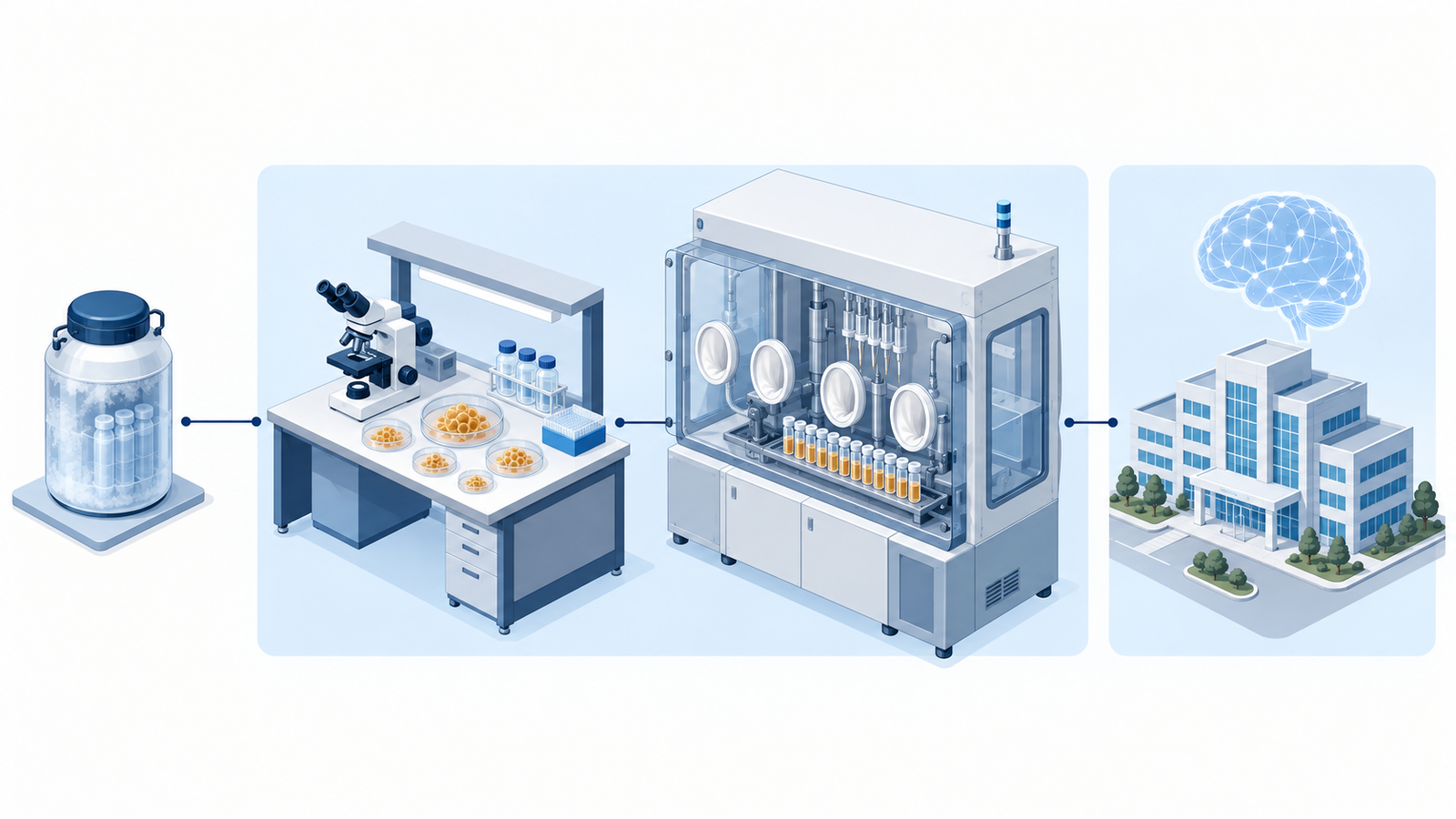
Companies involved in cell culture can be divided into three types: contract development and manufacturing organisations (CDMOs), suppliers of equipment, consumables and media, and developers of cell and regenerative therapies. Sumitomo Pharma belongs to the cell and regenerative therapy type, and of the two meanings of "cell culture" it is involved in (2), where the cells themselves are the product Sourced. It does not do everything in house, however. In February 2025 it spun off its regenerative and cell medicine business into RACTHERA and transferred 66.6% of RACTHERA's shares to its parent, Sumitomo Chemical. Today Sumitomo Pharma holds 33.4% each of RACTHERA and S-RACMO (a CDMO for regenerative and cell medicines), and for Amchepry it handles sales as the marketing authorisation holder that obtained the approval. The work that fits the CDMO type is done by S-RACMO, an equity-method affiliate.
2. The logo and how the name is written

The Sumitomo Pharma logo is a trademark of the company. We have not recreated it with generated imagery;
the brand mark (SVG) used on the official website is placed here as img/sumitomo_pharma_logo.svg.
A note on names: the legal entity's English name is Sumitomo Pharma Co., Ltd. It changed its name from Sumitomo Dainippon Pharma in April 2022. RACTHERA and S-RACMO are both joint ventures with Sumitomo Chemical, and are not consolidated subsidiaries of Sumitomo Pharma but equity-method affiliates. Its U.S. sales company is Sumitomo Pharma America, Inc. (SMPA).
Official site: https://www.sumitomo-pharma.co.jp/3. Where the company sits in the cell culture landscape
4. Scale (the pharmaceutical business in brief)
The pharmaceutical business as a whole is not the subject here, so only its size is noted Sourced.
| Measure (consolidated, IFRS) | Year to March 2025 | Year to March 2026 | Year to March 2027 (company forecast) |
|---|---|---|---|
| Revenue (¥ million) | 398,832 | 453,294 | 540,000 |
| Core operating profit (¥ million) | 43,153 | 105,908 | 91,000 |
| R&D expenses (¥ billion) | - | 44.0 | - |
| Employees | 3,832 | 3,123 | - |
Figures for products made by cell culture
| Item | Value | Source |
|---|---|---|
| Rethymic (U.S.) revenue | ¥6.8 billion in the year to March 2025, then ¥6.3 billion in the year to March 2026 (forecast ¥5.4 billion for the year to March 2027) | Supplementary materials for FY2025 results |
| Amchepry sales | None in the year to March 2026 | Approved on 6 March 2026; the first transplant is planned for autumn 2026 |
| Amchepry peak forecast | 133 patients and ¥7.4 billion in year 10 | "Market size forecast by the applicant for listing (Sumitomo Pharma)" in Chuikyo materials Not yet confirmed |
| Consideration for the sale of RACTHERA shares | ¥1,998 million received; development milestones of up to ¥3,996 million; sales milestones of up to ¥154,512 million | Annual securities report (contingent consideration agreement). States that ¥666 million was due to be received in June 2026 on approval |
Sumitomo Pharma manages R&D globally, and R&D spending on regenerative and cell medicine is not allocated to segments or products in its disclosures. And because RACTHERA and S-RACMO are equity-method affiliates, their sales, profit or loss and headcount are not included in Sumitomo Pharma's consolidated figures Sourced. The "sales milestones of up to ¥154,512 million" in the table above is a ceiling that applies only if every condition is met, not an amount the company is certain to receive.
5. Resources committed to cell culture
| Resource | What primary sources confirm | Confirmed? |
|---|---|---|
| People (organisation, sites, headcount) | 3,123 consolidated employees (31 March 2026). R&D is carried out by RACTHERA (Chuo-ku, Tokyo), and manufacturing at S-RACMO's commercial manufacturing facility "SMaRT" (Suita, Osaka; completed in 2018), which the company describes as "the world's first commercial manufacturing facility dedicated to regenerative and cell medicines derived from non-autologous iPS cells". It is preparing to set up its own manufacturing facility for Rethymic in the U.S. Dedicated headcount for regenerative and cell medicine is not disclosed | Partly confirmed |
| Money (R&D, capital expenditure) | Of estimated net proceeds of ¥96,956 million from the April 2026 public share offering, ¥10,000 million is to go to "investments and loans for growing the regenerative and cell medicine business" by the end of March 2029. Boost 2028 states that about ¥50 billion of capital expenditure, investments and loans in FY2026 to FY2028 includes "investments and loans to RACTHERA and S-RACMO". R&D spending on regenerative and cell medicine itself is not disclosed | Partly confirmed |
| Outside investments and acquisitions | Stakes in RACTHERA and S-RACMO (33.4% each). In February 2025 the regenerative and cell medicine business was spun off into RACTHERA, and 66.6% of its shares were transferred to Sumitomo Chemical | Confirmed |
| Universities and research institutes | Kyoto University's Center for iPS Cell Research and Application (CiRA) (dopaminergic neural progenitor cells), Kyoto University Hospital (investigator-initiated trial and post-marketing clinical trial), the University of California San Diego (investigator-initiated trial in the U.S.), Massachusetts Eye and Ear (retinal sheets) and the CiRA Foundation (supply of iPS cell stock). The manufacturing method for retinal sheets was established through joint research with RIKEN (now concluded) | Confirmed |
Amchepry is an allogeneic product made from an iPS cell stock derived from a healthy person, so in principle one manufacturing run could supply many patients. Yet the press conference materials at approval list, as a task ahead, "an application for a partial change of approval from one lot per patient to one lot for multiple patients" Sourced. Amchepry is a non-frozen cell product, while the company-sponsored trial in the U.S. uses frozen cells (development code DSP-1083) (annual securities report). Non-frozen cells limit the time between manufacture and transplant, so lots tend to be made to match each patient's surgery date; that is how it looks from the materials side Not yet confirmed. If cells could be cryopreserved while keeping their viability and function, one lot could be distributed to many patients and manufacturing costs would fall sharply. The economics of allogeneic cell products depend as much on freezing, thawing and transport technology as on culture technology. See also our explainers on iPS cells and GMP.
6. What it has done so far
| When | What happened | Why it matters |
|---|---|---|
| 2012 | Decided to enter the regenerative and cell medicine business in earnest (timeline in the press conference materials) | The same year Professor Yamanaka won the Nobel Prize |
| February 2017 | SAKIGAKE designation (a Japanese fast-track scheme) as a regenerative medicine product for Parkinson's disease | Eligible for priority review |
| 2018 | Commercial manufacturing facility "SMaRT" completed. In August, an investigator-initiated trial began at Kyoto University Hospital | Both the manufacturing base and the clinical trial get going |
| 8 October 2021 | Rethymic (cultured human thymus tissue) approved by the FDA in the U.S. (applicant: Enzyvant Therapeutics GmbH) | Sales of a cell and tissue product begin in the U.S. (from March 2022) |
| February 2025 | Regenerative and cell medicine business spun off into RACTHERA, and 66.6% of the shares transferred to Sumitomo Chemical | Control of the business shifts to the Sumitomo Chemical group |
| April 2025 | Results of Kyoto University's investigator-initiated trial published in Nature | The data underpinning the approval filing |
| 5 August 2025 | Filed for marketing approval | - |
| December 2025 | Designated an orphan regenerative medicine product | Also became a basis for the marketability premium on the NHI price |
| 6 March 2026 | Amchepry received conditional and time-limited approval (endorsed on 19 February by the relevant committee of the Pharmaceutical Affairs Council, which advises the health ministry) | On the same day Cuorips' iPS cell-derived cardiomyocyte sheet "Reheart" also received conditional and time-limited approval (PMDA list) |
| March 2026 | The retinal sheet (DSP-3077) received orphan drug designation from the U.S. FDA | A boost to development in the U.S. |
| April 2026 | Public share offering, with ¥10 billion of the proceeds earmarked for investments and loans in the regenerative and cell medicine business | Named explicitly as a use of funds |
| 13 / 20 May 2026 | The Central Social Insurance Medical Council (Chuikyo), which advises the health ministry on insurance pricing, approved coverage, and the product was listed on 20 May (cost-based method, with a 10% marketability premium (I) and a 10% SAKIGAKE premium) | Now usable under Japan's public health insurance |
| July 2026 | Contracted with Kyoto University Hospital for the post-marketing clinical trial (Phase 4), published details on jRCT (Japan's clinical trial registry) and began enrolling patients | Start of the trial aimed at full approval |
| 21 July 2026 | Takara Bio announced a basic agreement with Sumitomo Chemical, Sumitomo Pharma and S-RACMO on transferring its contract GMP cell processing business to S-RACMO | S-RACMO's contract capacity is expected to grow |
| 13 August 2026 | The first patient in the U.S. Phase 1/2 trial of the retinal sheet (DSP-3077) received a transplant | Cells made at SMaRT used in a U.S. trial |
7. What comes next
in autumn 2026About 10 in FY2027 and about 10 to 20 in FY2028
the time limit (7 years)Until around 2029, transplants only for Phase 4 patients
According to the press conference materials, once transplants in Phase 4 patients are complete the company plans to widen the range of sites and patients, and at the same time to file a partial change application to switch manufacturing "from one lot per patient to one lot for multiple patients" Not yet confirmed. In the retina, it is running Phase 1/2 trials of retinal pigment epithelial cells (HLCR011, Japan, retinal pigment epithelium tear) and retinal sheets (DSP-3077, U.S., retinitis pigmentosa, 12 patients planned).
None of the following appears in primary sources Not yet confirmed.
The target year for full approval of Amchepry (anything more specific than "within seven years"); when the switch to one lot for multiple patients will happen; SMaRT's annual manufacturing capacity; RACTHERA's and S-RACMO's sales, profit or loss and headcount; when a U.S. approval filing will be made; and the cumulative R&D spending on regenerative and cell medicine.
8. What the company is aiming for in cell culture
This section goes beyond what the company says directly. It sets out inferences that can be drawn from primary sources, each with its basis.
| What can be read | Primary evidence behind it | Category |
|---|---|---|
| Control of regenerative and cell medicine has moved to the Sumitomo Chemical group, and Sumitomo Pharma's role has narrowed to approval holder and seller | 66.6% of RACTHERA was transferred to Sumitomo Chemical, and the stakes in both RACTHERA and S-RACMO are 33.4%. Sales by Sumitomo Pharma and manufacturing by S-RACMO are stated explicitly | Inference |
| Amchepry will not bring in large sales until around 2029 | The Phase 4 transplant plan runs to FY2028 with roughly 20 to 30 patients in total. Until Phase 4 is complete, only trial participants will receive transplants | Inference |
| Part of Sumitomo Pharma's economic return is designed to come through sales milestones and equity-method profits | The contingent consideration for the RACTHERA sale includes sales milestones of up to ¥154,512 million | Inference |
| Company-wide, oncology has higher priority, and regenerative and cell medicine are advanced with outside capital and joint ventures | The annual securities report says it will "concentrate resources on two oncology products". The share offering allocates ¥30 billion to oncology and ¥10 billion to regenerative and cell medicine | Sourced |
| S-RACMO is heading towards more contract work beyond group products | It has negotiated, and reached a basic agreement on, taking over Takara Bio's contract GMP cell processing (CAR-T and others) | Inference |
Sumitomo Pharma's own market size forecast in the Chuikyo materials is 133 patients and ¥7.4 billion at peak (year 10) Sourced. Meanwhile, the press conference materials at approval describe a Phase 4 trial of 30 + 5 patients, about 20 to 30 transplants in total planned up to FY2028, and state that "from 2026 until around 2029, transplants will be given only to patients taking part in the Phase 4 trial". Multiplying the price of ¥55,306,737 by 10 to 20 patients a year gives only about ¥550 million to ¥1.1 billion a year Our calculation. Our reading, then, is that even after approval and NHI listing, Amchepry is not at the "generating sales" stage but at the "collecting data for full approval" stage, and that sales will take off only after full approval and the switch to one lot for multiple patients Not yet confirmed.
9. Map of cell culture partnerships
10. Technologies, products and services
| Product | What it is | Stage |
|---|---|---|
| Amchepry® (raguneprocel) | Aggregates of dopaminergic neural progenitor cells, made by culturing, differentiating and aggregating iPS cells generated by introducing genes with episomal vectors into peripheral blood mononuclear cells from a healthy adult (PMDA list). 1×10⁶ cells in 1 mL per tube. Transplanted into the putamen on both sides by stereotactic brain surgery (target of 5.4×10⁶ cells per side) | Conditional and time-limited approval in Japan (6 March 2026); NHI-listed on 20 May 2026 |
| CT1-DAP001 / DSP-1083 (U.S.) | The same dopaminergic neural progenitor cells. The non-frozen version (CT1-DAP001) is used in UCSD's investigator-initiated trial, the frozen version (DSP-1083) in the company-sponsored trial | Phase 1/2 |
| HLCR011 | Allogeneic iPS cell-derived retinal pigment epithelial cells (in partnership with Healios) | Phase 1/2 in Japan (retinal pigment epithelium tear) |
| DSP-3077 | Allogeneic iPS cell-derived retinal sheets (3D retina), based on a self-organising culture method (SFEBq) | Phase 1/2 in the U.S. (retinitis pigmentosa; first transplant in August 2026) |
| Rethymic (U.S.) | Cultured human thymus tissue for children with congenital athymia. The FDA-approved indication is "immune reconstitution in pediatric patients with congenital athymia" | On sale in the U.S. (FDA-approved October 2021) |
DSP-3077 is made using a self-organising culture method (SFEBq) that differentiates pluripotent stem cells into three-dimensional neural tissue, and the company says it "has a multilayered retinal tissue structure and is rich in precursors of photoreceptor cells, the light-sensing cells" Sourced. Unlike ordinary culture, which expands cells in a flat vessel, this is culture that sets up the conditions for cells to build layered structures themselves, and the manufacturing challenge is to produce tissue of consistent shape reliably. The company improved and established this method through joint research with RIKEN, and products made at SMaRT are now being used in the U.S. trial. Whereas dopaminergic neural progenitor cells are "a cell suspension", retinal sheets turn "tissue" into the product, so the technical difficulties of cell culture are of a different kind.
11. The risks this company carries
| Risk | Substance | Category |
|---|---|---|
| Full approval may not be reached | A conditional and time-limited approval lapses unless the company refiles and obtains approval within the time limit. The company also says "it is necessary to reapply and obtain approval within seven years" | Not yet confirmed |
| Limited efficacy data | The Chuikyo materials state, on the SAKIGAKE premium, that "because this is a conditional and time-limited approval and data showing efficacy are limited, a limited assessment was made". Council members also remarked that the number of patients studied was small and the efficacy limited | Sourced |
| Manufacturing cost and supply | Manufacturing is currently one lot per patient. Switching to one lot for multiple patients depends on a future partial change application | Sourced |
| Control rests with the joint ventures | Sumitomo Pharma holds 33.4% of both RACTHERA and S-RACMO. Decisions on R&D and manufacturing depend on the joint ventures and the Sumitomo Chemical group | Inference |
| Third-party report | In August 2026 Gotham City Research of the U.S., which disclosed a short position, published a report that also touched on Amchepry. The company published its view that it had "confirmed the reliability of the materials used in the approval review", and that the product was approved after review by the regulator | Sourced |
| Allocation of resources within the company | The company states that it will "concentrate resources on two oncology products", and the allocation to regenerative and cell medicine in the share offering's uses of funds, ¥10 billion, is smaller than oncology's ¥30 billion | Sourced |
12. Glossary
- iPS cells
- Stem cells made from ordinary body cells that can become many different cell types. See our explainer on iPS cells for more.
- Allogeneic (non-autologous)
- Using cells from a healthy donor rather than the patient. Amchepry's raw material is iPS cell stock from the CiRA Foundation.
- Dopaminergic neural progenitor cells
- Cells one step before becoming dopamine-producing nerve cells. In Parkinson's disease, dopaminergic nerve cells are lost.
- Conditional and time-limited approval
- A Japanese system that grants early approval to a regenerative medicine product, with conditions and a time limit (up to seven years), when efficacy is presumed and safety is confirmed.
- Post-marketing clinical trial (Phase 4)
- A clinical trial conducted after approval. For Amchepry, verifying efficacy towards full approval is a condition of the approval.
- NHI price listing
- Setting the price at which a product can be used under Japan's public health insurance and adding it to the NHI price standard.
- Cost-based pricing method
- A way of setting the NHI price when no similar product exists, by adding up manufacturing cost, operating profit, distribution costs and so on.
- Equity-method affiliate
- A company that is not a consolidated subsidiary but over which the investor has significant influence, for example through 20% or more of the voting rights. Its profit is taken in according to the stake held.
- CDMO
- A business that develops manufacturing processes for drugs and manufactures them under contract. See our explainer on CDMOs for more.
- Self-organising culture (SFEBq)
- A culture method in which pluripotent stem cells are aggregated in suspension and left to build three-dimensional tissue themselves.
13. References
- Sumitomo Pharma Annual securities report for the 206th fiscal period (1 April 2025 to 31 March 2026; in Japanese, filed 23 June 2026): history (spin-off into RACTHERA), affiliates (33.4% stakes), R&D activities, headcount, the parent's share of voting rights, uses of funds from the public offering and the contingent consideration agreement. https://www.sumitomo-pharma.co.jp/ir/library/securities_report/assets/pdf/securities_report_20260623.pdf
- Sumitomo Pharma Consolidated financial results summary for the year to March 2026 [IFRS] (in Japanese, 13 May 2026): revenue, core operating profit, the forecast for the year to March 2027 and preparations for a U.S. manufacturing facility for Rethymic. https://www.sumitomo-pharma.co.jp/news/assets/pdf/br20260513_1.pdf
- Sumitomo Pharma Supplementary materials for FY2025 (year to March 2026) results [IFRS] (in Japanese, 13 May 2026): revenue by product (Rethymic) and R&D partners in regenerative and cell medicine. https://www.sumitomo-pharma.co.jp/news/assets/pdf/br20260513_2.pdf
- Sumitomo Pharma Presentation for the FY2026 (year to March 2027) first-quarter results briefing (in Japanese, 31 July 2026): schedule of the Amchepry post-marketing clinical trial and preparation of sites. https://www.sumitomo-pharma.co.jp/news/assets/pdf/ir20260731.pdf
- Sumitomo Pharma Notice of marketing approval in Japan for Amchepry, dopaminergic neural progenitor cells derived from non-autologous iPS cells (in Japanese, 6 March 2026). https://www.sumitomo-pharma.co.jp/news/20260306.html
- Sumitomo Pharma Press conference materials (press conference on the conditional and time-limited approval of Amchepry; in Japanese, 6 March 2026): development timeline, Phase 4 trial design, plans to widen sites and patients, and the partial change application for one lot for multiple patients. https://www.sumitomo-pharma.co.jp/news/assets/pdf/pr20260306.pdf
- Sumitomo Pharma "Boost 2028: accelerating a stronger Sumitomo Pharma" briefing materials (in Japanese, 2 March 2026): capital allocation, the date of endorsement by the Pharmaceutical Affairs Council committee, and the organisation for regenerative and cell medicine. https://www.sumitomo-pharma.co.jp/news/assets/pdf/ir20260302.pdf
- Sumitomo Pharma Notice of the first patient transplanted in the U.S. Phase 1/2 trial of "treatment of retinitis pigmentosa using allogeneic iPS cell-derived retinal sheets (3D retina)" (in Japanese, 13 August 2026). https://www.sumitomo-pharma.co.jp/news/20260813-1.html
- Sumitomo Pharma "Regarding a report about the company" (the company's view on Gotham City Research's report of 7 August 2026; in Japanese, 12 August 2026). https://www.sumitomo-pharma.co.jp/news/20260812-1.html
- Pharmaceuticals and Medical Devices Agency (PMDA) List of products approved in FY2025 (regenerative medicine products; in Japanese): approval dates, type of approval and product descriptions for Amchepry and Reheart. https://www.pmda.go.jp/files/000280052.pdf
- Ministry of Health, Labour and Welfare Materials for the 650th general meeting of the Central Social Insurance Medical Council, item So-5, "Insurance coverage of regenerative medicine products" (in Japanese, 13 May 2026): calculated price, pricing method, premiums, market size forecast and planned listing date. https://www.mhlw.go.jp/content/10808000/001699508.pdf
- Ministry of Health, Labour and Welfare Minutes of the 650th general meeting of the Central Social Insurance Medical Council (in Japanese, 13 May 2026). https://www.mhlw.go.jp/stf/newpage_73716.html
- Ministry of Health, Labour and Welfare List of products under the NHI price standard (injectables, applicable from 20 May 2026; in Japanese): Amchepry's listing date. https://www.mhlw.go.jp/topics/2026/04/dl/tp20260520-01_05.pdf
- U.S. Food and Drug Administration (FDA) RETHYMIC approval information (approval date, indication and applicant). https://www.fda.gov/vaccines-blood-biologics/rethymic
- Takara Bio Conclusion of a basic agreement on the transfer of the contract GMP cell processing business (in Japanese, 21 July 2026). https://www.takara-bio.co.jp/ja/news/newsr_26m721hyti.html
- Sumitomo Pharma Official website (in Japanese; used to check the logo). https://www.sumitomo-pharma.co.jp/
14. Claim-to-source audit
| Claim in the article | Category | Source |
|---|---|---|
| Legal name, head office location, the April 2022 name change, listing market, and the parent's share of voting rights (51.81% at the end of March 2026; at least 45.84% as of the filing date) | Sourced | Reference 1 https://www.sumitomo-pharma.co.jp/ir/library/securities_report/assets/pdf/securities_report_20260623.pdf |
| The spin-off into RACTHERA and transfer of 66.6% to Sumitomo Chemical; the 33.4% stakes in RACTHERA and S-RACMO and their businesses | Sourced | Reference 1 https://www.sumitomo-pharma.co.jp/ir/library/securities_report/assets/pdf/securities_report_20260623.pdf |
| Revenue, core operating profit and the forecast for the year to March 2027 | Sourced | Reference 2 https://www.sumitomo-pharma.co.jp/news/assets/pdf/br20260513_1.pdf |
| R&D expenses of ¥44.0 billion, headcount, and R&D not being allocated to segments | Sourced | Reference 1 https://www.sumitomo-pharma.co.jp/ir/library/securities_report/assets/pdf/securities_report_20260623.pdf |
| Rethymic revenue and forecast; R&D partners in regenerative and cell medicine (CiRA, UCSD, Healios, Mass Eye and Ear) | Sourced | Reference 3 https://www.sumitomo-pharma.co.jp/news/assets/pdf/br20260513_2.pdf |
| FDA approval of Rethymic (8 October 2021, indication, applicant) | Sourced | Reference 14 https://www.fda.gov/vaccines-blood-biologics/rethymic |
| Amchepry's approval (conditional and time-limited, 6 March 2026), division of sales and manufacturing, SMaRT, the iPS cell stock and Eisai's technology | Sourced | Reference 5 https://www.sumitomo-pharma.co.jp/news/20260306.html |
| Approval dates and types for Amchepry and Reheart, and the description of Amchepry's manufacturing method | Sourced | Reference 10 https://www.pmda.go.jp/files/000280052.pdf |
| Calculated price of ¥55,306,737 (per set of 18 vials), cost-based method, premiums, planned listing date, market size forecast (133 patients and ¥7.4 billion in year 10), and the limited assessment for the SAKIGAKE premium | Sourced | Reference 11 https://www.mhlw.go.jp/content/10808000/001699508.pdf |
| Council members' remarks that efficacy is limited, and Reheart being handled as a medical material | Sourced | Reference 12 https://www.mhlw.go.jp/stf/newpage_73716.html |
| NHI listing on 20 May 2026 | Sourced | Reference 13 https://www.mhlw.go.jp/topics/2026/04/dl/tp20260520-01_05.pdf |
| The development timeline (2012 decision to enter, 2017 SAKIGAKE designation, 2018 SMaRT completion and trial start), the Phase 4 trial design, and the planned partial change application for one lot for multiple patients | Sourced | Reference 6 https://www.sumitomo-pharma.co.jp/news/assets/pdf/pr20260306.pdf |
| The Phase 4 transplant schedule (first patient in autumn 2026, about 10 in FY2027, about 10 to 20 in FY2028) and the contract with Kyoto University Hospital | Sourced | Reference 4 https://www.sumitomo-pharma.co.jp/news/assets/pdf/ir20260731.pdf |
| Endorsement by the Pharmaceutical Affairs Council committee (19 February 2026), and the inclusion of investments and loans to RACTHERA and S-RACMO in the roughly ¥50 billion of capital expenditure, investments and loans | Sourced | Reference 7 https://www.sumitomo-pharma.co.jp/news/assets/pdf/ir20260302.pdf |
| Uses of funds from the public offering (¥10 billion for regenerative and cell medicine, ¥30 billion for oncology) and the contingent consideration for the RACTHERA sale | Sourced | Reference 1 https://www.sumitomo-pharma.co.jp/ir/library/securities_report/assets/pdf/securities_report_20260623.pdf |
| The U.S. trial of the DSP-3077 retinal sheet (first transplant, 12 patients planned), SFEBq, the joint research with RIKEN (concluded) and FDA orphan designation | Sourced | Reference 8 https://www.sumitomo-pharma.co.jp/news/20260813-1.html |
| The third-party report and the company's view | Sourced | Reference 9 https://www.sumitomo-pharma.co.jp/news/20260812-1.html |
| The basic agreement on transferring Takara Bio's contract GMP cell processing to S-RACMO | Sourced | Reference 15 https://www.takara-bio.co.jp/ja/news/newsr_26m721hyti.html |
| Target year for full approval, timing of the switch to one lot for multiple patients, SMaRT's capacity, the joint ventures' results and headcount, and R&D spending on regenerative and cell medicine | Not yet confirmed | Not in primary sources. This article makes no estimate https://www.sumitomo-pharma.co.jp/news/assets/pdf/pr20260306.pdf |
| The scale of about ¥550 million to ¥1.1 billion a year from the price multiplied by 10 to 20 patients a year | Our calculation | Our calculation from figures in references 4 and 11 |
| The three types of cell culture company, and Sumitomo Pharma's type | Our calculation | Our own classification. Companies shown are examples from the 20 in this series |
| The reading that control has moved to the Sumitomo Chemical group, and the risk that control rests with the joint ventures | Inference | This article's interpretation of the shareholding structure and division of roles |
| The reading that there will be no large sales until around 2029 | Inference | This article's interpretation of the Phase 4 transplant plan |
| The reading that economic returns are designed to come through sales milestones and equity-method profits | Inference | This article's interpretation of the contingent consideration agreement |
| The reading that S-RACMO will widen its contract work beyond the group | Inference | This article's interpretation of the basic agreement with Takara Bio |
| The reading that non-frozen cells tend to mean one lot per patient | Inference | This article's interpretation of the press conference materials and the annual securities report |
Last updated 23 September 2026 / Troy Technical
Every figure in this article comes from Sumitomo Pharma's annual securities report, financial results summaries, supplementary results materials, briefing materials and announcements, from the PMDA's lists of approved products, from Central Social Insurance Medical Council materials and minutes, from the Ministry of Health, Labour and Welfare's NHI price list, and from U.S. FDA approval information. No research-firm estimates or press-based figures have been used. The market size forecast is Sumitomo Pharma's own forecast as recorded in the Chuikyo materials, not a confirmed figure. Passages marked "Inference" are this article's interpretation of primary sources, not statements made by the company.