COMPANY PROFILE / CELL CULTURE TECHNOLOGY
Catalent
A U.S. CDMO that, since going private, has been leaning towards contract work on iPS cells and gene therapy
Catalent is a U.S. CDMO (contract development and manufacturing organisation) whose contract work ranges from softgel capsules to antibodies and cell and gene therapies. On 18 December 2024, Novo Holdings of Denmark completed its acquisition of the company at an enterprise value of about US$16.5 billion, and Catalent was delisted from the New York Stock Exchange. At the same time, three fill-finish sites (Bloomington in the U.S., Anagni in Italy and Brussels in Belgium) passed to Novo Nordisk. Because the company no longer publishes its results, this profile uses the statutory filings made with the U.S. SEC before the acquisition to establish the substance and scale of the business, and Catalent's own official announcements since the acquisition to follow what it has done. Its 2026 announcements show partners concentrated among companies developing cell therapies derived from iPS and ES cells and AAV gene therapies.
- Catalent in 30 seconds, and where it stands in cell culture
- The logo and how the name is written
- Where the company sits in the cell culture landscape
- Scale (from pre-acquisition disclosures)
- Resources committed to cell culture
- What it has done so far
- What comes next
- What the company is aiming for in cell culture
- Map of cell culture partnerships
- Technologies, products and services
- The risks this company carries
- Glossary, references and claim-to-source audit
1. Catalent in 30 seconds, and where it stands in cell culture
(100%, via a subsidiary)Acquisition completed on 18 December 2024
about US$16.5 billionUS$63.50 per share in cash
Gosselies, BelgiumiPS cells near Duesseldorf, Germany
Companies involved in cell culture fall into three broad types: contract development and manufacturing organisations (CDMOs), suppliers of equipment, consumables and media, and developers of cell and regenerative therapies. Catalent is a CDMO and takes on contract work in both senses of "cell culture": (1) growing animal cells to make antibodies and other proteins, and (2) cell therapy, where the cells themselves are the product Sourced. The first rests on its own cell line technology, "GPEx", and single-use bioreactors (250 to 4,000 L) in Madison in the U.S.; the second on sites in Princeton (U.S.), Gosselies (Belgium) and its iPS cell site in Germany. Across the company as a whole, however, Pharma and Consumer Health, which covers softgels, tablets and the like, is the larger business (Biologics was about 45% of revenue in the year to June 2024), so Catalent is not a cell culture specialist.
2. The logo and how the name is written

The Catalent logo is a registered trademark of the company. We have not recreated it with generated imagery;
the logo image (SVG) shown at the top of the official website's pages is placed here as img/catalent_logo.svg
(the image the site displays, taken from the content delivery server the site uses for its images).
A note on names: Japanese-language coverage writes the name phonetically in katakana; this series uses the Latin-alphabet name throughout. The parent company, Novo Holdings, is the holding and investment company that manages the assets of the Novo Nordisk Foundation. It is a separate company from the drugmaker Novo Nordisk, of which it is the controlling shareholder. The head office was in Somerset, New Jersey, according to the pre-acquisition 10-K, but the 2026 official releases are datelined Tampa, Florida. We could not find an official announcement that explicitly states the head office has moved.
Official site: https://www.catalent.com/3. Where the company sits in the cell culture landscape
Before the acquisition, Catalent reported two segments, Biologics and Pharma and Consumer Health Sourced. Cell culture belongs to Biologics, which the 10-K describes as providing "development and manufacturing for biologic proteins; cell, gene, and other nucleic acid therapies; plasmid DNA ("pDNA"); induced pluripotent stem cells ("iPSCs"), and oncolytic viruses; and vaccines".
4. Scale (from pre-acquisition disclosures)
Results have not been published since the company went private, so its scale is shown using the last annual report, the Form 10-K for the year ended June 2024 Sourced. Amounts are in U.S. dollars.
| Measure (US$ million) | Year to June 2022 | Year to June 2023 | Year to June 2024 |
|---|---|---|---|
| Total revenue | - | 4,263 | 4,381 |
| Biologics revenue | - | 1,978 | 1,952 |
| Biologics segment EBITDA | - | 277 | 272 |
| Biologics share of revenue (before inter-segment eliminations) | 53% | 46% | 45% |
| Biologics capital expenditure | 453 | 346 | 171 |
| Company-wide R&D expense | 23 | 18 | 17 |
At the end of June 2024 the company had about 16,900 employees and 53 sites on four continents (17 of them in Biologics: 11 in North America and 6 in Europe) Sourced. The 10-K explains the fall in Biologics revenue as "primarily driven by a significant decline in demand for COVID-19 related programs, partially offset by strong growth in our gene therapy offerings".
Revenue, profit and headcount since July 2024 have not been published Not yet confirmed. And because three sites, including Bloomington, a major Biologics site (drug substance and fill-finish), passed to Novo Nordisk when the acquisition closed, the figures above do not describe the size of today's Catalent. The 2026 official releases describe the company as having "nearly 40 global sites", down from 53 before the acquisition, but there is no primary source for its current revenue. This article makes no estimate. The 10-K also does not disclose revenue for cell and gene therapy on its own.
5. Resources committed to cell culture
As in every profile in this series, we check four kinds of resource (people, money, external investments and acquisitions, and ties with universities and research institutes) and show whether each could be confirmed from primary sources.
| Type of resource | What could be confirmed | Status |
|---|---|---|
| People (sites) | Cell therapy: Princeton, U.S. (16 suites usable for both autologous and allogeneic work), Gosselies, Belgium, and an iPS cell site near Duesseldorf, Germany. Gene therapy: Harmans, Maryland (18 viral vector suites). Antibodies: Madison, U.S. (single-use bioreactors of 250 to 4,000 L, five suites) | Confirmed (as of June 2024) |
| People (headcount) | About 16,900 company-wide (end of June 2024). Headcount in cell culture, and any headcount since going private, is | Not disclosed |
| Money (capital expenditure) | Biologics capital expenditure went from US$453 million (year to June 2022) to US$346 million (2023) and US$171 million (2024). More than US$3.6 billion invested in Biologics since the year to June 2020 (about US$1.8 billion of it on acquisitions). Since going private it is | Confirmed before the acquisition / not disclosed since |
| Money (R&D) | US$17 million company-wide (year to June 2024). The amount for cell culture alone is | Not disclosed |
| External investments and acquisitions | Paragon Bioservices (gene therapy, May 2019, about US$1.19 billion), MaSTherCell (cell therapy, February 2020, about US$320 million), RheinCell Therapeutics (iPS cells, August 2021, US$26 million) and Erytech Pharma's Princeton cell therapy plant (April 2022, US$45 million) | Confirmed |
| University and research ties | No joint research with universities or research institutes in cell culture appears in the 10-K or the 2026 official releases consulted | Not confirmed |
According to its 2026 official releases, Catalent has built a portfolio of clinical-grade iPS cell lines, made under GMP conditions and exhaustively characterised, and licenses them to customers Sourced. It is the same idea it applied to antibodies, where licensing its GPEx cell line technology led on to manufacturing, now brought to cell therapy. In cell therapy the starting cells (donor consent, genetic stability, sterility, differentiation potential) are scrutinised by regulators, so being able to use a cell line that has already been through that review saves a developer time. Indeed, the Cartherics release says that, with Catalent's support, the FDA approved the use of the licensed line as the starting cell. From a materials standpoint, the value of this business lies not only in the cells themselves but in the bundle of cell history and test data that comes with them.
6. What it has done so far
| When | What happened | Why it matters |
|---|---|---|
| 1933 | Predecessor R.P. Scherer Corporation founded (it developed the rotary die process for softgels). Current form dates from 2007 | The company's roots are in softgels |
| 2002 | Began building the foundation of its Biologics business (per the 10-K) | The GPEx cell line technology as the core |
| July 2014 | Listed on the NYSE (CTLT) | - |
| May 2019 | Acquired Paragon Bioservices (about US$1.19 billion), a gene therapy developer and manufacturer in Maryland | Full-scale entry into contract AAV gene therapy |
| February 2020 | Acquired MaSTherCell (about US$320 million), a contractor for autologous and allogeneic cell therapies | Entry into contract cell therapy (Gosselies, Belgium) |
| August 2021 | Acquired German iPS cell company RheinCell Therapeutics (US$26 million) | Its own GMP-grade iPS cell lines |
| April 2022 | Acquired a commercial-scale cell therapy plant in Princeton from Erytech Pharma (US$45 million), with a long-term supply agreement for Erytech's product | A cell therapy site in the U.S. |
| 5 February 2024 | Agreement to be acquired by Novo Holdings (US$63.50 per share, enterprise value US$16.5 billion) | The path to going private |
| 18 December 2024 | Acquisition completed and NYSE listing ended. Three fill-finish sites (Anagni, Bloomington and Brussels) passed to Novo Nordisk | Became a wholly owned subsidiary of Novo Holdings |
| February 2026 | Partnership with S.Biomedics to develop and manufacture "TED-A9", an ES cell-derived cell therapy for Parkinson's disease | Contract work on cell therapies derived from pluripotent stem cells |
| March 2026 | Partnership with GelMEDIX on development and clinical manufacture of iPS cell-derived cell therapies for eye diseases | Supplying its own iPS cell lines and manufacturing |
| April 2026 | Commercial licence agreement for an iPS cell line with Cartherics expanded (iPS cell-derived CAR-NK) | Linking cell line licensing to late-phase and commercial manufacture |
| May to August 2026 | A run of agreements with Elpida (late-phase AAV gene therapy manufacture), Nanoscope (commercial packaging and distribution of a gene therapy) and Taysha (commercial supply of an AAV gene therapy) | Gearing up for commercial gene therapies |
| August 2026 | Refinancing with a US$4.1 billion equivalent term loan and a US$600 million credit facility, expected to cut annual interest costs by about US$100 million | A better capital structure after going private |
7. What comes next
manufacturer after approvalAt the Harmans gene therapy plant in the U.S.
U.S. pivotal trialBuilding manufacturing for commercialisation
exclusive rights on other AAV programmesAgreed in May 2026
Announcing the refinancing, Catalent's CEO said that "the improved capital structure gives us even greater ability to invest in our people, capabilities, network and customer partnerships" Sourced. No specific capital expenditure plans or amounts were given, however.
None of the following appears in the primary sources consulted Not yet confirmed.
Revenue, profit and headcount since going private; capital expenditure plans and amounts in cell and gene therapy; the future role of Madison and other antibody drug substance sites; and how the 53 pre-acquisition sites became "nearly 40" (whether any sites besides the three that went to Novo Nordisk were transferred or closed). Figures and plans that appear in press coverage are not used in this article.
8. What the company is aiming for in cell culture
This section goes beyond what the company says directly. It sets out inferences that can be drawn from primary sources, each with its basis.
| What can be read | Primary evidence behind it | Category |
|---|---|---|
| Since going private, the growth pillar in cell culture is contract cell and gene therapy work | All six customer and partnership announcements found in the news list on the official website for February to August 2026 (S.Biomedics, GelMEDIX, Cartherics, Elpida, Nanoscope and Taysha) concern cell and gene therapy | Inference |
| In cell therapy the focus is on allogeneic cells derived from pluripotent stem cells such as iPS and ES cells | All three cell therapy deals in 2026 involve pluripotent stem cell-derived products. Through the RheinCell acquisition it owns iPS cell lines and licenses them | Inference |
| Cell line licensing is the entry point for capturing late-phase and commercial manufacture | The Cartherics agreement is described as providing "a robust framework for collaboration and incentives for utilizing Catalent as its contract manufacturing organization for late-stage clinical trials and commercial supply" | Sourced |
| Large-scale antibody drug substance manufacturing carries less weight than before the acquisition | Bloomington, which handled drug substance and fill-finish, went to Novo Nordisk. No antibody drug substance deals appear in the 2026 official releases | Inference |
| In gene therapy it is going after commercial supply after approval | The Taysha commercial supply agreement, the late-phase manufacture and exclusive manufacturing rights with Elpida, and the description of Harmans as an "FDA-licensed commercial gene therapy facility" | Inference |
The expanded agreement with Cartherics gives Cartherics the rights to develop and commercialise CAR-NK cells derived from a Catalent clinical-grade iPS cell line. The release says the agreement provides a framework and incentives for using Catalent as its contract manufacturer for late-stage clinical trials and commercial supply, while "Cartherics retains the ability to manufacture clinical trial material" Sourced. The GelMEDIX partnership likewise pairs access to "Catalent's proprietary, off-the-shelf, GMP-compliant iPSC lines" with Catalent's iPS cell-derived cell therapy manufacturing capabilities. The company that supplies the cell line first carries the programme on from process development to GMP manufacture. This article reads that as an attempt to repeat with iPS cells the approach it used with GPEx as the entry point for antibodies Not yet confirmed.
9. Map of cell culture partnerships
10. Technologies, products and services
| Category | What it covers (per the 10-K and official releases) | Type of cell culture |
|---|---|---|
| Cell line development | Its patented "GPEx" technology (including GPEx Boost and GPEx Lightning) develops high-yielding animal cell lines for originator drugs and biosimilars. More than 1,200 cell lines developed | (1) Biologics |
| Drug substance manufacture (antibodies and others) | Single-use bioreactors of 250 to 4,000 L operated in five suites in Madison, U.S. (as of June 2024) | (1) Biologics |
| Contract cell therapy | Process development and GMP manufacture of autologous and allogeneic cell therapies such as CAR-T. Princeton (16 suites) and Gosselies | (2) Cell therapy |
| iPS cells | Licensing of clinical-grade iPS cell lines made and characterised under GMP conditions. The company says its procedures for reprogramming, expansion, gene editing, differentiation and quality control are validated. A manufacturing platform for iPS cell-derived NK cells | (2) Cell therapy |
| Gene therapy | Manufacture of AAV, lentiviral and oncolytic viruses. Harmans (18 viral vector suites). The "UpTempo" platform, which halves AAV development time | Culture of producer cells for viral vectors |
| Plasmid DNA | Manufacture of plasmid DNA, a starting material for cell therapies, mRNA and virus-based therapies | Microbial culture (an upstream material for cell culture) |
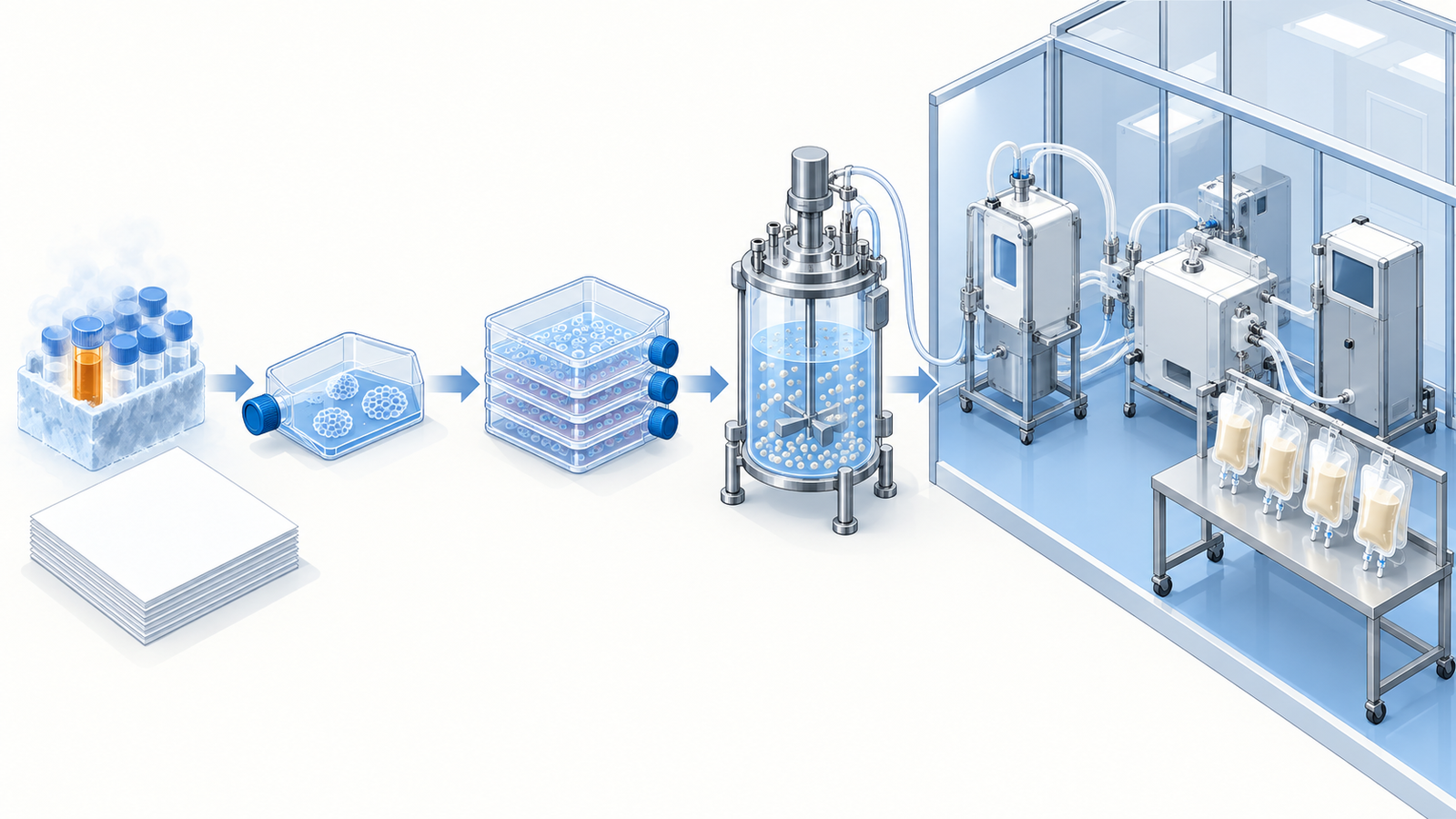
The 10-K describes the 16 suites at the Princeton plant as usable for clinical and commercial manufacture of both autologous and allogeneic therapies Sourced. Autologous therapies, made from each patient's own cells, involve many small single-patient lots handled in parallel, so capacity grows by "scaling out": lining up closed bags and small devices by the dozen. Allogeneic therapies made from iPS or other cells produce doses for many patients in one lot, so the vessel itself has to "scale up", and the surfaces cells attach to (microcarriers, multilayer flasks) and agitator designs that limit shear on the cells start to matter Not yet confirmed (this is a general explanation of cell therapy manufacturing; Catalent has not disclosed the vessels or materials it uses). The tilt of the 2026 partnerships towards iPS and ES cell-derived products means scale-up cell culture is gaining weight for the company.
11. The risks this company carries
| Risk | Substance | Category |
|---|---|---|
| Less financial transparency | Going private ended the publication of results, limiting outsiders' ability to check performance and investment progress | Sourced |
| Size of the debt | Refinanced in August 2026 with a US$4.1 billion equivalent term loan. Rated B1 by Moody's and B+ by S&P (both below investment grade, with stable outlooks) | Sourced |
| Uncertainty in the cell and gene therapy market | The 10-K risk factors say cell and gene therapy remain relatively new treatments with only a few approved to date, and may be affected by shifts in public opinion and regulation | Sourced |
| Dependence on customers' approvals | The Taysha commercial supply agreement depends on FDA approval; without approval, there is no commercial manufacturing | Sourced |
| Internal control findings (past) | The 10-K for the year to June 2024 disclosed that a material weakness in inventory reconciliation at the Baltimore, Maryland facility (identified in the year to June 2023) had been remediated, while a material weakness in inventory valuation at the Bloomington facility (now Novo Nordisk's) was still being remediated. Its status since the company went private has not been disclosed | Sourced |
| A smaller large-scale antibody business | With Bloomington transferred, antibody drug substance capacity may be smaller than before the acquisition. If growth in cell and gene therapy lags, this cannot be offset | Inference |
12. Glossary
- CDMO
- A company that develops and manufactures medicines under contract. See our explainer on CDMOs for more.
- iPS cells
- Induced pluripotent stem cells. Body cells reprogrammed by introducing genes so that they can differentiate into many cell types. See our explainer on iPS cells.
- ES cells
- Embryonic stem cells. Pluripotent stem cells derived from an early embryo.
- Autologous / allogeneic
- Autologous cell therapies use the patient's own cells; allogeneic therapies use cells from someone else (a donor or a cell line).
- CAR-T / CAR-NK
- T cells or NK cells given the gene for a receptor (CAR) that recognises cancer. See our explainer on CAR-T cells.
- AAV
- Adeno-associated virus. The most widely used "carrier" for delivering genes into the body in gene therapy. Cultured cells are used to produce it.
- GPEx
- Catalent's cell line development technology, which quickly creates animal cell lines that produce large amounts of the target antibody.
- Single-use bioreactor
- A culture tank that uses a disposable plastic bag. See our explainer on single-use systems.
- Form 10-K / 8-K
- The annual report / current report on material events that U.S.-listed companies file with the SEC.
- Enterprise value
- A measure of the value of a whole company: equity market value plus net interest-bearing debt and similar items. Used to compare acquisition prices.
13. References
- Catalent, Inc. Form 10-K for the fiscal year ended June 30, 2024 (filed with the U.S. SEC on 6 September 2024). Business description, the Biologics segment (GPEx, Madison, Princeton, Gosselies, the iPS cell site and Harmans), revenue, EBITDA and capital expenditure by segment, R&D expense, headcount, number of sites, the RheinCell and Princeton acquisitions, the merger agreement with Novo Holdings, risk factors and material weaknesses in internal control. https://www.sec.gov/Archives/edgar/data/1596783/000159678324000087/ctlt-20240630.htm
- Catalent, Inc. Form 10-K for the fiscal year ended June 30, 2020 (filed with the U.S. SEC on 31 August 2020). Timing, price and business of the Paragon and MaSTherCell acquisitions. https://www.sec.gov/Archives/edgar/data/1596783/000159678320000155/ctlt-20200630.htm
- Catalent, Inc. Form 8-K (filed with the U.S. SEC on 18 December 2024). Completion of the acquisition by Novo Holdings, cash consideration of US$63.50 per share, and the transfer of three sites to Novo Nordisk. https://www.sec.gov/Archives/edgar/data/1596783/000119312524280922/d902883d8k.htm
- Catalent, Inc. Press release "Novo Holdings to Acquire Catalent" (5 February 2024). Enterprise value of US$16.5 billion, US$63.50 per share, the plan to sell three of more than 50 sites to Novo Nordisk, and going private. https://www.catalent.com/news/novo-holdings-to-acquire-catalent
- Catalent, Inc. Press release "Novo Holdings Completes Acquisition of Catalent" (18 December 2024). Completion of the acquisition, delisting, continuation of the CEO, and a description of Novo Holdings. https://www.catalent.com/news/novo-holdings-completes-acquisition-of-catalent
- Catalent, Inc. Press release "Catalent and S.Biomedics Announce Partnership to Develop and Manufacture TED-A9" (18 February 2026). https://www.catalent.com/news/catalent-and-s-biomedics-announce-partnership-to-develop-and-manufacture-ted-a9
- Catalent, Inc. Press release "Catalent and GelMEDIX Enter Global Partnership for the Development and Clinical Manufacturing of iPSC-Derived Cell Therapies in Ocular and Retinal Diseases" (11 March 2026). https://www.catalent.com/news/catalent-and-gelmedix-enter-global-partnership-for-the-development-and-clinical-manufacturing-of-ipsc-derived-cell-therapies-in-ocular-and-retinal-diseases
- Catalent, Inc. Press release "Cartherics and Catalent Expand Commercial License Agreement" (9 April 2026). Licensing of the iPS cell line, FDA approval of its use as the starting cell, and the framework for late-phase and commercial manufacture. https://www.catalent.com/news/cartherics-and-catalent-expand-commercial-license-agreement
- Catalent, Inc. Press release "Catalent and Elpida Therapeutics Enter Strategic Partnership for Late-Phase AAV Manufacturing" (13 May 2026). https://www.catalent.com/news/catalent-and-elpida-therapeutics-enter-strategic-partnership-for-late-phase-aav-manufacturing
- Catalent, Inc. Press release "Catalent and Nanoscope Therapeutics Expand Partnership to Support Late-Phase Development and Commercial Supply of MCO-010" (7 July 2026). https://www.catalent.com/news/catalent-and-nanoscope-therapeutics-expand-partnership-to-support-late-phase-development-and-commercial-supply-of-mco-010
- Catalent, Inc. Press release "Taysha Gene Therapies and Catalent Expand Strategic Partnership to Include Future Commercial Supply" (3 August 2026). Commercial supply from the Harmans plant. https://www.catalent.com/news/taysha-gene-therapies-and-catalent-expand-strategic-partnership-to-include-future-commercial
- Catalent, Inc. Press release "Catalent Completes Successful Debt Refinancing to Support Continued Growth and Innovation" (25 August 2026). Terms of the refinancing, liquidity, credit ratings, and the company description (nearly 40 sites). https://www.catalent.com/news/catalent-completes-successful-debt-refinancing-to-support-continued-growth-and-innovation
- Catalent, Inc. Official website (source of the logo image). https://www.catalent.com/
14. Claim-to-source audit
| Claim in the article | Category | Source |
|---|---|---|
| Legal name, Delaware incorporation, founding in 1933 and current form from 2007, 2014 NYSE listing, pre-acquisition head office (Somerset) | Sourced | Reference 1 https://www.sec.gov/Archives/edgar/data/1596783/000159678324000087/ctlt-20240630.htm |
| Acquisition agreement (5 February 2024, US$63.50 per share, enterprise value US$16.5 billion, plan to sell three sites to Novo Nordisk) | Sourced | Reference 4 https://www.catalent.com/news/novo-holdings-to-acquire-catalent |
| Completion of the acquisition (18 December 2024) and transfer of three sites (Anagni, Bloomington and Brussels) | Sourced | Reference 3 https://www.sec.gov/Archives/edgar/data/1596783/000119312524280922/d902883d8k.htm |
| Delisting, continuation of the CEO, and the relationship between Novo Holdings and Novo Nordisk | Sourced | Reference 5 https://www.catalent.com/news/novo-holdings-completes-acquisition-of-catalent |
| Revenue for the years to June 2023 and 2024; Biologics revenue, EBITDA, revenue share and capital expenditure; R&D expense | Sourced | Reference 1 https://www.sec.gov/Archives/edgar/data/1596783/000159678324000087/ctlt-20240630.htm |
| About 16,900 employees, 53 sites (17 in Biologics), more than US$3.6 billion invested in Biologics | Sourced | Reference 1 https://www.sec.gov/Archives/edgar/data/1596783/000159678324000087/ctlt-20240630.htm |
| GPEx (more than 1,200 cell lines), single-use bioreactors at Madison, 16 suites at Princeton, Gosselies, the iPS cell site, 18 suites at Harmans, UpTempo | Sourced | Reference 1 https://www.sec.gov/Archives/edgar/data/1596783/000159678324000087/ctlt-20240630.htm |
| Acquisitions of RheinCell (August 2021, US$26 million) and the Princeton plant (April 2022, US$45 million, long-term supply agreement with Erytech) | Sourced | Reference 1 https://www.sec.gov/Archives/edgar/data/1596783/000159678324000087/ctlt-20240630.htm |
| Acquisitions of Paragon (May 2019, about US$1.19 billion, gene therapy) and MaSTherCell (February 2020, about US$320 million, cell therapy) | Sourced | Reference 2 https://www.sec.gov/Archives/edgar/data/1596783/000159678320000155/ctlt-20200630.htm |
| Partnership with S.Biomedics on TED-A9 | Sourced | Reference 6 https://www.catalent.com/news/catalent-and-s-biomedics-announce-partnership-to-develop-and-manufacture-ted-a9 |
| Partnership with GelMEDIX on iPS cell-derived cell therapies | Sourced | Reference 7 https://www.catalent.com/news/catalent-and-gelmedix-enter-global-partnership-for-the-development-and-clinical-manufacturing-of-ipsc-derived-cell-therapies-in-ocular-and-retinal-diseases |
| iPS cell line licence to Cartherics, FDA approval, and the framework for late-phase and commercial manufacture | Sourced | Reference 8 https://www.catalent.com/news/cartherics-and-catalent-expand-commercial-license-agreement |
| Late-phase manufacture and exclusive manufacturing rights with Elpida | Sourced | Reference 9 https://www.catalent.com/news/catalent-and-elpida-therapeutics-enter-strategic-partnership-for-late-phase-aav-manufacturing |
| Commercial packaging and distribution of Nanoscope's MCO-010 | Sourced | Reference 10 https://www.catalent.com/news/catalent-and-nanoscope-therapeutics-expand-partnership-to-support-late-phase-development-and-commercial-supply-of-mco-010 |
| Commercial supply agreement for Taysha's TSHA-102 (after approval, at Harmans) | Not yet confirmed | Reference 11. Future supply that depends on FDA approval https://www.catalent.com/news/taysha-gene-therapies-and-catalent-expand-strategic-partnership-to-include-future-commercial |
| Refinancing (US$4.1 billion equivalent term loan, US$600 million credit facility, about US$1.1 billion of liquidity, credit ratings) and nearly 40 sites | Sourced | Reference 12 https://www.catalent.com/news/catalent-completes-successful-debt-refinancing-to-support-continued-growth-and-innovation |
| Cell and gene therapy risk factors; material weaknesses in internal control at the Baltimore and Bloomington facilities and their remediation status | Sourced | Reference 1 https://www.sec.gov/Archives/edgar/data/1596783/000159678324000087/ctlt-20240630.htm |
| Biologics at about 45% of revenue (1,952 / 4,381) | Our calculation | Checked in this article against the figures in reference 1; matches the company's disclosed figure (45%, before inter-segment eliminations) |
| Revenue, profit and headcount since going private; investment plans in cell and gene therapy; how the number of sites fell; whether the head office has moved | Not yet confirmed | None is officially disclosed, and this article makes no estimate |
| Joint research with universities and research institutes in cell culture | Not yet confirmed | Not in reference 1 or the 2026 official releases. This article does not conclude that none exists https://www.sec.gov/Archives/edgar/data/1596783/000159678324000087/ctlt-20240630.htm |
| The three types (CDMO; tools, consumables and media; cell and regenerative therapy) | Our calculation | Our own classification. Companies shown are examples from the 20 in this series |
| The reading that the growth pillar since going private is cell and gene therapy | Inference | This article's interpretation of the mix of 2026 official releases |
| The reading that the focus is on allogeneic cells derived from pluripotent stem cells | Inference | This article's interpretation of the three 2026 cell therapy deals and the RheinCell acquisition |
| The reading that large-scale antibody drug substance work carries less weight, and the associated risk | Inference | This article's interpretation of the Bloomington transfer and the content of the 2026 official releases |
| The reading that in gene therapy the company is going after commercial supply after approval | Inference | This article's interpretation of the Taysha and Elpida agreements |
| The reading that it is trying to repeat with iPS cells the model of using cell line licensing as the entry point to manufacturing | Not yet confirmed | This article's interpretation of the Cartherics and GelMEDIX agreements |
| The explanation that autologous (scale-out) and allogeneic (scale-up) therapies need different culture vessels | Not yet confirmed | A general explanation by this article, not based on Catalent's disclosures |
Last updated 24 September 2026 / Troy Technical
The figures in this article come from the statutory filings Catalent, Inc. made with the U.S. Securities and Exchange Commission (SEC) before going private and from Catalent's official press releases. No research-firm estimates or press-based figures have been used. Passages marked "Inference" are this article's interpretation of primary sources, not statements made by the company.