COMPANY PROFILE / CELL CULTURE TECHNOLOGY
Cytiva
Danaher's dedicated bioprocess supplier, delivering everything from media and bioreactors to whole factories
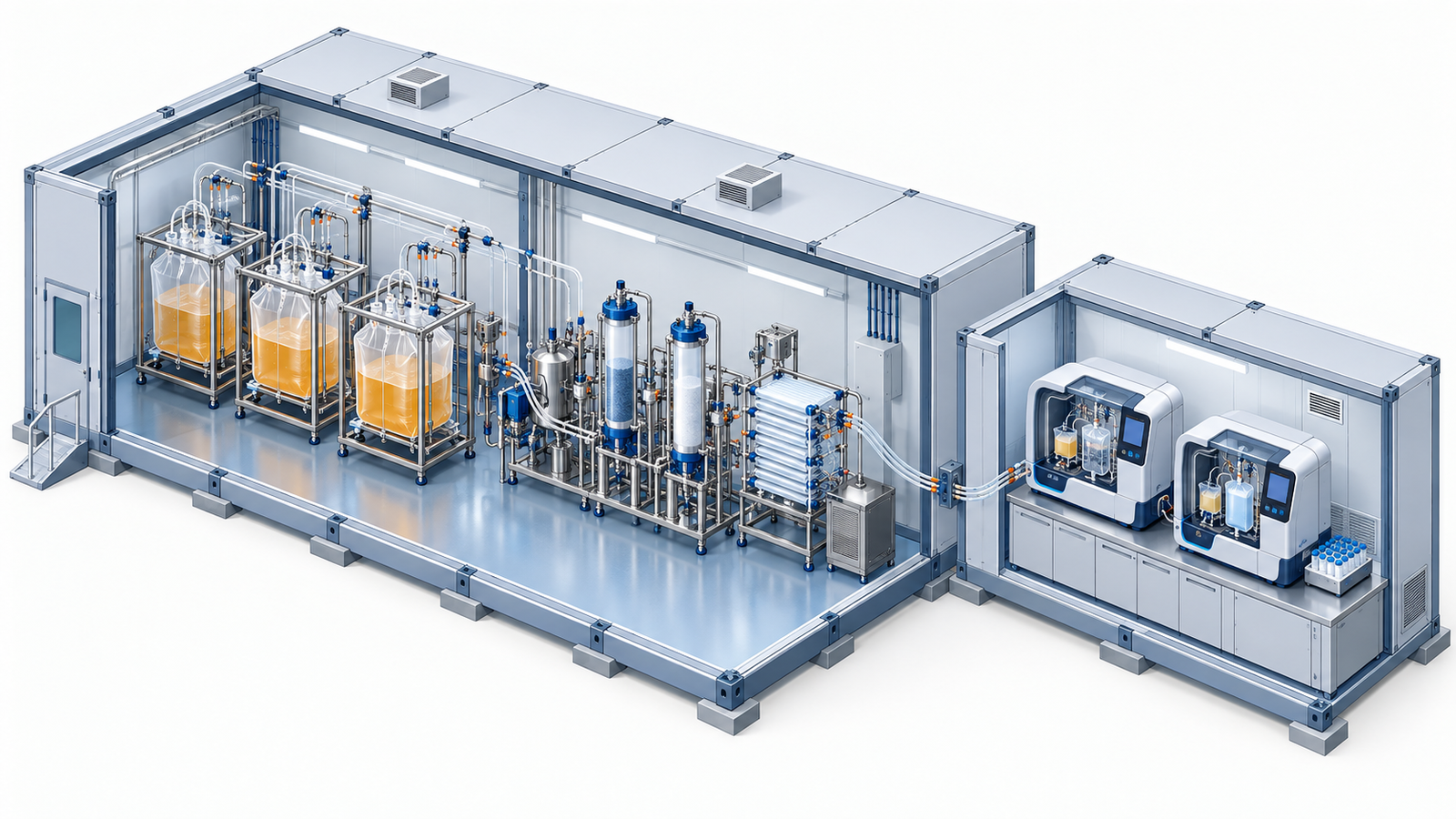
Cytiva was created when Danaher of the United States bought GE's biopharma business in 2020 for about US$20.7 billion. Because it is not listed, it publishes no accounts of its own, and the only window onto its numbers is its parent Danaher's "Biotechnology" segment. That segment had revenue of US$7,293 million in 2025, and in its 10-K Danaher says it expects bioprocessing to keep growing in 2026 at a pace similar to 2025. Beyond the equipment and consumables used to culture and purify antibody drugs, Cytiva offers FlexFactory, which delivers an entire single-use factory, and Sefia, a system that automates the manufacture of CAR-T cells. This profile concentrates on what Cytiva is putting into cell culture, who it is working with and what it is aiming for, and keeps what can be confirmed from the parent's filings separate from Cytiva's own announcements.
- Cytiva in 30 seconds, and where it stands in cell culture
- The logo and how the name is written
- Where the company sits in the cell culture field
- Scale (as seen through the parent's filings)
- Resources committed to cell culture
- What it has done so far
- What comes next
- What the company is aiming for in cell culture
- Map of cell culture partnerships
- Technologies, products and services
- The risks this company carries
- Glossary, references and claim-to-source audit
1. Cytiva in 30 seconds, and where it stands in cell culture
41 countries36 manufacturing sites, 23 R&D and innovation sites
US$7,293 million2025 revenue. Includes businesses other than Cytiva
150 unitsCumulative number delivered as of April 2024 (company announcement)
Companies involved in cell culture fall into three broad types: contract development and manufacturing organisations (CDMOs), suppliers of tools, consumables and media, and developers of cell and regenerative therapies. Cytiva is a supplier. Danaher's 10-K says the bioprocessing business's offering includes "cell line and cell culture media development services; cell culture media, process liquids and buffers for manufacturing, chromatography resins, filtration technologies, aseptic fill finish, as well as single-use hardware and consumables and services such as the design and installation of full manufacturing suites". Nowhere does it say that the business manufactures drugs for others under contract Sourced. As our Thermo Fisher profile shows, that company also runs a contract manufacturing arm. Cytiva, by contrast, stays out of manufacturing and sells tools and factories to the companies that do the making (drug makers and CDMOs). Of the two meanings of "cell culture" (1) growing animal cells to produce antibodies and other biologics and (2) cell therapy, where the cells themselves are the product, Cytiva sells into both.
2. The logo and how the name is written

The Cytiva logo is a trademark of the company (its press releases state that "Cytiva and the drop logo are trademarks of Global Life Sciences Solutions USA LLC or an affiliate").
We have not recreated it with generated imagery; the file img/cytiva_logo.svg is an image taken from the company's official website.
A note on names: Cytiva is a brand and business name, not the name of a legal entity. Press releases describe it as "Cytiva (Global Life Sciences Solutions USA, LLC), a Danaher company". At the time of the 2020 acquisition it was "the Biopharma business of GE's Life Sciences division". In 2023 the life sciences business of Pall Corporation, another Danaher company, was folded into Cytiva, so Pall's former products for biopharmaceuticals now also sit under the Cytiva brand. This article uses "Cytiva" throughout.
https://www.cytivalifesciences.com/en/us/about-us3. Where the company sits in the cell culture field
For Cytiva, the CDMOs on the left are not competitors but major customers. As shown later, CDMOs such as AGC Biologics in Japan and Chime Biologics in China have announced that they have installed Cytiva's complete factory set-ups or large bioreactors Sourced.
4. Scale (as seen through the parent's filings)
Cytiva is a subsidiary of Danaher, and none of its revenue, profit, R&D spending or capital expenditure is disclosed on its own Not yet confirmed. The tables below come from Danaher's statutory filings and show the whole company and the Biotechnology segment, which includes Cytiva. The Biotechnology segment, however, is made up of two businesses, "bioprocessing" and "discovery and medical" (research purification and analysis instruments, medical filtration and so on), so its figures match neither Cytiva's revenue nor that of the bioprocessing business. Revenue for the bioprocessing business alone is not disclosed either.
| Danaher as a whole | Year to Dec 2023 | Year to Dec 2024 | Year to Dec 2025 |
|---|---|---|---|
| Sales (US$ million) | 23,890 | 23,875 | 24,568 |
| R&D expenses (US$ million) | 1,503 | 1,584 | 1,598 |
| Employees | - | - | About 60,000 |
| Biotechnology segment (US$ million) | 2023 | 2024 | 2025 | Jan to Jun 2026 |
|---|---|---|---|---|
| Sales | 7,172 | 6,759 | 7,293 | 3,717 (prior-year period 3,462) |
| Operating profit | 1,909 | 1,685 | 1,864 | 1,090 (prior-year period 972) |
| Operating margin | 26.6% | 24.9% | 25.6% | 29.3% (prior-year period 28.1%) |
| Capital expenditure (total) | 417 | 447 | 370 | - |
| Sales growth (core, excluding currency and other effects) | - | -6.0% (-4.5%) | +8.0% (+6.5%) | +7.5% |
Sources: Danaher Form 10-K for the year to December 2025 (segment information) and Form 10-Q for the quarter ended June 2026.
The Biotechnology segment accounted for about 29.7% of Danaher's 2025 sales Our calculation (7,293 ÷ 24,568). The 10-K explains that the segment's growth in 2025 "was led by high-single digit increases in core sales in the bioprocessing business and was primarily driven by improved consumables demand from large pharmaceutical and CDMO customers, partially offset by lower year-over-year demand for equipment" Sourced. That growth was driven not by equipment such as bioreactors but by consumables bought again and again, such as media, resins and bags, which says a great deal about the nature of this business.
On its corporate profile page Cytiva describes itself as having about 15,000 people in 41 countries, with 36 manufacturing sites and 23 R&D and innovation sites Sourced. These are not audited figures but the company's own description.
5. Resources committed to cell culture
| Resource | What primary sources confirm | Status |
|---|---|---|
| People (organisation) | Cytiva has a president of its Genomic Medicine business (quoted in the Sefia and CEVEC announcements), a chief technology officer and a chief operating officer. About 15,000 people company-wide (corporate profile) | Organisation confirmed. Dedicated headcount for cell culture or cell therapy not disclosed |
| Money (capital expenditure) | US$1.6 billion of capacity investment since 2019 (continuing to 2028). For media, capacity for powder and liquid media in Logan, Utah has been expanded, with a further 73,850 square feet to be added by 2026. In the parent's filings, Biotechnology segment capital expenditure was US$370 million (2025) | Confirmed (the amount for media alone is not disclosed) |
| Money (R&D) | US$1,598 million for Danaher as a whole (2025). R&D by segment, or for Cytiva alone | Not disclosed |
| Investments and acquisitions | Acquired CEVEC Pharmaceuticals (Cologne, Germany, October 2022; producer cell line technology for viral vectors; 46 staff). The price is not given in the press release. On the parent's side, Cytiva itself was bought in 2020 for about US$20.7 billion | Confirmed (the CEVEC price is not disclosed) |
| Universities and research institutions | Joint research with the San Raffaele Telethon Institute for Gene Therapy (SR-TIGET, Italy) under the "Danaher Beacon" framework (March 2026). Leads in vivo CAR-T research funded by the U.S. agency ARPA-H, with IGI, UCSF, UC Berkeley, Stanford and Ohio State University expected to take part (October 2025) | Confirmed |
| Relationships with start-ups | A robotic manufacturing collaboration with Cellular Origins (a TTP group company). No investment (corporate venture capital) in cell culture start-ups is mentioned in the material we read | Investments not mentioned (we do not conclude that none exists) |
The breakdown of the US$1.6 billion shows the money spread widely across both the upstream side of culture (media and single-use bags) and the downstream side (resins and filtration) Sourced. The company reports that capacity at its chromatography resin plant in Uppsala, Sweden has roughly doubled; single-use bag capacity has tripled in Beijing and doubled in Duncan, South Carolina; and filtration capacity has risen by 20% in Pensacola, Florida, by 33% in Fajardo, Puerto Rico and by 81% in Ilfracombe, England. The company describes this as a policy of "in-region, for region": making products in a region to supply that region.
6. What it has done so far
| When | What happened | Why it matters |
|---|---|---|
| March 2020 | Danaher acquires the Biopharma business of GE's Life Sciences division for about US$20.7 billion in cash plus the assumption of about US$0.4 billion of pension liabilities. It is launched as Cytiva | The 10-K states that it was, at the time, Danaher's largest acquisition to date by purchase price |
| October 2022 | Acquires CEVEC Pharmaceuticals, gaining ELEVECTA, a producer cell line technology for AAV and adenovirus | Secures the very "cells that do the culturing" for gene therapy viral vectors |
| May 2023 | Completes integration with Pall's life sciences business, creating an organisation of about 16,000 people in 40 countries. Pall's former bioprocess products (Allegro, iCELLis, Kleenpak and others) join Cytiva's range | Culture (Cytiva) and filtration (Pall) products come under a single sales and service organisation |
| August 2023 | Genepeutic Bio in Thailand uses FlexFactory to build Thailand's first GMP-certified cell therapy manufacturing facility (600 square metres) | Supplies complete plants for cell therapy too |
| April 2024 | AGC Biologics adopts two FlexFactory platforms for its new plant in Yokohama. Xuri, Sepax C-Pro, VIA Freeze and other equipment are also supplied for its cell therapy services. FlexFactory deliveries reach 150 in total | A large supply deal with a Japanese CDMO |
| May 2024 | Unveils Sefia, a platform that automates CAR-T cell manufacturing, developed in collaboration with Kite (a Gilead company) | Moves cell therapy manufacturing from manual work to machines |
| January 2025 | Collaborates with Cellular Origins to connect Sefia to a robotic manufacturing platform | Aims to "industrialise" cell therapy |
| June 2025 | Announces that the main projects in US$1.6 billion of capital investment since 2019 are largely complete. The U.S. resin plant is due to reach full operation in 2028 | Supply capacity and geographic spread |
| October 2025 | Selected for the EMBODY programme of the U.S. agency ARPA-H. Leads development of non-viral technology to make CAR-T cells directly inside the body (in vivo) | A move towards therapies that do not culture cells outside the body |
| March 2026 | Joint research with SR-TIGET (Danaher Beacon). FlexFactory contract with Yoshindo of Toyama, Japan | A European research institute, and biosimilar manufacturing in Japan |
| May to June 2026 | Announces that the ELEVECTA transient cell line has received FDA Advanced Manufacturing Technology (AMT) designation. Chime Biologics in China installs eight 2,000-litre Xcellerex single-use bioreactors at its new plant in Wuhan | Both the upstream side of gene therapy and large-scale culture for antibody drugs |
7. What comes next
much as in 2025Assumes consumables for antibody drugs keep growing (10-K)
to start in 2026At an innovation hub that doubles as a manufacturing site
On the customer side, Yoshindo plans to begin supplying biosimilars from its own plant in Toyama from 2028 onwards, and has announced that the plant will use FlexFactory Sourced. The same press release gives a forecast for the size of Japan's biosimilar market, but it is an estimate by a research firm (Fuji Keizai), so we do not use it.
None of the following appears in the Danaher 10-K and 10-Q or the Cytiva press releases we read Not yet confirmed.
Revenue or profit targets for Cytiva alone; revenue or unit sales for cell therapy products such as Sefia; the price paid for CEVEC; the amount of funding from ARPA-H; and how much of the US$1.6 billion went to media or cell therapy. The corporate profile page says Cytiva solutions are used in six of the seven approved CAR-T products, but it gives no date for that statement, and the May 2024 press release counts ten approved autologous CAR-T products, so this article does not treat the figure as current.
8. What the company is aiming for in cell culture
This section goes beyond what the company says directly. It sets out inferences that can be drawn from primary sources, each with its basis.
| What can be read | Primary evidence behind it | Category |
|---|---|---|
| By selling whole factories rather than individual products, it locks in long-term demand for consumables | The 10-K includes "the design and installation of full manufacturing suites" in the business, and FlexFactory deliveries total 150. Chime Biologics has kept expanding its plants through a collaboration spanning ten years | Inference |
| The parent sees steady growth in consumables as the mainstay of earnings | The 10-K attributes the 2025 growth to consumables and assumes growth in consumables for antibody drugs in 2026 as well | Sourced |
| In cell therapy, it aims to capture the automation and industrialisation of manufacturing | Sefia (automation) and the Cellular Origins collaboration (scaling from thousands of doses a year to hundreds of thousands) | Inference |
| At the same time, it is also placing a bet on therapies that do not culture cells outside the body (in vivo CAR-T) | It leads ARPA-H's EMBODY programme, whose stated goal is to do away with the ex vivo steps of autologous CAR-T | Inference |
| In gene therapy, it wants to own the "cells that do the culturing" through its own technology | The acquisition of CEVEC (producer cell lines) and the later announcement of FDA AMT designation for ELEVECTA | Inference |
Two of Cytiva's moves look contradictory at first sight. With Sefia, it sells equipment that automates "CAR-T manufacturing in which the patient's cells are expanded outside the body". Yet in the ARPA-H research it leads the development of technology to "make CAR-T cells inside the body without taking the cells out", and says it aims to cut manufacturing costs to one-tenth of today's level Sourced. If the second succeeds, demand for the first kind of equipment could fall. Our reading is that Cytiva is betting on both so that it remains a supplier whichever way cell therapy manufacturing goes Not yet confirmed. Even the in vivo approach still requires the gene delivery material injected into the body to be manufactured (lipid nanoparticles, or LNPs, in the ARPA-H research). How the company itself sees the relationship between the two has not been made public, however.
9. Map of cell culture partnerships
Two of the companies on the right of the map, AGC Biologics and Yoshindo, are Japanese. Official company announcements confirm that Cytiva's complete factory set-ups are being used to bring new biopharmaceutical plants into operation in Japan Sourced.
10. Technologies, products and services
| Area | Main products and services (as described in press releases and the 10-K) | (1) Biologics / (2) Cell therapy |
|---|---|---|
| Media | Powder and liquid media (made in Logan, Utah for North America). The 10-K lists media, process liquids and buffers, and "cell line and cell culture media development services" | (1) (2) |
| Bioreactors | Xcellerex (single-use bioreactors; Chime Biologics installed eight of the 2,000-litre model) and Xuri (one of the main systems supplied for AGC Biologics' cell therapy services) | (1) (Xcellerex), (2) (Xuri) |
| Complete factories | FlexFactory (modular manufacturing built on standardised single-use equipment; 150 delivered as of April 2024) and KUBio (modular factory buildings) | (1) (2) |
| Purification and filtration | Chromatography resins (made in Uppsala, Sweden and Muskegon, Michigan) and filtration membranes and devices (made in Pensacola, Fajardo in Puerto Rico and Ilfracombe in England). Pall's former bioprocess products have also joined the Cytiva range | (1) |
| Cell therapy manufacturing equipment | Sefia (Sefia Select for cell isolation, recovery and formulation; Sefia expansion for activation, gene transfer and expansion), Sepax C-Pro, VIA Freeze and VIA Thaw (freezing and thawing) and Chronicle (manufacturing management software) | (2) |
| Upstream gene therapy | ELEVECTA (producer cell lines for AAV and adenovirus, and a transient cell line for AAV) and CAP-branded technologies (formerly CEVEC) | (2) (vector manufacturing) |
The company says Sefia is designed to allow up to 50% more manufacturing runs a year than the industry standard Sourced. It does not, however, define what that "industry standard" is, and this is the company's own design claim.
The May 2026 ELEVECTA press release discusses host cell DNA, a problem in AAV vector manufacturing, explaining that once it is packaged inside the viral shell (the capsid), downstream purification cannot remove it effectively. It then claims that the company's transient cell line reduces host cell DNA inside the capsid by up to 99% compared with commercially available cell lines Sourced.
Translated into the language of materials, this is the same situation as "impurities trapped inside a particle cannot be washed off its surface". For antibody drugs, much of the quality can be built in downstream, through purification (resins and filtration); for viral vectors, the upstream choice of which cells to make them in determines quality. We read this as part of the reason why Cytiva, although a leader in resins and filtration, bought a cell line company (CEVEC) in 2022 Not yet confirmed. Our explainers on viral vectors and on GMP also cover the difference between upstream and downstream quality control.
11. The risks this company carries
| Risk | Substance | Category |
|---|---|---|
| Revenue swings sharply from year to year | Biotechnology segment sales fell 6.0% in 2024 and rose 8.0% in 2025, reflecting waves in customers' inventories and orders | Sourced |
| Timing of shipments to large customers | The 10-Q for April to June 2026 refers to the impact of "certain large commercial customers moving the timing of shipments out of the quarter" | Sourced |
| Weak equipment demand | In 2025 consumables grew but equipment demand was lower than the year before. When the wave of new plant construction stops, equipment sales fall | Sourced |
| Tariffs and China | Danaher incurred incremental tariff costs of less than US$300 million in 2025. Danaher's total sales in China fell from US$3.14 billion in 2023 to US$2.63 billion in 2025 | Sourced |
| Impairments | In 2025 the Biotechnology segment recorded impairments of technology, other intangible assets and a facility (US$101 million) | Sourced |
| A shift in how cell therapies are made | If in vivo CAR-T reaches practical use, demand for equipment used in ex vivo culture (such as Sefia) could fall. Cytiva itself is leading that research | Inference |
| Hard to verify from outside | Neither Cytiva's own financials nor its cell therapy revenue are disclosed, and the parent's segment includes other businesses | Not yet confirmed |
12. Glossary
- Bioprocessing
- The full sequence of steps from culturing cells to make a medicine through to purifying it into a finished product.
- Culture media
- The liquids (or powders dissolved before use) that nourish cells. See our explainer on cell culture media for more.
- Single-use systems
- An approach in which culture bags and fluid paths are disposable, removing the need for cleaning and sterilisation. See also our explainer on single-use systems.
- FlexFactory
- A Cytiva trademark. Modular drug manufacturing facilities built by combining standardised single-use equipment.
- Protein A resin
- A chromatography material that selectively binds antibodies. Used in the first step of antibody drug purification.
- CAR-T cell therapy
- A treatment in which a patient's T cells are genetically modified to attack cancer. See our explainer on CAR-T cells for more.
- In vivo CAR-T
- An approach in which CAR-T cells are made inside the body using injected gene delivery material, without taking cells out. At the research stage.
- AAV
- Adeno-associated virus. Widely used as a vector to carry genes in gene therapy.
- CDMO
- A company that develops and manufactures drugs under contract. For Cytiva, a major customer. See also our explainer on CDMOs.
- AMT designation
- The U.S. FDA's Advanced Manufacturing Technology designation. Granted to a manufacturing technology independently of any specific application.
13. References
- Danaher Corporation Form 10-K for the fiscal year ended December 31, 2025 (filed with the U.S. SEC on 24 February 2026). Description, sales, operating profit and capital expenditure of the Biotechnology segment; company-wide sales, R&D expenses and headcount; the 2026 assumptions; tariffs, impairments and sales in China. https://www.sec.gov/Archives/edgar/data/313616/000031361626000062/dhr-20251231.htm
- Danaher Corporation Form 10-Q for the quarterly period ended June 26, 2026 (filed with the U.S. SEC on 21 July 2026). Biotechnology segment results and commentary for January to June 2026. https://www.sec.gov/Archives/edgar/data/313616/000031361626000161/dhr-20260626.htm
- Danaher Corporation Form 10-K for the fiscal year ended December 31, 2020 (filed with the U.S. SEC on 25 February 2021). Acquisition date and price of Cytiva (the GE Biopharma business), the assumption of pension liabilities, and its status as the largest acquisition to date. https://www.sec.gov/Archives/edgar/data/313616/000031361621000045/dhr-20201231.htm
- Cytiva About us (corporate profile page, accessed September 2026). Headcount, number of countries, manufacturing sites and R&D sites. https://www.cytivalifesciences.com/en/us/about-us
- Cytiva "Cytiva completing 1.6 billion USD in strategic investments to further enhance global supply chain and customer benefits" (11 June 2025). https://www.cytivalifesciences.com/en/us/about-us/newsroom/cytiva-completing-1-6-billion-usd-in-strategic-investments
- Cytiva "Cytiva and Pall Life Sciences complete integration to create a global innovation and solutions leader in biotechnology" (2 May 2023). https://www.cytivalifesciences.com/en/us/about-us/newsroom/cytiva-and-pall-life-sciences-complete-integration
- Cytiva "Cytiva strengthens cell line development with CEVEC acquisition" (6 October 2022). https://www.cytivalifesciences.com/en/us/about-us/newsroom/cytiva-strengthens-cell-line-development-with-cevec-acquisition
- Cytiva "Innovation and automation are driving forces behind next generation cell therapy manufacturing platform from Cytiva" (29 May 2024). Sefia. https://www.cytivalifesciences.com/en/us/about-us/newsroom/cytiva-unveils-new-cell-therapy-manufacturing-platform
- Cytiva "Cellular Origins and Cytiva are collaborating to deliver automated robotic manufacturing capabilities for cell and gene therapies" (16 January 2025). https://www.cytivalifesciences.com/en/us/about-us/newsroom/cellular-origins-collaboration
- Cytiva "Cytiva receives ARPA-H award with ambition to help transform CAR-T cell therapy for solid tumors" (7 October 2025). https://www.cytivalifesciences.com/en/us/about-us/newsroom/cytiva-receives-arpa-h-award
- Cytiva "Cytiva and San Raffaele Telethon Institute for Gene Therapy launch collaboration to advance next-generation genomic medicine platforms" (23 March 2026). https://www.cytivalifesciences.com/en/us/about-us/newsroom/cytiva-part-of-new-danaher-beacon-formed-to-advance-next-generation-medicine-platforms
- Cytiva "AGC Biologics selects Cytiva to provide FlexFactory platforms in new biomanufacturing facility in Japan" (18 April 2024). https://www.cytivalifesciences.com/en/us/about-us/newsroom/agc-selects-cytiva-flexfactory
- Cytiva "Cytiva helps Genepeutic Bio install first GMP-certified cell therapy facility in Thailand" (3 August 2023). https://www.cytivalifesciences.com/en/us/about-us/newsroom/cytiva-helps-genepeutic-bio-install-a-cell-therapy-facility-in-thailand
- Cytiva "Cytiva and Yoshindo advance domestic biosimilar manufacturing in Japan through FlexFactory collaboration" (23 March 2026). The market size forecast it cites (from Fuji Keizai) is a research-firm estimate and is not used in this article. https://www.cytivalifesciences.com/en/us/about-us/newsroom/cytiva-and-yoshindo-advance-domestic-biosimilar-manufacturing-in-japan
- Cytiva "Chime Biologics deepens collaboration with Cytiva to boost manufacturing capacity" (8 June 2026). https://www.cytivalifesciences.com/en/us/about-us/newsroom/chime-biologics-deepens-collaboration-with-cytiva
- Cytiva "Cytiva’s ELEVECTA transient cell line receives advanced manufacturing technology (AMT) designation from the FDA" (13 May 2026). https://www.cytivalifesciences.com/en/us/about-us/newsroom/cytiva-receives-amt-designation-from-fda
14. Claim-to-source audit
| Claim in the article | Category | Source |
|---|---|---|
| Danaher's head office and listing, and the make-up (bioprocessing plus discovery and medical) and activities of the Biotechnology segment | Sourced | Reference 1 https://www.sec.gov/Archives/edgar/data/313616/000031361626000062/dhr-20251231.htm |
| Danaher's total sales and R&D expenses (2023 to 2025), and about 60,000 employees | Sourced | Reference 1 https://www.sec.gov/Archives/edgar/data/313616/000031361626000062/dhr-20251231.htm |
| Biotechnology segment sales, operating profit, margin, capital expenditure and growth rates (2023 to 2025), and the reasons for the 2025 increase (consumables up, equipment down) | Sourced | Reference 1 https://www.sec.gov/Archives/edgar/data/313616/000031361626000062/dhr-20251231.htm |
| Biotechnology segment results for January to June 2026, and the shift in shipment timing by large customers | Sourced | Reference 2 https://www.sec.gov/Archives/edgar/data/313616/000031361626000161/dhr-20260626.htm |
| The assumption that bioprocessing grows in 2026 much as in 2025, with consumables for antibody drugs growing | Sourced | Reference 1 https://www.sec.gov/Archives/edgar/data/313616/000031361626000062/dhr-20251231.htm |
| The Biotechnology segment at about 29.7% of sales | Our calculation | Calculated by this article from figures in Reference 1 |
| The Cytiva acquisition (31 March 2020, about US$20.7 billion in cash, about US$0.4 billion of pension liabilities, the largest acquisition to date) | Sourced | Reference 3 https://www.sec.gov/Archives/edgar/data/313616/000031361621000045/dhr-20201231.htm |
| About 15,000 people, 41 countries, 36 manufacturing sites and 23 R&D sites, and the statement about six of seven approved CAR-T products | Sourced | Reference 4 https://www.cytivalifesciences.com/en/us/about-us |
| US$1.6 billion invested since 2019, the capacity increases at each site, the Logan media plant expansion, the Muskegon hiring plan, filtration manufacturing in South Korea, and "in-region, for region" | Sourced | Reference 5 https://www.cytivalifesciences.com/en/us/about-us/newsroom/cytiva-completing-1-6-billion-usd-in-strategic-investments |
| Integration of Pall's life sciences business (May 2023, about 16,000 people in 40 countries, former Pall product brands) | Sourced | Reference 6 https://www.cytivalifesciences.com/en/us/about-us/newsroom/cytiva-and-pall-life-sciences-complete-integration |
| The CEVEC acquisition (October 2022, 46 staff, ELEVECTA and CAP) | Sourced | Reference 7 https://www.cytivalifesciences.com/en/us/about-us/newsroom/cytiva-strengthens-cell-line-development-with-cevec-acquisition |
| Sefia's components, the collaboration with Kite, the design claim of up to 50% more runs, and the count of ten approved autologous CAR-T products | Sourced | Reference 8 https://www.cytivalifesciences.com/en/us/about-us/newsroom/cytiva-unveils-new-cell-therapy-manufacturing-platform |
| The Cellular Origins collaboration and the description of scaling from thousands to hundreds of thousands of doses a year | Sourced | Reference 9 https://www.cytivalifesciences.com/en/us/about-us/newsroom/cellular-origins-collaboration |
| Selection for ARPA-H EMBODY, the universities expected to take part, and the target of one-tenth the manufacturing cost | Sourced | Reference 10 https://www.cytivalifesciences.com/en/us/about-us/newsroom/cytiva-receives-arpa-h-award |
| Danaher Beacon with SR-TIGET | Sourced | Reference 11 https://www.cytivalifesciences.com/en/us/about-us/newsroom/cytiva-part-of-new-danaher-beacon-formed-to-advance-next-generation-medicine-platforms |
| Two FlexFactory platforms and cell therapy equipment for AGC Biologics' Yokohama plant, and 150 delivered in total | Sourced | Reference 12 https://www.cytivalifesciences.com/en/us/about-us/newsroom/agc-selects-cytiva-flexfactory |
| Genepeutic Bio's first GMP-certified cell therapy facility in Thailand | Sourced | Reference 13 https://www.cytivalifesciences.com/en/us/about-us/newsroom/cytiva-helps-genepeutic-bio-install-a-cell-therapy-facility-in-thailand |
| The FlexFactory contract with Yoshindo and its plan to supply from 2028 onwards | Sourced | Reference 14 https://www.cytivalifesciences.com/en/us/about-us/newsroom/cytiva-and-yoshindo-advance-domestic-biosimilar-manufacturing-in-japan |
| Chime Biologics' GMP-2 plant in Wuhan (eight 2,000-litre Xcellerex units, a ten-year collaboration) | Sourced | Reference 15 https://www.cytivalifesciences.com/en/us/about-us/newsroom/chime-biologics-deepens-collaboration-with-cytiva |
| FDA AMT designation for the ELEVECTA transient cell line, and the claim of up to 99% less host cell DNA | Sourced | Reference 16 https://www.cytivalifesciences.com/en/us/about-us/newsroom/cytiva-receives-amt-designation-from-fda |
| Tariff costs, the trend in sales in China, and impairments in the Biotechnology segment | Sourced | Reference 1 https://www.sec.gov/Archives/edgar/data/313616/000031361626000062/dhr-20251231.htm |
| The three types of cell culture company, and placing Cytiva among the suppliers | Our calculation | Our own classification. Companies shown are examples from the 20 in this series |
| Cytiva's own financials, revenue of the bioprocessing business alone, cell therapy revenue, the CEVEC price and the ARPA-H funding amount | Not yet confirmed | Not in References 1, 2, 7 or 10. This article makes no estimate https://www.sec.gov/Archives/edgar/data/313616/000031361626000062/dhr-20251231.htm |
| Investments in cell culture start-ups | Not yet confirmed | Not in the sources we read. This article does not conclude that none exists https://www.sec.gov/Archives/edgar/data/313616/000031361626000062/dhr-20251231.htm |
| The readings about selling whole factories, automation and industrialisation, hedging with in vivo, and owning the cell lines | Inference | This article's interpretation of statements in References 1, 5, 7, 8, 9, 10, 15 and 16 |
| The risk that in vivo CAR-T reduces demand for equipment | Inference | This article's interpretation of statements in References 8 and 10 |
| The materials explanation of impurities inside the capsid and upstream quality control | Not yet confirmed | This article's commentary on the facts in Reference 16 |
Last updated 24 September 2026 / Troy Technical
The figures in this article are based on statutory filings made by the parent company, Danaher Corporation, with the U.S. Securities and Exchange Commission (SEC), and on Cytiva's official newsroom and corporate profile page. No research-firm estimates or press-based figures have been used (including the research-firm market forecast quoted in a Cytiva press release). Passages marked "Inference" are this article's interpretation of primary sources, not statements made by the company.