COMPANY PROFILE / CELL CULTURE TECHNOLOGY
Takara Bio
A company spanning reagents, CDMO and cell therapy pulls out of cell processing in 2026
Takara Bio was created in 2002 by spinning off the biotechnology division of Takara Shuzo (now Takara Holdings), and research reagents account for 70% of its sales. On top of that, it built a contract development and manufacturing (CDMO) business for gene and cell therapies and developed its own gene-modified T cell therapies. But after an operating loss of ¥4,688 million in the year to March 2026 and a tender offer by its parent, it was delisted from the Tokyo Stock Exchange on 12 June 2026. In May of that year it decided to exit contract GMP cell processing and stop developing its own gene therapies, and it is negotiating to transfer the cell processing business to S-RACMO, a joint venture of Sumitomo Chemical and Sumitomo Pharma. Using only primary sources, this profile sets out what the company put into cell culture, what it has stopped and what it has kept.
- Takara Bio in 30 seconds, and where it stands in cell culture
- The logo and how the name is written
- Where the company sits in the cell culture landscape
- Scale
- Resources committed to cell culture
- What it has done so far
- What comes next
- What the company is aiming for in cell culture
- Map of cell culture partnerships
- Technologies, products and services
- The risks this company carries
- Glossary, references and claim-to-source audit
1. Takara Bio in 30 seconds, and where it stands in cell culture
12 June 2026Now a wholly owned subsidiary of Takara Holdings
CDMO (secondary)Own cell therapy development stopped in 2026
and media productsAncillary materials for making gene-modified cells
Companies involved in cell culture can be divided into three types: contract development and manufacturing organisations (CDMOs), suppliers of equipment, consumables and media, and developers of cell and regenerative therapies. Takara Bio was originally an unusual company that spanned all three. In its May 2026 structural reforms, however, it decided to stop developing its own cell therapies (NY-ESO-1 siTCR® gene therapy and others) and exit contract GMP cell processing Sourced. What remains is its main type, supplier (research reagents, and RetroNectin® and media used to make cell therapies), and its secondary type, CDMO (now narrowed to nucleic acids and plasmids, proteins and enzymes, and viral vectors). In terms of the two meanings of cell culture, it is involved in both: (1) producing biopharmaceuticals such as antibodies (an antibody CDMO using 3,000 L-class single-use bioreactors), and (2) cell therapies in which the cells themselves are the product (supplying ancillary materials). But in (2) it is moving away from "making the cells themselves".
2. The logo and how the name is written

The Takara Bio logo is a trademark of the company. We have not recreated it with generated imagery;
the name logo (SVG) used in the header of the official website is placed here as img/takara_bio_logo.svg.
A note on names: the legal entity's English name is Takara Bio Inc. Its parent is Takara Holdings Inc. (Tokyo Stock Exchange Prime 2531), a separate legal entity from Takara Shuzo, the alcoholic beverages company. The U.S. subsidiary Takara Bio USA, Inc. was formerly Clontech Laboratories, and is still known to researchers by the "Clontech" brand. S-RACMO Co., Ltd., with which the company is negotiating the transfer of its cell processing business, is a joint venture of Sumitomo Chemical and Sumitomo Pharma.
Official site: https://www.takara-bio.co.jp/ja/index.html3. Where the company sits in the cell culture landscape
The company reports a single segment, and discloses sales in four areas: reagents, instruments, contract services and gene medicine. Set against cell culture, they look like this Sourced.
| Area | Sales, year to March 2026 | Link to cell culture | Type in this article |
|---|---|---|---|
| Reagents | ¥29,197 million | Research reagents for PCR, gene transfer, stem cells (ES and iPS cells) and more, including materials used in cell culture research | Supplier (main) |
| Instruments | ¥896 million | PCR instruments and single-cell analysis instruments. Since September 2025, distributes Wilson Wolf's "G-Rex®" cell culture vessels in Japan | Supplier |
| Contract services | ¥7,291 million | Contract work related to regenerative medicine products (vectors, cell processing, quality testing) and contract genetic analysis and testing. Contract manufacturing of antibody drugs also began in 2024 | CDMO (secondary) |
| Gene medicine | ¥2,932 million | Ancillary materials such as RetroNectin®, media for lymphocyte culture and enzymes for mRNA manufacturing, plus the company's own gene therapy development | Supplier plus cell therapy (development stopped) |
4. Scale
Takara Bio has consolidated sales of around ¥40 billion. No figure is disclosed for cell culture-related sales alone, but the combined total of "contract services" and "gene medicine" (¥10.2 billion) serves as a rough upper bound for the businesses close to cell and gene therapy Our calculation. Contract services include genetic analysis, however, and gene medicine includes enzymes for mRNA vaccines, so not all of that total is related to cell culture.
| Measure (consolidated, ¥ million) | Year to March 2025 | Year to March 2026 | Year to March 2027 (company forecast) |
|---|---|---|---|
| Revenue | 45,039 | 40,318 | 44,000 |
| Operating profit or loss | 2,263 | −4,688 | −2,700 |
| Net profit or loss attributable to owners of the parent | 1,041 | −9,599 | −6,400 |
| R&D expenses | 6,897 | 6,806 | - |
| Employees (consolidated) | 1,779 | Not disclosed | - |
| Sales by region (year to March 2026, ¥ million) | Japan | U.S. | China | Asia excl. Japan and China | Europe | Other |
|---|---|---|---|---|---|---|
| Revenue | 14,139 | 12,255 | 5,378 | 2,763 | 5,409 | 372 |
The net loss of ¥9.6 billion for the year to March 2026 includes impairment losses of ¥3,876 million on idle contract manufacturing facilities and other assets Sourced. According to the company's presentation materials, the assets concerned were the large-scale, parallel cell processing facilities in Building 2 of the Center for Gene and Cell Processing (CGCP) and a 2,000 L viral vector mass culture and purification facility. They had been "an upfront investment anticipating large-scale manufacturing demand in regenerative and cell medicine and gene therapy, but the trend changed, with major pharmaceutical companies discontinuing development". The figure should be read as a real example of a company that invested ahead in large cell culture facilities and ended up with impairments because it misjudged demand. Note that no annual securities report later than the one for the year to March 2025 was posted on the company's IR page at the time of writing, so the headcount at the end of March 2026 could not be confirmed.
5. Resources committed to cell culture
| Resource | What primary sources confirm | Confirmed? |
|---|---|---|
| People (organisation, sites, headcount) | 1,779 consolidated employees and 762 at the parent company (31 March 2025). Sites: Building 1 (operating since 2014, total floor area 6,700 m²) and Building 2 (operating since 2020, 14,500 m²) of the Center for Gene and Cell Processing at the head office site (Kusatsu, Shiga). As of July 2023, two manufacturing rooms and one filling room were added to what the company called "11 cell processing rooms, among the largest in Japan". 148 people took voluntary retirement in 2026 (leaving date planned for 31 October 2026), and the board was cut from nine directors to three. Dedicated headcount for cell processing or CDMO is not disclosed | Partly confirmed |
| Money (R&D, capital expenditure) | R&D expenses of ¥6,806 million (year to March 2026). Of capital expenditure of ¥10,106 million in the year to March 2025, ¥7,618 million went to dual-use manufacturing facilities for vaccines and the CDMO business (CGCP Building 3). Planned total investment in Building 3 is ¥34,640 million (own funds and subsidies; completion planned for June 2027). Impairments of ¥3,876 million on cell processing and other facilities. Investment in cell culture alone is not disclosed | Partly confirmed |
| Outside investments and acquisitions | Clontech Laboratories (U.S., 2005), Cellectis AB (Sweden, stem cell-related products, 2014), Rubicon Genomics and WaferGen (U.S., 2017), Curio Bioscience (U.S., spatial analysis, January 2025; acquisition cost US$107.4 million), ViSpot (Kobe, viral safety testing, February 2025). Those directly tied to cell culture are Cellectis AB (2014) and ViSpot | Confirmed |
| Universities and research institutes | Patents on siTCR® technology are co-owned with Mie University. Human iPS cell-derived intestinal epithelial cells came out of joint research with Osaka University and the National Institutes of Biomedical Innovation, Health and Nutrition (the rights were transferred to J-TEC in 2025). In July 2022 an industry-sponsored "Cell and Tissue Communication" programme was set up at the University of Tokyo Hospital for joint research on extracellular vesicles. In May 2026 the company was selected for AMED's SCARDA programme (the topic is manufacturing template DNA for mRNA vaccines, not cell culture) | Confirmed |
| Start-up investments | Investments in cell therapy start-ups | Not confirmed (the tie with Noile-Immune is a manufacturing business alliance; no investment is mentioned) |
RetroNectin® is a recombinant protein engineered from fibronectin, a cell-adhesion protein. The company says that adding it when genes are delivered to cells with a viral vector greatly raises transduction efficiency and lets the transduced cells expand efficiently Sourced. From a materials standpoint, it is a kind of "scaffold material" coated on the surface of the culture vessel, drawing virus and cells to the same spot. For gene-modified cells such as CAR-T, the efficiency of this step directly determines the yield of the final product. And ancillary materials, once built into the manufacturing process of an approved product, can only be changed by proving comparability, so they tend to stay in use for a long time. The company has announced that RetroNectin® is used in making Strimvelis™ (approved in Europe) and Waskyra™ (approved in the U.S. and Europe in 2026) from Italy's Telethon. That it kept RetroNectin® and media while giving up contract cell processing is consistent with this property Not yet confirmed.
6. What it has done so far
| When | What happened | Why it matters |
|---|---|---|
| May 1995 | (In the Takara Shuzo era) developed the RetroNectin method and started the gene medicine business | The starting point for gene transfer into cells |
| April 2002 | Takara Bio set up by spinning off Takara Shuzo's biotechnology business. Listed on the Tokyo Stock Exchange Mothers market in December 2004 | Becomes a listed biotech subsidiary |
| September 2005 | Acquired Clontech Laboratories of the U.S. | Strengthens research reagents for cell and molecular biology |
| August 2014 | Acquired Cellectis AB of Sweden | Adds stem cell-related products (Cellartis®) |
| October 2014 | The Center for Gene and Cell Processing started operating, and the CDMO business began in earnest | Into contract development and manufacturing of regenerative medicine products |
| January 2020 | Building 2 of the Center began full operation | Supports CDMO work and launch preparations for its own gene therapies |
| May 2023 | Drew up the "Medium-Term Management Plan 2025", targeting operating profit of ¥15 billion in the final year | Promised "dramatic growth" in the CDMO business |
| July 2023 | Added cell processing rooms (two manufacturing rooms and one filling room) to Building 2 | Capacity for CAR-T, iPS cell and mesenchymal stem cell banks, and large-scale allogeneic cell manufacturing |
| September to October 2023 | Licensed commercial use of RetroNectin® to Telethon. Announced construction of CGCP Building 3 (with a METI subsidy and own funds) | Commercial supply of an ancillary material, and a dual-use facility |
| September to October 2024 | Alliance to be the exclusive manufacturer of Noile-Immune Biotech's CAR-T "NIB103". Launched an antibody drug CDMO using 3,000 L-class single-use bioreactors | Contract work expanded in both cell therapy and antibody drugs |
| January to March 2025 | Acquired Curio Bioscience and ViSpot. Transferred rights to iPS cell-derived intestinal epithelial cells to J-TEC | Invests in spatial analysis and viral testing, and lets go of an iPS cell product |
| May / September 2025 | Changed the plan for NY-ESO-1 siTCR® gene therapy (TBI-1301) to seek full approval rather than conditional and time-limited approval. Submitted a clinical trial notification for Phase III | A change of direction in its own cell therapy development |
| September 2025 | Became the official distributor in Japan of Wilson Wolf's "G-Rex®" cell culture vessels | Broader range of culture equipment for cell therapy |
| October 2025 | Announced impairment of contract manufacturing facilities for cell processing and viral vectors | Large facility investments could no longer be expected to pay back |
| February 2026 | Waskyra™, made using RetroNectin®, approved in the U.S. and Europe. The parent launched a tender offer at ¥1,150 per share | A track record for the ancillary material, and the start of going private |
| May 2026 | Structural reforms decided: own clinical development such as TBI-1301 stopped, exit from contract GMP cell processing, closure of the Swedish site | Exit from the business of making cells themselves |
| 12 June 2026 | Delisted | Becomes a wholly owned subsidiary of Takara Holdings |
| June to July 2026 | Negotiated transfer of contract GMP cell processing to S-RACMO, reaching a basic agreement on 21 July. Also negotiating transfer of TBI-1301 to the Sumitomo Chemical group | Cell processing staff and assets expected to move to the Sumitomo Chemical group |
7. What comes next
targeted for October 2026With S-RACMO. Completion depends on conditions being met and is not yet certain
Proteins and enzymes
Viral vectorsNon-GMP cell processing (such as process development) continues
and sales pushRetroNectin®, enzymes for mRNA vaccine manufacturing, media products
Sales of ¥60.6 billion in FY to March 2031Operating profit of ¥4.6 billion. Company targets, not yet confirmed
As a result of the structural reforms, the company expects to cut fixed costs by about ¥2.3 billion over the two years from the year to March 2027, and total expenses by about ¥2.8 billion including other costs; it has built extraordinary losses of about ¥2.8 billion for restructuring costs into its forecast for the year to March 2027 Not yet confirmed. Building 3 (total floor area 16,400 m²) is due to be completed in 2027; in normal times it is to be used for CDMO work on gene therapy vectors and nucleic acid drugs and for manufacturing ancillary materials such as RetroNectin®.
None of the following appears in primary sources Not yet confirmed.
The consideration, number of staff and facilities involved in the transfer to S-RACMO; what happens after the transfer to the CAR-T manufacturing alliance with Noile-Immune; who will take over TBI-1301 and on what terms; what happens to the stem cell-related products (Cellartis®) after the Swedish site closes; and RetroNectin®'s own sales (no breakdown of the gene medicine area is disclosed).
8. What the company is aiming for in cell culture
This section goes beyond what the company says directly. It sets out inferences that can be drawn from primary sources, each with its basis.
| What can be read | Primary evidence behind it | Category |
|---|---|---|
| In cell therapy it is going back from "the side that makes cells" to "the side that sells materials to those who make cells" | It is exiting contract GMP cell processing, and states that ancillary material (AM) products such as RetroNectin® and media "will continue to be developed and manufactured for B2B customers, with a focus on expanding sales" | Inference |
| Its CDMO is switching from large facilities waiting for mass production to small and medium-scale work handling many projects | The presentation materials describe a "shift from facilities designed for large-scale manufacturing to small and medium-scale manufacturing targeting low-volume or local administration from early development" | Sourced |
| Its cell processing technology and staff are likely to survive within the Sumitomo Chemical group | It is negotiating a business transfer to S-RACMO that includes employees, and has signed a basic agreement | Inference |
| Going private means far less disclosure on cell culture from now on | Delisting ends the obligation to publish annual securities reports and results summaries. In the parent's disclosures, Takara Bio is treated as part of the group | Inference |
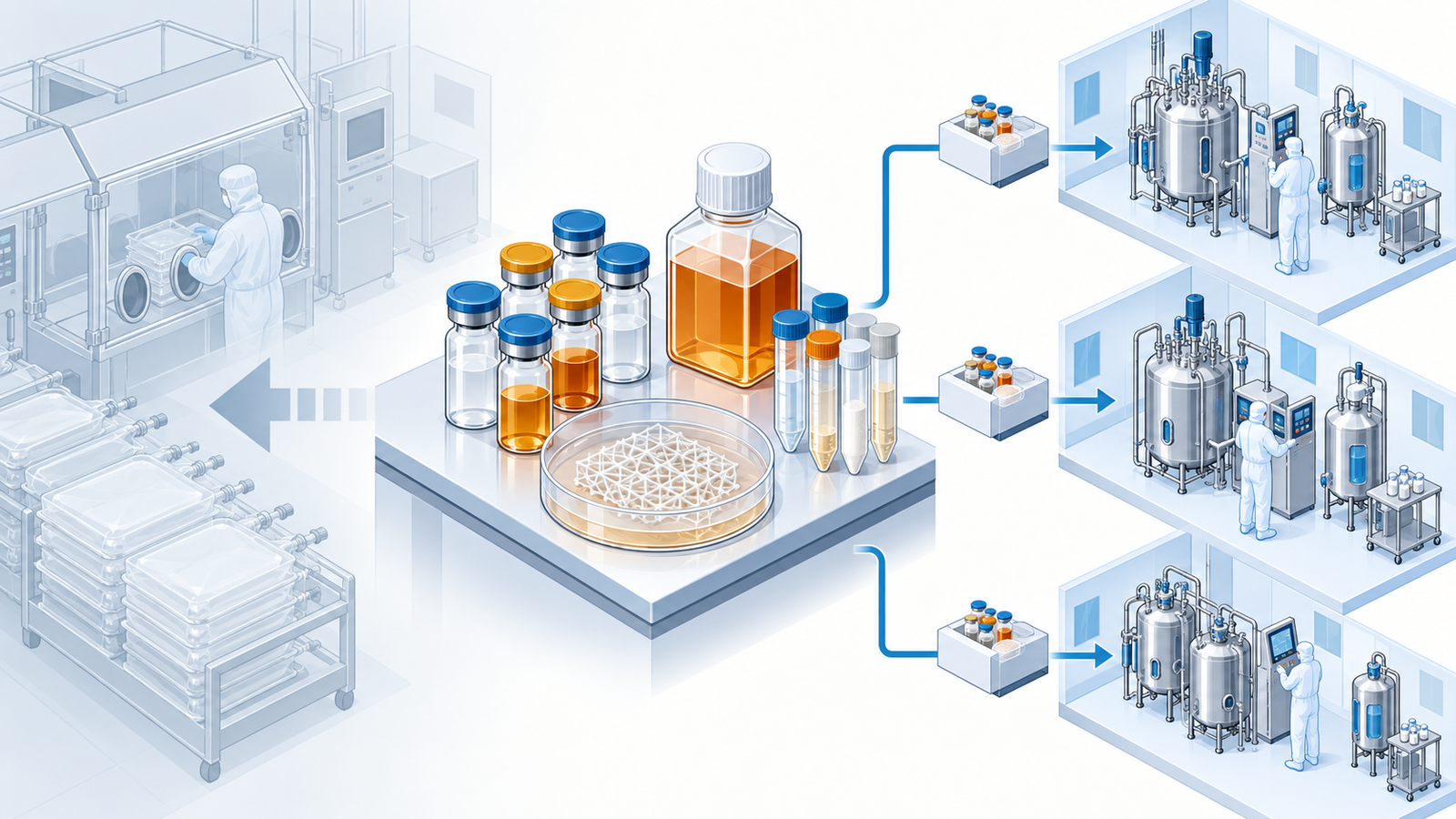
The structural reform disclosure clearly separates what the company is leaving (its own clinical development and contract GMP cell processing) from what it is keeping. The things named as staying are ancillary materials such as RetroNectin® and enzymes for mRNA vaccine manufacturing, and media products Sourced. All of these are "materials that go into customers' manufacturing processes", which create some demand whichever customer's drug succeeds. The contract cell processing it is leaving, by contrast, was a business whose facilities go idle when "the trend changes, with major pharmaceutical companies discontinuing development", as the presentation materials put it. Our reading, then, is that Takara Bio has removed the riskiest parts of the left (CDMO) and right (cell therapy) columns in Fig. 1, and moved its centre of gravity back to the middle (materials) Not yet confirmed. The company also cites "lower RetroNectin® demand from a major customer" in its presentation materials, so a materials business, too, still depends on how customers' development goes.
9. Map of cell culture partnerships
10. Technologies, products and services
| Category | Product or service | What primary sources say | From May 2026 |
|---|---|---|---|
| Ancillary materials | RetroNectin® | A recombinant protein that raises the efficiency of gene transfer with viral vectors and makes expansion of the transduced cells more efficient. Used in making Strimvelis™ and Waskyra™ | Continued, with a sales push |
| Media | Media for lymphocyte culture and others | The presentation materials refer to "development of AM products following RetroNectin® and lymphocyte culture media" | Continued, with a sales push |
| Culture equipment (as distributor) | Wilson Wolf "G-Rex®" | A vessel with a gas-permeable membrane at the base for large-scale culture of immune cells. Described as combinable with the RetroNectin® method and the company's short-duration CAR-T manufacturing method, the "Spo-T® method" | Not mentioned in the structural reform disclosure |
| Research reagents (stem cells) | ES and iPS cell-related products (Cellartis® and others) | Product range added through the 2014 acquisition of Cellectis AB | Closure of the Swedish site decided. What happens to the products could not be confirmed |
| CDMO (cell processing) | GMP manufacturing of gene-modified cells such as CAR-T, and of iPS cell and mesenchymal stem cell banks | Carried out in the cell processing rooms of Building 2 | Exit (non-GMP process development continues). Transfer to S-RACMO under negotiation |
| CDMO (viral vectors, nucleic acids, proteins) | Vectors for gene therapy, mRNA, plasmids, antibody drugs (3,000 L-class single-use bioreactors) | Also offers contract quality testing (such as viral clearance tests) | A priority |
| Own gene therapies | NY-ESO-1 siTCR® gene therapy (TBI-1301), CD19 JAK/STAT CAR (TBI-2001) | TBI-1301 holds orphan regenerative medicine product and SAKIGAKE designations (the latter is a Japanese fast-track scheme). Clinical trial notification for Phase III filed in September 2025 | Own development stopped. Transfer of TBI-1301 to the Sumitomo Chemical group under negotiation |
The company's presentation materials describe the background to the impairment as a "shift from facilities designed for large-scale manufacturing to small and medium-scale manufacturing targeting low-volume or local administration from early development" Sourced. Cell therapies do not readily fit the antibody-drug model of making a large batch in one tank and distributing it to many patients; autologous therapies in particular, which use the patient's own cells, mean one lot per patient. As a result, investment premised on "lining up big facilities and making a lot at once" will not see high utilisation unless the number of approved products grows. Its choice of viral vectors, nucleic acids and proteins as future priorities can be read as picking modalities in which one facility can easily make products for multiple customers Not yet confirmed. Our explainers on bioreactors, CDMOs and CAR-T cells help show the differences between autologous and allogeneic, and between cell and molecule, manufacturing.
11. The risks this company carries
| Risk | Substance | Category |
|---|---|---|
| A weak research market | Sharp cuts to U.S. research grants and fiercer competition in China cut sales of the mainstay reagents by 8.7% in the year to March 2026 | Sourced |
| Paying back Building 3 | Building 3, with planned total investment of ¥34,640 million, is due for completion in 2027. Large facilities in Building 2 have already been impaired | Not yet confirmed |
| The business transfer falling through | The transfer to S-RACMO depends on a final agreement and conditions being met, and the company states that it "has not been finalised at this time" | Sourced |
| Customer concentration in ancillary materials | The presentation materials cite "lower RetroNectin® demand from a major customer" as a reason for lower gene medicine sales | Sourced |
| Loss of talent | On top of 148 voluntary retirements, cell processing staff are expected to move to the acquirer. How many cell culture engineers remain in the company is not disclosed | Inference |
| Harder to verify from outside | After delisting, the state of each business can no longer be checked through statutory disclosures | Inference |
12. Glossary
- CDMO
- A business that develops manufacturing processes for drugs and manufactures them under contract. See our explainer on CDMOs for more.
- Ancillary materials
- Materials used in a drug's manufacturing process that are not intended to remain in the final product, such as media additives and enzymes.
- RetroNectin®
- A recombinant protein engineered from fibronectin that raises the efficiency of gene transfer into cells with viral vectors. A registered trademark of Takara Bio.
- Contract GMP cell processing
- Contract work processing and manufacturing another company's therapeutic cells in line with good manufacturing practice (GMP) for medicines.
- siTCR®
- The company's technology for introducing a cancer-recognising receptor while suppressing expression of the T cell's own T cell receptor.
- CAR-T
- A treatment that gives T cells the gene for a cancer-recognising receptor and returns them to the patient. See our explainer on CAR-T cells for more.
- Single-use bioreactor
- A bioreactor that uses a disposable bag as the culture vessel, reducing cleaning and sterilisation work. See our explainer on single-use systems.
- Conditional and time-limited approval
- A Japanese system for regenerative medicine products that allows early approval, with conditions and a time limit, when efficacy is presumed and safety is confirmed. TBI-1301 abandoned this route in favour of seeking full approval.
- Dual-use facility
- A facility used for ordinary contract manufacturing in normal times, and for making vaccines and similar products on government instruction during an epidemic.
- Tender offer (TOB)
- A procedure for buying up shares off-market at a published price and within a published period. In this case it was used by the parent to make the company a wholly owned subsidiary.
13. References
- Takara Bio Consolidated financial results summary for the year to March 2026 [Japanese GAAP] (in Japanese, 13 May 2026): revenue, sales by area and region, operating result, R&D expenses, impairment losses, the acquisition cost of Curio and the forecast for the year to March 2027. https://www.takara-bio.co.jp/ja/ir/news/auto_20260513528430/pdfFile.pdf
- Takara Bio "Implementation of structural reforms to improve profitability" (in Japanese, 13 May 2026): end of own clinical development, exit from contract GMP cell processing, voluntary retirement, expected cost savings, priority areas and targets for the year to March 2031. https://www.takara-bio.co.jp/ja/ir/news/auto_20260513528923/pdfFile.pdf
- Takara Bio Annual securities report for the 23rd fiscal period (1 April 2024 to 31 March 2025; in Japanese, filed 20 June 2025): history, business description, employees, R&D, capital expenditure, the investment plan for Building 3 and patents. https://www.takara-bio.co.jp/ja/ir/news/auto_20250620142400_S100VZNP/pdfFile.pdf
- Takara Bio Notice of statement of opinion in support of, and recommendation to tender in, the tender offer for the company's shares by its parent, Takara Holdings Inc. (in Japanese, 13 February 2026): tender offer price, state of the CDMO business, positioning of Buildings 2 and 3, and background to the impairments. https://www.takara-bio.co.jp/ja/ir/news/auto_20260213562303/pdfFile.pdf
- Takara Bio Notice of the results of the tender offer for the company's common shares by its parent, Takara Holdings Inc. (in Japanese, 7 April 2026). https://www.takara-bio.co.jp/ja/ir/news/auto_20260407599455/pdfFile.pdf
- Takara Bio Notice of delisting of the company's shares (in Japanese, 11 June 2026). https://www.takara-bio.co.jp/ja/ir/news/auto_20260611567951/pdfFile.pdf
- Takara Bio Presentation for the second-quarter results briefing, year to March 2026 (in Japanese, 13 November 2025): state of each area, issues in the contract business, the facilities impaired and why, and the gene medicine area. https://www.takara-bio.co.jp/ja/ir/news/newsir_251113_smkPRE_2603Q2/main/0/link/2603Q2prz.pdf
- Takara Bio "Takara Bio Group formulates Medium-Term Management Plan 2025" (in Japanese, 11 May 2023). https://www.takara-bio.co.jp/ja/ir/news/auto_20230511565114/pdfFile.pdf
- Takara Bio Status of negotiations on the transfer of the contract GMP cell processing business (in Japanese, 23 June 2026). https://www.takara-bio.co.jp/ja/news/newsr_26m0623hyti.html
- Takara Bio Conclusion of a basic agreement on the transfer of the contract GMP cell processing business (in Japanese, 21 July 2026). https://www.takara-bio.co.jp/ja/news/newsr_26m721hyti.html
- Takara Bio Results of the voluntary retirement programme (in Japanese, 21 July 2026). https://www.takara-bio.co.jp/ja/news/newsr_26m7212-2tihy.html
- Takara Bio "Waskyra™, a gene therapy made using RetroNectin®, receives marketing approval in the U.S. and Europe through Telethon" (in Japanese, 6 February 2026). https://www.takara-bio.co.jp/ja/news/newsr_26m0206tikk.html
- Takara Bio "Commercial licence for RetroNectin® granted to Telethon of Italy" (in Japanese, 25 September 2023). https://www.takara-bio.co.jp/ja/news/newsr_23m0925tlt.html
- Takara Bio "Sales in Japan of Wilson Wolf's innovative 'G-Rex®' cell culture system begin, as official distributor" (in Japanese, 17 September 2025). https://www.takara-bio.co.jp/ja/news/newsr_25m0917-iuky.html
- Takara Bio Notice of completed submission of a clinical trial notification for the confirmatory trial of NY-ESO-1 siTCR® gene therapy (in Japanese, 16 September 2025). https://www.takara-bio.co.jp/ja/news/newsr_25m0916_stmt.html
- Takara Bio "Business alliance agreement with Noile-Immune Biotech on co-development of a CAR-T product for solid tumours" (in Japanese, 25 September 2024). https://www.takara-bio.co.jp/ja/news/newsr_24m0925myck.html
- Takara Bio "Biopharmaceutical CDMO services expand into antibody drug development and manufacturing" (in Japanese, 8 October 2024). https://www.takara-bio.co.jp/ja/news/newsr_24m1008kmjm.html
- Takara Bio "Expansion of the cell processing area with the latest equipment for diverse modalities" (in Japanese, 3 July 2023). https://www.takara-bio.co.jp/ja/news/newsr_23m0703nmd.html
- Takara Bio "Construction of Building 3 of the Center for Gene and Cell Processing to manufacture mRNA vaccine drug substances, components and materials" (in Japanese, 5 October 2023). https://www.takara-bio.co.jp/ja/news/newsr_23m1005cgcpt.html
- Takara Bio "Rights to human iPS cell-derived intestinal epithelial cells transferred to Japan Tissue Engineering Co., Ltd." (in Japanese, 24 March 2025). https://www.takara-bio.co.jp/ja/news/newsr_25m0324iuck.html
- Takara Bio "'Cell and Tissue Communication' programme established at the University of Tokyo Hospital; joint research on extracellular vesicles begins" (in Japanese, 1 July 2022). https://www.takara-bio.co.jp/ja/news/newsr_22m0701Hieb02s7f6b8.html
- Takara Bio "Selected for a programme of AMED's Strategic Center of Biomedical Advanced Vaccine Research and Development for Preparedness and Response (SCARDA)" (in Japanese, 11 May 2026). https://www.takara-bio.co.jp/ja/news/newsr_26m0511hmkm.html
- Takara Bio Official website (in Japanese; used to check the company profile and logo). https://www.takara-bio.co.jp/ja/index.html
14. Claim-to-source audit
| Claim in the article | Category | Source |
|---|---|---|
| Legal name, head office address, founding background and parent company | Sourced | Reference 3 https://www.takara-bio.co.jp/ja/ir/news/auto_20250620142400_S100VZNP/pdfFile.pdf |
| Revenue, operating result, net result and R&D expenses for the years to March 2026 and 2025; sales by area and region; single segment | Sourced | Reference 1 https://www.takara-bio.co.jp/ja/ir/news/auto_20260513528430/pdfFile.pdf |
| Impairment losses of ¥3,876 million (idle contract manufacturing facilities and others) | Sourced | Reference 1 https://www.takara-bio.co.jp/ja/ir/news/auto_20260513528430/pdfFile.pdf |
| What was impaired (large, parallel cell processing facilities in CGCP Building 2 and the 2,000 L vector facility) and why, and the shift to small and medium-scale manufacturing | Sourced | Reference 7 https://www.takara-bio.co.jp/ja/ir/news/newsir_251113_smkPRE_2603Q2/main/0/link/2603Q2prz.pdf |
| Treating the ¥10.2 billion total of "contract services" and "gene medicine" as a rough upper bound for businesses close to cell and gene therapy | Our calculation | Our total of the sales by area in reference 1 |
| Forecast for the year to March 2027 (revenue ¥44,000 million, operating loss ¥2,700 million) | Sourced | Reference 1 https://www.takara-bio.co.jp/ja/ir/news/auto_20260513528430/pdfFile.pdf |
| The structural reforms (end of own clinical development, exit from contract GMP cell processing, closure of the Swedish site, priority modalities, cost savings and targets for the year to March 2031) | Sourced | Reference 2 https://www.takara-bio.co.jp/ja/ir/news/auto_20260513528923/pdfFile.pdf |
| Headcount (31 March 2025), capital expenditure, planned total investment in Building 3, acquisition history and co-owned patents with Mie University | Sourced | Reference 3 https://www.takara-bio.co.jp/ja/ir/news/auto_20250620142400_S100VZNP/pdfFile.pdf |
| Headcount at the end of March 2026 | Not yet confirmed | Could not be confirmed in primary sources https://www.takara-bio.co.jp/ja/ir/news/auto_20260513528430/pdfFile.pdf |
| Tender offer price of ¥1,150, the Medium-Term Management Plan 2025 target of ¥15 billion operating profit and the CDMO shortfall, and the positioning of Buildings 2 and 3 | Sourced | Reference 4 https://www.takara-bio.co.jp/ja/ir/news/auto_20260213562303/pdfFile.pdf |
| Completion of the tender offer | Sourced | Reference 5 https://www.takara-bio.co.jp/ja/ir/news/auto_20260407599455/pdfFile.pdf |
| Delisting on 12 June 2026 | Sourced | Reference 6 https://www.takara-bio.co.jp/ja/ir/news/auto_20260611567951/pdfFile.pdf |
| Content of the Medium-Term Management Plan 2025 (operating profit of ¥15 billion, preparations to build Building 3, more RetroNectin® capacity) | Sourced | Reference 8 https://www.takara-bio.co.jp/ja/ir/news/auto_20230511565114/pdfFile.pdf |
| Negotiations and basic agreement on transferring contract GMP cell processing to S-RACMO, a final agreement targeted for October 2026, and negotiations on transferring TBI-1301 | Sourced | References 9 and 10 https://www.takara-bio.co.jp/ja/news/newsr_26m721hyti.html |
| Consideration, staff and facilities in the transfer, and the treatment of the Noile-Immune alliance | Not yet confirmed | Not in primary sources https://www.takara-bio.co.jp/ja/news/newsr_26m721hyti.html |
| 148 voluntary retirements | Sourced | Reference 11 https://www.takara-bio.co.jp/ja/news/newsr_26m7212-2tihy.html |
| How RetroNectin® works, and its use in Waskyra™ and Strimvelis™ | Sourced | References 12 and 13 https://www.takara-bio.co.jp/ja/news/newsr_26m0206tikk.html |
| Official distributor of G-Rex® in Japan, and its combination with the Spo-T® method | Sourced | Reference 14 https://www.takara-bio.co.jp/ja/news/newsr_25m0917-iuky.html |
| Change of development plan for TBI-1301 (seeking full approval) and the Phase III clinical trial notification | Sourced | Reference 15 https://www.takara-bio.co.jp/ja/news/newsr_25m0916_stmt.html |
| Business alliance to be the exclusive manufacturer of Noile-Immune's NIB103 | Sourced | Reference 16 https://www.takara-bio.co.jp/ja/news/newsr_24m0925myck.html |
| Antibody drug CDMO using 3,000 L-class single-use bioreactors | Sourced | Reference 17 https://www.takara-bio.co.jp/ja/news/newsr_24m1008kmjm.html |
| Expansion of cell processing rooms (two manufacturing rooms and one filling room added to 11 rooms) | Sourced | Reference 18 https://www.takara-bio.co.jp/ja/news/newsr_23m0703nmd.html |
| Purpose, size and schedule of Building 3, the METI subsidy, and the floor areas of Buildings 1 and 2 | Sourced | Reference 19 https://www.takara-bio.co.jp/ja/news/newsr_23m1005cgcpt.html |
| Transfer to J-TEC of rights to iPS cell-derived intestinal epithelial cells, and joint research with Osaka University and others | Sourced | Reference 20 https://www.takara-bio.co.jp/ja/news/newsr_25m0324iuck.html |
| The sponsored programme at the University of Tokyo Hospital (July 2022) and selection for AMED's SCARDA programme (May 2026) | Sourced | References 21 and 22 https://www.takara-bio.co.jp/ja/news/newsr_22m0701Hieb02s7f6b8.html |
| Investments in cell therapy start-ups | Not yet confirmed | Not in primary sources. This article does not conclude that none exist https://www.takara-bio.co.jp/ja/ir/news/auto_20250620142400_S100VZNP/pdfFile.pdf |
| The three types of cell culture company, and Takara Bio's main and secondary types | Our calculation | Our own classification. Companies shown are examples from the 20 in this series |
| The reading that the company is moving its weight back to "selling materials" | Inference | This article's interpretation of which businesses the structural reforms keep and which they exit |
| The reading that cell processing technology and staff will survive within the Sumitomo Chemical group | Inference | This article's interpretation of the transfer negotiations, which include employees |
| Less disclosure after going private, and the risk of losing talent | Inference | This article's interpretation of the delisting and the voluntary retirements |
| Why the priority modalities were chosen (one facility can easily serve multiple customers) | Inference | This article's interpretation of statements in the presentation materials |
Last updated 23 September 2026 / Troy Technical
Every figure in this article comes from Takara Bio's financial results summaries, annual securities report, timely disclosures, results presentation materials and news releases. No research-firm estimates or press-based figures have been used. Passages marked "Inference" are this article's interpretation of primary sources, not statements made by the company.