TECHNOLOGY EXPLAINER
GMP (Good Manufacturing Practice)
— Product-contact surfaces must not be reactive, additive, or absorptive
GMP is not a pharmaceutical company's house rulebook. It is a legal standard: a ministerial ordinance in Japan, federal regulations in the United States and, in the EU, guidelines based on EU law (directives and regulations). And its text contains passages that speak plainly about the materials and components of equipment, and the suppliers of both. For cell-based products, one manufacturing run can be one patient's dose.

- What GMP is (the short version)
- Japan, the US and the EU — which standard is written where
- What is asked of materials and components — the gates they pass through
- A materials engineer's view (1): a certificate of analysis is not the end of it
- Our calculation: how clean is Grade A?
- A materials engineer's view (2): not the particle count but “no growth”
- What is different about cell products — one lot can be one patient
- A materials engineer's view (3): the more the starting material varies, the tighter the components must be
- QbD and CMC — what sits “upstream” of GMP (overview)
- Open problems and what is still undecided
- Glossary / References / Claim-to-source audit
Sourced = stated in a law, guideline or published document (link given)
Our calculation = a figure this article derived, with the assumptions spelled out
Not yet confirmed = a draft, a plan or anything else not yet settled
Our own structuring of the rules and readings from a materials or process angle are marked separately as Commentary.
Quotations from Japanese ordinances are our own translations; quotations from US and EU texts are in the original English.
This article explains regulatory and manufacturing mechanisms; it says nothing about the efficacy of any individual product or about treatment choices.
1. What GMP is (the short version)
GMP (Good Manufacturing Practice) is the set of manufacturing-control and quality-control standards for making a medicine to a defined quality, the same way, every time. In the United States it is called CGMP, the C standing for “current”.
- Legal status: Japan's GMP Ordinance is itself “the standards specified by Ministry of Health, Labour and Welfare ordinance” referred to in Article 14(2)(iv) of the PMD Act, Japan's main law on pharmaceuticals and medical devicesSourced. In the US, 21 CFR Part 210 states that it and Part 211 and related parts contain “the minimum current good manufacturing practice”Sourced
- What happens if you don't comply: under 21 CFR 210.1(b), failure to comply with these regulations “shall render such drug to be adulterated”Sourced
- What it looks at: people, buildings, equipment, raw materials, procedures, records and changes — not the product itself but the whole system that makes the product (commentary)
On equipment, the US regulation 21 CFR 211.65(a) says that “surfaces that contact components, in-process materials, or drug products shall not be reactive, additive, or absorptive”Sourced.
In plain terms: don't react, don't add anything, don't soak anything up. That is a statement about materials. GMP is not only a standard for drug companies; it also puts concrete demands, framed as material properties, on the people who make equipment and components (commentary).
2. Japan, the US and the EU — which standard is written where
GMP is set in law country by country. But because inspection cooperation (PIC/S) and harmonisation of technical requirements (ICH) have come a long way, the substance is largely shared. For cell-based products, each region has a separate framework alongside the one for conventional medicines.
| Region | Medicines in general | Rules touching cell products and similar | Key points confirmed for this article |
|---|---|---|---|
| Japan | GMP Ordinance (MHLW Ordinance No. 179 of 2004) | GCTP Ordinance (MHLW Ordinance No. 93 of 2014) | The GCTP Ordinance took effect on 25 November 2014. It provides that where validation cannot be performed, verification is to be performed |
| United States | 21 CFR Parts 210 and 211 | 21 CFR Part 1271 (HCT/Ps), biologics regulations | HCT/Ps that are drugs are subject to Part 1271 requirements in addition to Parts 210 and 211 (210.1(c)) |
| European Union | EudraLex Volume 4 Parts I and II, Annex 1 | EudraLex Volume 4 Part IV (ATMPs) | ATMP manufacturers were to apply it no later than 22 May 2018. Other Volume 4 documents are not applicable to ATMPs unless specific reference is made to them |
| International | PIC/S, ICH | — | The US FDA joined PIC/S in January 2011; Japan (MHLW and PMDA) in July 2014 |
All Sourced (GMP Ordinance [Ref. 1], GCTP Ordinance [Ref. 2], 21 CFR Part 210 [Ref. 3], EU GMP Part IV [Ref. 6], PIC/S [Ref. 8]).
Japanese law separates the marketing authorisation holder (MAH), which holds the approval and is responsible for putting the product on the market, from the manufacturer, which actually makes it. Article 3 of the GCTP Ordinance says the MAH “shall have the manufacturer … carry out manufacturing control and quality control of the product at the manufacturing site”Sourced. That split between the party that has a product made and the party that makes it is the regulatory foundation for contract manufacturing (see our explainer on CDMOs) (commentary).
3. What is asked of materials and components — the gates they pass through
Read the rules again from the materials side, and a component meets five gates on its way to the product, the last of them whenever something changes (our structuring).
Gate 1: selecting suppliers — GMP Ordinance, Article 11-4
The current GMP Ordinance has an article headed “control of suppliers of raw materials, etc.” The manufacturer must have its quality assurance department “set appropriate specifications to ensure the quality of raw materials, etc.”, “select suppliers of raw materials, etc. after evaluating their suitability” and “periodically confirm whether manufacturing control and quality control of raw materials, etc. are being carried out appropriately and smoothly”Sourced. For raw materials, etc. that affect product quality, it must also “conclude the necessary arrangements in writing” with the supplierSourced. In the ordinance, “raw materials, etc.” means “raw materials and packaging materials”Sourced.
Gate 2: receiving — 21 CFR 211.84
The US regulation requires each lot of components, drug product containers and closures to be withheld from use until the quality control unit has tested or examined it and released it for useSourced. It does allow a supplier's report of analysis to stand in for the manufacturer's own testing, but on two conditions: “at least one specific identity test is conducted on such component by the manufacturer”, and “the manufacturer establishes the reliability of the supplier's analyses through appropriate validation of the supplier's test results at appropriate intervals”Sourced.
Gate 3: contact during processing — 21 CFR 211.65
Following the “not reactive, additive, or absorptive” requirement quoted above, 211.65(b) says that substances required for operation, such as lubricants or coolants, shall not come into contact with components, containers, closures, in-process materials or drug productsSourced. On buildings and facilities, Japan's GCTP Ordinance likewise requires for injectable products that “product-contact piping and the like that affect sterility assurance be easy to clean and capable of being sterilised”Sourced.
Gate 4: single-use components — EU GMP Annex 1
The EU's Annex 1 (Manufacture of Sterile Medicinal Products), revised in 2022, gives single-use systems (SUS) a section of their ownSourced.
- 8.135: the adsorption and reactivity of the product with product contact surfaces should be evaluated under process conditions
- 8.136: the extractable and leachable profiles of the SUS and any impact on product quality should be evaluated, “especially where the system is made from polymer-based materials”
- 8.137: SUS should be designed to maintain integrity throughout processing, including where exposed to more extreme conditions such as freezing and thawing
- 8.138: on receipt, before use, checks such as a visual inspection of the outer packaging and review of accompanying documents such as certificates of conformance and proof of sterilisation should be carried out and recorded
All Sourced (EU GMP Annex 1 [Ref. 5]). Annex 1 came into operation on 25 August 2023 (25 August 2024 for point 8.123 only)Sourced.
Gate 5: making changes — GMP Ordinance, Article 14
The GMP Ordinance's change-control article applies “when changes are made to the specifications of raw materials, packaging materials or products, or to manufacturing procedures, etc.”Sourced The manufacturer must assess the impact of the change on product quality and on the approved particulars, and, where there is or may be an impact, notify the marketing authorisation holder and obtain its confirmationSourced. The “approved particulars” are what was written in the application and approved; this is where GMP connects to QbD and CMC (Section 9).
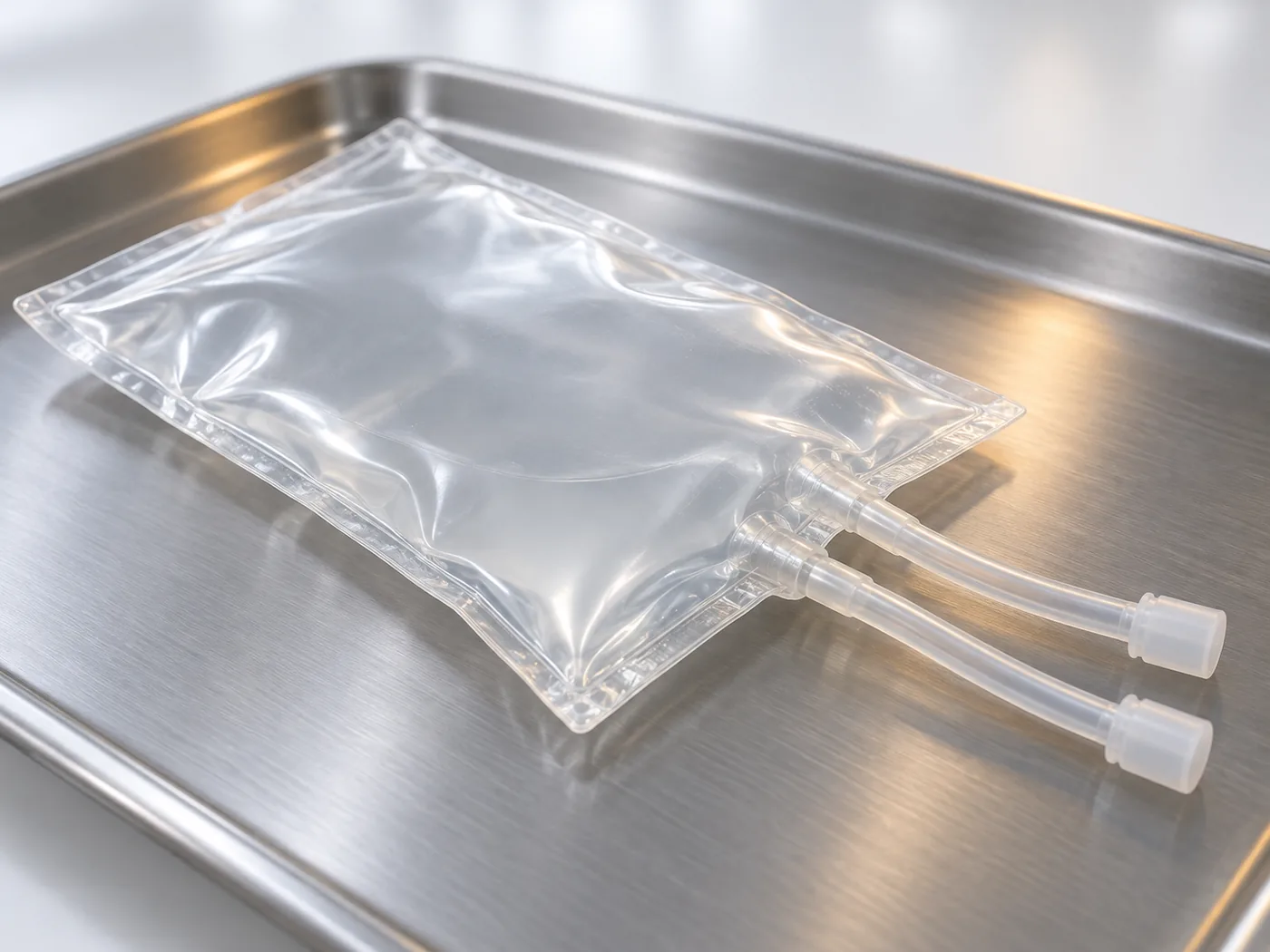
4. A materials engineer's view (1): a certificate of analysis is not the end of it
Look at how 21 CFR 211.84(d)(2) is worded. A user may rely on a supplier's report of analysis only if it runs at least one identity test itself and validates the reliability of the supplier's results “at appropriate intervals”Sourced.
Seen from a materials supplier, that means the following (commentary).
- A certificate of analysis is not a one-off. Customers will periodically set your certificate against their own test results
- An identity test will always be run. Materials must be designed and made on the assumption that the customer can confirm, by infrared spectroscopy or similar, that this is the same material as always
- Supplier audits are part of the system. Article 11-4 of the GMP Ordinance makes qualification and periodic review of suppliers mandatorySourced; audits and questionnaires are how that is done
The EU's GMP for ATMPs (Part IV) goes further: for critical raw materials in authorised products, the quality requirements in the specification “should be agreed with the supplier(s) (‘agreed specifications’)”Sourced. Shipping against a specification agreed individually with the customer rather than a catalogue specification is close to the way semiconductor materials suppliers settle control limits customer by customer (commentary).
5. Our calculation: how clean is Grade A?
EU GMP Annex 1 divides the areas where sterile medicines are made into four grades, A to D. Grade A is “the critical zone for high-risk operations”, for example an aseptic processing line, a filling zone or open primary packagingSourced. The grades are defined by the number of particles of 0.5 µm and larger per cubic metre, and by the number of microorganisms.
| Grade | Particles ≥0.5 µm, at rest | Particles ≥0.5 µm, in operation | ISO class (at rest / in operation) | Airborne microbes (CFU/m³) |
|---|---|---|---|---|
| A | 3,520 | 3,520 | 5 / 5 | No growth |
| B | 3,520 | 352,000 | 5 / 7 | 10 |
| C | 352,000 | 3,520,000 | 7 / 8 | 100 |
| D | 3,520,000 | Not predetermined | 8 | 200 |
All Sourced. Particle and airborne-microbe limits are from Tables 1 and 2 of EU GMP Annex 1 [Ref. 5]; ISO classes are from the table in EU GMP Part IV (ATMPs) [Ref. 6]. For Grade D in operation the limit is “not predetermined” and is set by the manufacturer.
Converting the table into more familiar units and ratiosOur calculation:
- Per cubic foot: 1 ft³ = 0.02832 m³, so 3,520 × 0.02832 = about 100. Grade A allows up to about 100 particles of 0.5 µm and larger per cubic foot
- A versus D: at rest, 3,520,000 ÷ 3,520 = 1,000 times
- When people come in: Grade B allows 3,520 at rest and 352,000 in operation, so 352,000 ÷ 3,520 = 100 times headroom is built in
Assumptions and limits: the conversion factor (1 ft³ = 0.02832 m³) is the one this article used. These are ratios between upper limits; they do not show measured values or the real cleanliness of any actual area.
6. A materials engineer's view (2): not the particle count but “no growth”
The particle limit for Grade A corresponds to ISO Class 5Sourced. On particle count alone, some industries run at stricter cleanliness than this (commentary).
But GMP cleanliness has a second axis: microorganisms. The airborne-microbe limit for Grade A is “No growth”Sourced. It is not “up to so many”, as with particles. The standard is zero.
From the materials side, that difference comes back as demands like these (commentary).
- Survive sterilisation: components are sterilised by radiation, steam, gas and so on. Properties must hold, and extractables must not rise, after sterilisation
- Survive cleaning and disinfectants: the GCTP Ordinance requires facilities to be “appropriately cleaned and maintained, and sterilised where necessary”Sourced. Surface materials have to withstand repeated disinfection
- The packaging is part of the product: Annex 1 requires visual inspection of the outer packaging on receiptSourced. How clean the packaging is, and how well it resists tearing, is judged as quality too
Not just a material that sheds no particles, but a material and package that bring in no microbes: that is the biggest difference between supplying a pharmaceutical plant and supplying a semiconductor fab (commentary).
7. What is different about cell products — one lot can be one patient
The GMP Ordinance defines a lot as “a group of products and raw materials … manufactured to be homogeneous through a series of manufacturing steps within a single manufacturing period”Sourced. With a conventional medicine, one lot supplies many patients.
It is different for autologous cell products, whose starting material is the patient's own cells. In guidance issued in May 2026, FDA acknowledges that meeting the reserve-sample requirement “may not be feasible when CGT product lots are very small or manufactured for individual patients”Sourced. The same guidance lists “patient-specific manufacturing” among the challenges in developing cell and gene therapy productsSourced.
The EU's GMP for ATMPs (Part IV) contains a number of provisions specific to products like theseSourced.
| Issue | What the published text says | Source |
|---|---|---|
| Small, variable lots | Manufacture and testing of autologous ATMPs (and allogeneic products in a donor-matched scenario) need strategies tailored to “limited batch sizes and the inherent variability of the starting material” | EU GMP Part IV 2.10 [Ref. 6] |
| Concurrent production in one area | “Concurrent production of two different ATMPs/batches in the same area is not acceptable.” Closed systems such as isolators may, however, be used to separate activities | EU GMP Part IV 4.18 to 4.19 [Ref. 6] |
| Validation | Where starting materials are in short supply, as with autologous products, validation using surrogate material may be acceptable | EU GMP Part IV 10.41 [Ref. 6] |
| Conditions for release | For autologous products, the match between the origin of the starting material and the recipient is verified | EU GMP Part IV 11.27 [Ref. 6] |
| Out-of-specification product | Acknowledges that out-of-specification (OOS) products are not always attributable to failures in the manufacturing process (for example, factors in the patient), and requires all instances to be investigated | EU GMP Part IV 11.42 [Ref. 6] |
| Tests that cannot finish in time | Compensated by real-time testing for short shelf-life products and by reinforced process validation | EU GMP Part IV 2.35 to 2.36 [Ref. 6] |
| The Japanese rule | Where validation cannot be performed “for unavoidable reasons”, verification (confirming that the expected result was obtained) is performed instead | GCTP Ordinance, Article 14 [Ref. 2] |
All Sourced. The “Issue” headings are this article's own grouping.
FDA, too, says that cell-based products where each lot comes from a different donor “often have product characteristics with very wide ranges”, and that the number of lots needed for a statistically valid comparison before and after a manufacturing change “could be quite large, or even unfeasible”Sourced. That document, however, is a draft from July 2023, not final guidanceNot yet confirmed.
8. A materials engineer's view (3): the more the starting material varies, the tighter the components must be
In an autologous cell product, the starting material — the patient's own cells — is different every timeSourced. Break down the variability in product quality by process input and you get something like this (commentary):
- Variability in the cells: cannot be reduced, and the manufacturer cannot choose it
- Variability in process conditions: held down by equipment and procedures
- Variability in media and components: held down by supplier and user controls
If the overall tolerance is fixed, the larger the irreducible variability of the cells, the narrower the band left for components and media. And because the cells differ from lot to lot, the effect of a change of component lot is buried in the cell-to-cell variation and hard to see. A change that is hard to see is also hard to trace back afterwards (commentary).
The EU's Part IV asks manufacturers to understand the risks of research-grade raw materials, “including the risks to the continuity of supply when larger amounts of product are manufactured”Sourced. That can be read as saying that in this field being able to supply the same thing, the same way, for a long time is itself a quality requirement (commentary).
If one lot is one patient, a defective component means one patient's manufacture has failed. The weight of a failure is distributed differently from supplying the same component into a large-lot medicine, and that ought to shape how component inspection and release decisions are designed (commentary).
9. QbD and CMC — what sits “upstream” of GMP (overview)
GMP requires you to make the product as specified. So where does the specification come from? The answer is design during development (QbD) and the quality section of the marketing application (CMC). This article gives only an outline; the detail is in our explainer on QbD and CMC.
- QbD (Quality by Design): ICH Q8(R2) defines it as “a systematic approach to development that begins with predefined objectives and emphasizes product and process understanding and process control, based on sound science and quality risk management”Sourced
- CMC (Chemistry, Manufacturing and Controls): the quality part of the marketing application, describing the manufacturing method, specifications, control of raw materials and so on. Once approved it becomes the approved particulars (commentary)
- The link to GMP: Article 3-2 of the GMP Ordinance requires manufacturers to “manufacture in accordance with the approved particulars”Sourced. Articles 3-3 and 3-4 require them to establish a pharmaceutical quality system and quality risk managementSourced
10. Open problems and what is still undecided
(1) Sometimes only research-grade raw materials exist
EU GMP Part IV says raw materials should be of pharmaceutical grade, but acknowledges that “in some cases, only materials of research grade are available”Sourced. In that case the risks must be understood and suitability confirmed, where appropriate by functional or safety testingSourced. For materials makers, this reads as room to offer a “GMP grade” (commentary).
(2) GMP applies in stages during development
FDA states that, in general, production of an investigational drug for a Phase 1 clinical trial is exempt from compliance with 21 CFR Part 211 (21 CFR 210.2(c))Sourced. So a material chosen early in development can end up being carried all the way to demanding commercial requirements. Watch for the mismatch in timing, where a material adopted early later becomes a problem because “there is no GMP documentation for it” (commentary).
(3) Frameworks for decentralised manufacturing and automation are still developing
EU GMP Part IV notes that new manufacturing models, such as decentralised manufacturing, are emerging to address the challenges of autologous productsSourced. FDA's document on manufacturing changes for cell and gene therapies remains the July 2023 draftNot yet confirmed. As of this article's research (September 2026), we found no primary source stating that these practices had been settled in any region.
(4) Fine differences between regions
The Japanese, US and EU standards have much in common, but differ in terminology, classification and documentation requirements. This article gives the key points of the main provisions; it does not cover each region's implementation notices or inspection practice.
- GMP is a legal standard. Japan sets it by ministerial ordinance, the US by federal regulation and the EU by European Commission guidelinesSourced
- US regulation states that contact surfaces “shall not be reactive, additive, or absorptive”Sourced
- Supplier qualification, periodic review and written agreements are obligations under Japan's GMP OrdinanceSourced
- Grade A's particle limit works out at about 100 per cubic footOur calculation, and its airborne-microbe standard is “No growth”Sourced
- In autologous cell products, one lot can be one patient. Variable starting material and preventing mix-ups are issues conventional medicines do not haveSourced
- The more the starting material varies, the more consistent the components have to be (commentary)
11. Glossary
- GMP / CGMP
- Standards for manufacturing control and quality control of medicines. In the US, “current” is added to make CGMP.
- GMP Ordinance
- Japan's Ministerial Ordinance on Standards for Manufacturing Control and Quality Control of Drugs and Quasi-drugs (MHLW Ordinance No. 179 of 2004).
- GCTP Ordinance
- Japan's Ministerial Ordinance on Standards for Manufacturing Control and Quality Control of Regenerative Medical Products (MHLW Ordinance No. 93 of 2014).
- Marketing authorisation holder (MAH)
- The party that holds the approval and is responsible for putting the product on the market. It may have a manufacturer carry out the actual manufacturing.
- Approved particulars
- What was written in the application for approval and approved. Manufacturing must follow it.
- ATMP
- Advanced Therapy Medicinal Product. The EU category covering cell therapy, gene therapy and tissue-engineered products.
- HCT/P
- Human cells, tissues, and cellular and tissue-based products: the US category defined in 21 CFR Part 1271.
- PIC/S
- Pharmaceutical Inspection Convention and Pharmaceutical Inspection Co-operation Scheme. An international framework for cooperation on GMP inspection.
- Validation
- Verifying, and documenting, that facilities, equipment or procedures deliver the expected result.
- Verification
- Confirming, and documenting, that a procedure or similar delivered the expected result (as defined in the GCTP Ordinance).
- Grades A to D
- The EU GMP cleanliness grades. A is the cleanest, used for critical zones such as aseptic processing.
- Extractables and leachables
- Extractables are substances that can come out of a component under aggressive conditions; leachables are those that migrate into the product under actual conditions of use.
- Identity test
- A test confirming that a received material is the substance it is labelled as.
- Autologous / allogeneic
- Autologous products are made from the patient's own cells; allogeneic products from another person's (a donor's) cells.
12. References
- Ministry of Health, Labour and Welfare (e-Gov Law Search) “Ministerial Ordinance on Standards for Manufacturing Control and Quality Control of Drugs and Quasi-drugs”, MHLW Ordinance No. 179 of 2004 (in Japanese) https://laws.e-gov.go.jp/law/416M60000100179
- Ministry of Health, Labour and Welfare (e-Gov Law Search) “Ministerial Ordinance on Standards for Manufacturing Control and Quality Control of Regenerative Medical Products”, MHLW Ordinance No. 93 of 2014 (in Japanese) https://laws.e-gov.go.jp/law/426M60000100093
- U.S. Government Publishing Office “21 CFR Part 210 — Current Good Manufacturing Practice in Manufacturing, Processing, Packing, or Holding of Drugs; General” (2025 edition) https://www.govinfo.gov/content/pkg/CFR-2025-title21-vol4/pdf/CFR-2025-title21-vol4-part210.pdf
- U.S. Government Publishing Office “21 CFR Part 211 — Current Good Manufacturing Practice for Finished Pharmaceuticals” (2025 edition) https://www.govinfo.gov/content/pkg/CFR-2025-title21-vol4/pdf/CFR-2025-title21-vol4-part211.pdf
- European Commission “EudraLex Volume 4, Annex 1: Manufacture of Sterile Medicinal Products”, 25 August 2022 https://health.ec.europa.eu/system/files/2022-08/20220825_gmp-an1_en_0.pdf
- European Commission “Guidelines on Good Manufacturing Practice specific to Advanced Therapy Medicinal Products”, 22 November 2017 https://health.ec.europa.eu/system/files/2017-11/2017_11_22_guidelines_gmp_for_atmps_0.pdf
- European Commission “EudraLex - Volume 4 - Good Manufacturing Practice (GMP) guidelines” https://health.ec.europa.eu/medicinal-products/eudralex/eudralex-volume-4_en
- PIC/S “Members” https://picscheme.org/en/members
- U.S. FDA (CBER) “Manufacturing Changes and Comparability for Human Cellular and Gene Therapy Products” (Draft Guidance for Industry), July 2023 https://www.fda.gov/media/170198/download
- U.S. FDA (CBER) “Chemistry, Manufacturing, and Controls Flexibilities for Developing Human Cellular and Gene Therapy Products for a Biologics License Application” (Guidance for Industry), May 2026 https://www.fda.gov/media/192321/download
- ICH “Q8(R2) Pharmaceutical Development”, August 2009 https://database.ich.org/sites/default/files/Q8%28R2%29%20Guideline.pdf
- ICH “Q10 Pharmaceutical Quality System”, June 2008 https://database.ich.org/sites/default/files/Q10%20Guideline.pdf
- Ministry of Health, Labour and Welfare (e-Gov Law Search) “Ministerial Ordinance on Standards for Quality Control of Drugs, Quasi-drugs, Cosmetics and Regenerative Medical Products”, MHLW Ordinance No. 136 of 2004 (in Japanese) https://laws.e-gov.go.jp/law/416M60000100136
13. Claim-to-source audit
| Claim in the text | Basis | Label |
|---|---|---|
| That the GMP Ordinance is the “standards specified by MHLW ordinance” referred to in Article 14(2)(iv) of the PMD Act. Control of suppliers of raw materials, etc. (Article 11-4: specifications, qualification and selection, periodic review, written arrangements). That “raw materials, etc.” means raw materials and packaging materials. Change control (Article 14: changes to specifications of raw materials, packaging materials or products or to manufacturing procedures, assessment of impact on quality and approved particulars, notification of the MAH). Compliance with approved particulars (Article 3-2), pharmaceutical quality system (Article 3-3), quality risk management (Article 3-4). The definition of a lot | GMP Ordinance, Reference 1 https://laws.e-gov.go.jp/law/416M60000100179 | Sourced |
| Promulgation of the GCTP Ordinance (MHLW Ordinance No. 93 of 2014) and its effective date (25 November 2014). The MAH having the manufacturer carry out manufacturing control and quality control (Article 3). Cleaning, maintenance and sterilisation of facilities, filtered air and pressure differentials for aseptic areas, and ease of cleaning and sterilisability of product-contact piping for injectables (Article 10). Verification where validation cannot be performed (Article 14). The definition of verification (Article 2) | GCTP Ordinance, Reference 2 https://laws.e-gov.go.jp/law/426M60000100093 | Sourced |
| That 21 CFR Part 210 contains “the minimum current good manufacturing practice”, and that a drug made without complying is deemed adulterated (210.1(a), (b)). That HCT/Ps that are drugs are subject to Part 1271 in addition to Parts 210 and 211 (210.1(c)) | 21 CFR Part 210, Reference 3 https://www.govinfo.gov/content/pkg/CFR-2025-title21-vol4/pdf/CFR-2025-title21-vol4-part210.pdf | Sourced |
| That contact surfaces shall not be “reactive, additive, or absorptive” (211.65(a)) and that lubricants and coolants shall not come into contact (211.65(b)). That component lots are withheld until released by the quality control unit (211.84(a)), and the conditions for relying on a supplier's report of analysis (at least one specific identity test and periodic validation of the supplier's results, 211.84(d)(2)) | 21 CFR Part 211, Reference 4 https://www.govinfo.gov/content/pkg/CFR-2025-title21-vol4/pdf/CFR-2025-title21-vol4-part211.pdf | Sourced |
| Definitions of Grades A to D and the examples given for Grade A. Limits for particles of 0.5 µm and larger (Table 1: A 3,520/3,520, B 3,520/352,000, C 352,000/3,520,000, D 3,520,000/not predetermined). Airborne-microbe limits (Table 2: A No growth, B 10, C 100, D 200 CFU/m³). Points 8.135 to 8.138 on SUS (adsorption and reactivity; extractables and leachables of polymer-based materials; integrity including freeze-thaw; checks of outer packaging and accompanying documents). Dates of coming into operation (25 August 2023; 25 August 2024 for 8.123) | EU GMP Annex 1, Reference 5 https://health.ec.europa.eu/system/files/2022-08/20220825_gmp-an1_en_0.pdf | Sourced |
| That ATMP manufacturers apply the guidelines no later than 22 May 2018, and that other Volume 4 documents do not apply to ATMPs unless specifically referenced. ISO classes by grade (A 5/5, B 5/7, C 7/8, D 8). 2.10 (limited batch sizes and starting-material variability), 2.11 (decentralised manufacturing), 2.35 to 2.36 (real-time testing, reinforced process validation), 4.18 to 4.19 (no concurrent production in one area; separation by closed systems), 7.13 (research-grade raw materials and continuity-of-supply risk), 7.14 (agreed specifications), 10.41 (validation with surrogate material), 11.27 (verifying the match between origin and recipient), 11.42 (handling of out-of-specification products) | EU GMP Part IV (ATMPs), Reference 6 https://health.ec.europa.eu/system/files/2017-11/2017_11_22_guidelines_gmp_for_atmps_0.pdf | Sourced |
| That EudraLex Volume 4 consists of Parts I to IV and that Part IV sets GMP requirements for ATMPs | European Commission EudraLex Volume 4 page, Reference 7 https://health.ec.europa.eu/medicinal-products/eudralex/eudralex-volume-4_en | Sourced |
| That the US FDA joined PIC/S in January 2011 and Japan (MHLW and PMDA) in July 2014 | PIC/S member list, Reference 8 https://picscheme.org/en/members | Sourced |
| That cell and gene therapy products are regulated under the existing framework for biological products. That cell-based products where each lot comes from a different donor often have very wide ranges of product characteristics, and that the number of lots needed for a comparison could be quite large or even unfeasible | FDA draft guidance (July 2023), Reference 9 https://www.fda.gov/media/170198/download | Sourced |
| That the same draft guidance has not been finalised | It is dated July 2023 and marked “Draft – Not for Implementation”. No final version could be found as of this article's research (September 2026), Reference 9 https://www.fda.gov/media/170198/download | Not yet confirmed |
| That the reserve-sample requirement may not be feasible when CGT product lots are very small or made for individual patients. That “patient-specific manufacturing” is listed as a challenge. That production of Phase 1 investigational drugs is generally exempt from Part 211 (21 CFR 210.2(c)) | FDA guidance (May 2026), Reference 10 https://www.fda.gov/media/192321/download | Sourced |
| The definition of QbD | ICH Q8(R2), Reference 11 https://database.ich.org/sites/default/files/Q8%28R2%29%20Guideline.pdf | Sourced |
| That the pharmaceutical quality system is set out internationally as ICH Q10 (background to Section 9) | ICH Q10, Reference 12 https://database.ich.org/sites/default/files/Q10%20Guideline.pdf | Sourced |
| That Japan has quality-control standards for marketing authorisation holders (the GQP Ordinance), with a chapter covering regenerative medical products | GQP Ordinance, Reference 13 https://laws.e-gov.go.jp/law/416M60000100136 | Sourced |
| Converting 3,520 per m³ to about 100 per cubic foot. Putting the at-rest difference between A and D at 1,000-fold, and the at-rest to in-operation difference for Grade B at 100-fold | Our calculation. 1 ft³ = 0.02832 m³ is the conversion factor this article used. These are ratios between upper limits, not values showing the cleanliness of any real area | Our calculation |
| Restating 211.65 as “don't react, don't add anything, don't soak anything up”. The reading that a certificate of analysis is not a one-off. The comparison between agreed specifications and customer-specific control limits for semiconductor materials. The statement that some industries run at stricter particle cleanliness. The framing that GMP cleanliness has an extra axis for microbes. The readings on sterilisation, disinfection and packaging. The “variability budget” idea and the reading that component changes are easily buried in cell-to-cell variation. Reading room for a GMP grade into the research-grade provision. The point that early material choices can cause problems at the commercial stage. The framing of the MAH/manufacturer split as the regulatory foundation for CDMOs. The layouts and flows in Figs. 1 to 6 and the section headings | This article's own structuring and commentary based on the published material. Not views expressed by regulators or companies | Commentary |
| A primary source stating that decentralised manufacturing and similar practices have been settled in any region | None could be found as of this article's research (September 2026), so none is cited | Not yet confirmed |
| Details of each region's implementation notices and inspection practice; the efficacy of individual products | Outside the scope of this article and not covered (commentary) | Commentary |
| That Figs. 1, 2, 4, 5 and 6 are explanatory drawings, and that the hero image and Fig. 3 are AI-generated images | Our note | Commentary |
Last updated 23 September 2026. Sources are limited to primary material (Japanese ministerial ordinances, the US Code of Federal Regulations, European Commission guidelines, FDA guidance, ICH guidelines and PIC/S publications). Because the article includes our own structuring of the rules and readings from a materials and process angle, those are marked as Commentary and kept separate from sourced fact. FDA's document on manufacturing changes for cell and gene therapy products is a July 2023 draft, not final guidance. This article explains regulatory and manufacturing mechanisms and says nothing about the efficacy or safety of individual products or about treatment choices. Figs. 1, 2, 4, 5 and 6 are vector drawings; the hero image and Fig. 3 are AI-generated images, and none of them shows a real facility, product or measured value.