Key Findings
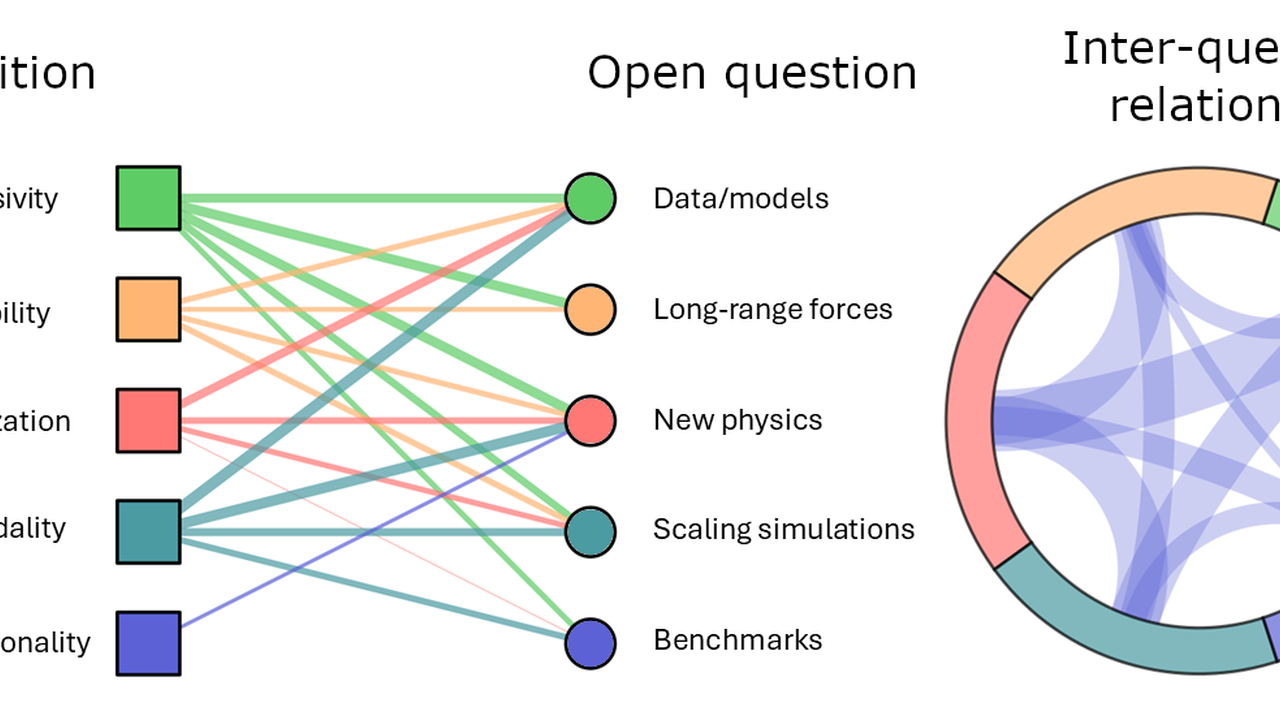
A new paper published on arXiv provides a detailed review of the rapid advancements in machine learning (ML) within the field of atomic modeling, specifically analyzing how machine-learned interatomic potentials (MLIPs) have become indispensable tools in materials science. The paper presents six key open questions that need to be addressed for the further advancement of MLIP foundation models, emphasizing that the development of multi-fidelity and multi-modal models represents the next frontier.
Technical / Clinical Details
Interatomic potentials play a central role in computational methods for simulating the physical properties of materials at the atomic level. Traditional potentials were constructed based on empirical parameterization or ab initio calculations, involving a trade-off between accuracy and computational cost. MLIPs, by learning from high-precision data derived from quantum mechanical calculations (e.g., Density Functional Theory), enable simulations to operate at the speed of classical molecular dynamics while maintaining near-quantum accuracy. This makes large-scale and long-duration simulations feasible. The six open questions discussed in the paper primarily highlight the limitations and potentials faced by MLIP foundation models. These include, for example, the robustness of predictive capabilities across diverse chemical environments and extreme conditions (high temperature, high pressure), the quantification of biases and uncertainties in training datasets, and the necessity for multi-modal learning that integrates various types of data (spectroscopic data, microscopic images, reaction pathways). Specifically, multi-fidelity learning and multi-modal models, which can predict material properties using data of different resolutions and types, not just single structural information, are expected to significantly enhance the versatility and predictive power of MLIPs.Background & Context
Understanding material behavior at the atomic level is indispensable in many scientific and technological fields, including material design, drug discovery, and catalyst identification. The advent of MLIPs has significantly advanced computational tools for deepening this understanding, enabling the exploration of complex material systems previously unreachable by traditional simulation methods. However, MLIP foundation models are still in their early stages, with limitations in their applicability and reliability. This paper systematically organizes these challenges faced by the entire MLIP community and contributes importantly to promoting the healthy development of the field by outlining future research directions.
Strategic Significance & Outlook
Resolving the challenges presented in this paper will provide a roadmap for evolving MLIP foundation models into more robust and versatile tools. The development of multi-fidelity and multi-modal models will enable AI to provide materials scientists with deeper insights, not just structural information, but also how materials interact with light, electrons, and interatomic forces. This is expected to further enhance the speed and accuracy of AI-driven materials discovery, accelerating the creation of sustainable energy materials, high-performance electronics, and new medical technologies. MLIPs will continue to play a central role at the forefront of materials science research.