Key Findings
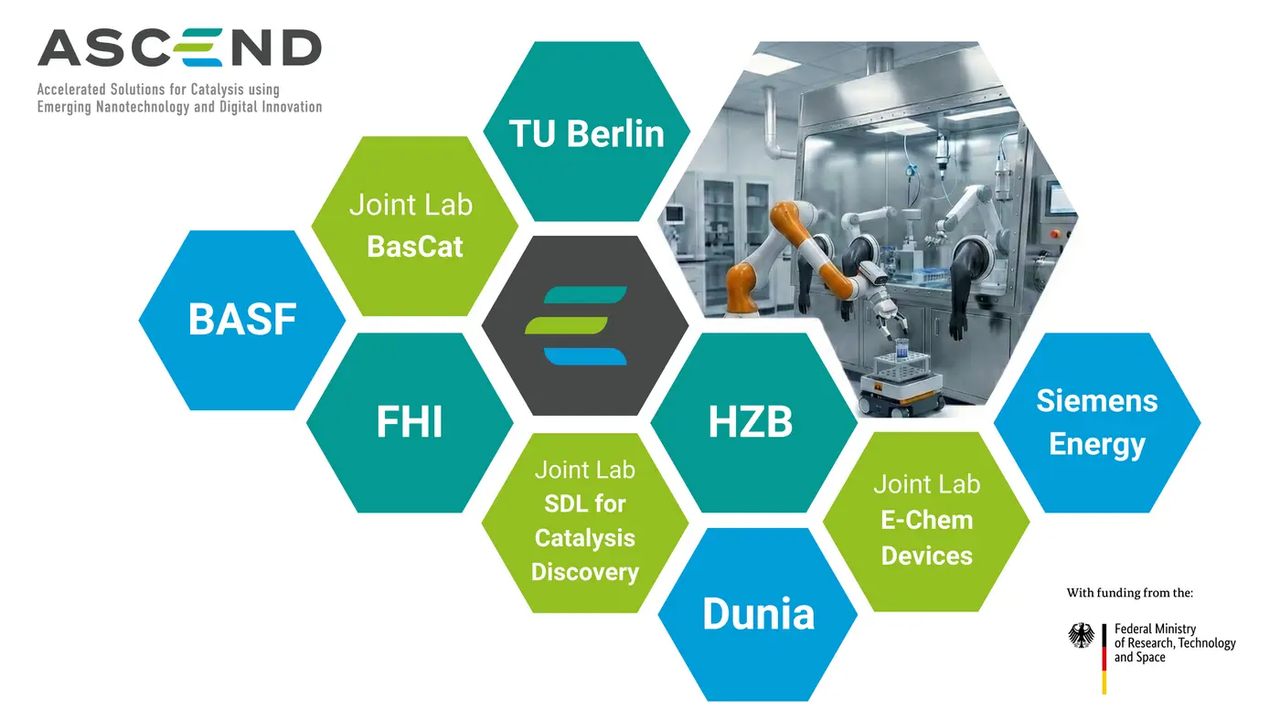
The German Federal Ministry of Education and Research (BMFTR) has launched the ‘ASCEND’ project, backed by €30 million in funding and involving six leading research institutions and industrial partners, including Helmholtz-Zentrum Berlin (HZB) and the global chemical company BASF. The primary objective of this project is to dramatically accelerate AI-driven catalyst development and streamline the discovery of high-performance materials essential for sustainable chemical production.
Technical / Clinical Details
The ASCEND project aims to fundamentally transform the catalyst development process by combining state-of-the-art AI technologies, advanced computational simulations, and autonomous self-driving laboratories (SDLs). Specifically, AI will play two main roles: Firstly, AI will autonomously build and update digital twins of materials. These models accurately represent real-world material properties and behaviors in a virtual space, enabling rapid evaluation during the initial material design phase. Secondly, AI will design experiments based on an iterative learning loop. The SDLs will autonomously execute experiments proposed by AI, and the generated data will be fed back to the AI in real-time. This closed-loop system allows the AI model to continuously refine its predictions and efficiently guide the search towards the most promising catalyst candidates. For example, it is expected to discover catalysts with higher selectivity, activity, and stability for specific chemical reactions in a fraction of the time and cost compared to traditional methods.
Background & Context
Catalysts are indispensable materials in the chemical industry, energy production, and environmental technology, and their performance improvement directly leads to enhanced process efficiency, reduced energy consumption, and the realization of a sustainable society. However, the discovery and optimization of high-performance catalysts have been extremely time-consuming and costly, requiring the exploration of a vast number of material compositions and structural combinations. Advancements in AI, simulation, and robotics offer the potential to break through this traditional bottleneck, giving rise to new R&D paradigms like materials informatics and autonomous labs. The substantial €30 million investment by the German government demonstrates a strong commitment to establishing European leadership in this field and accelerating the transition to sustainable chemistry.
Strategic Significance & Outlook
The ASCEND project is expected not only to dramatically improve the efficiency of catalyst development but also to pave the way for the discovery of new types of catalytic materials and reaction pathways. This digital catalysis technology holds promise for diverse industrial applications, including pharmaceutical manufacturing, polymer production, and exhaust gas treatment. Moving forward, the project will aim to enhance the accuracy and robustness of AI models, strengthen the autonomy of SDLs, and achieve industrial-scale demonstration. This is expected to further boost Germany’s, and by extension Europe’s, international competitiveness in sustainable chemical technologies. Furthermore, insights gained from this project will contribute to accelerating AI-driven discoveries in other areas of materials science.
Source: https://www.e-conversion.de/ai-driven-catalyst-development-en/