Key Findings
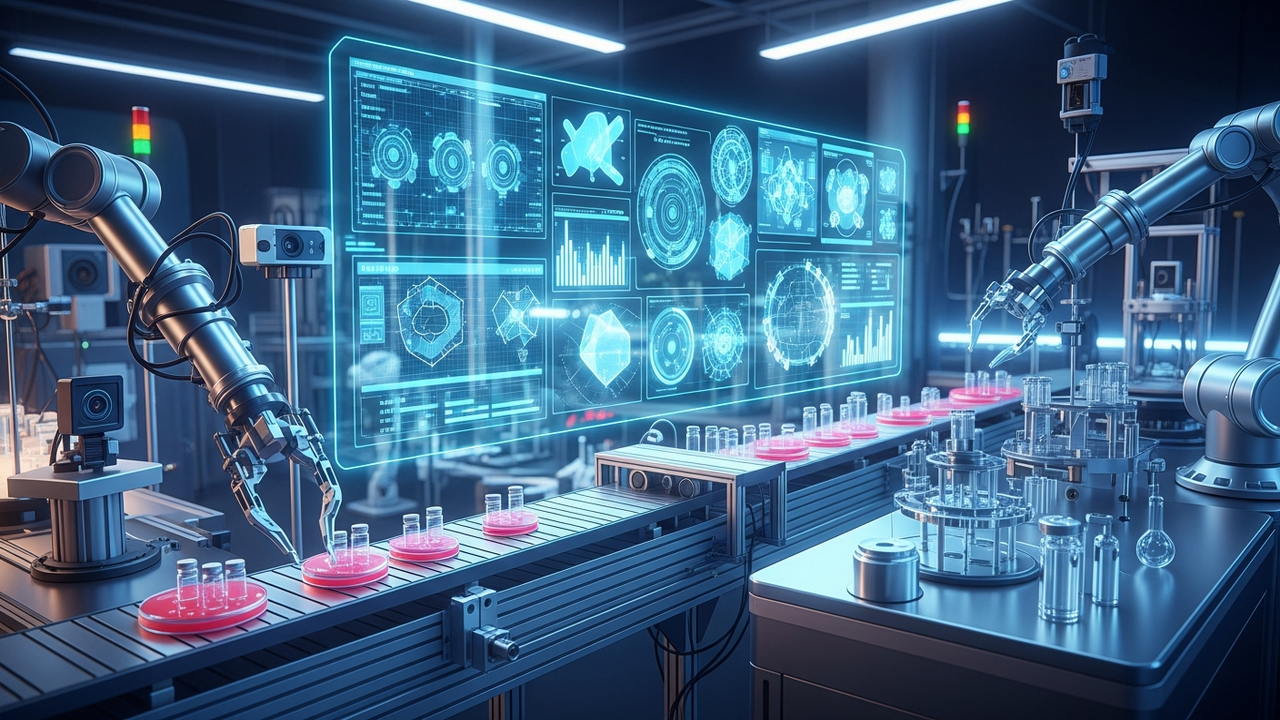
Lisa Pedrosa’s article highlights the rapid emergence of ‘self-driving labs’ as one of the most significant trends in the realm of scientific discovery. These laboratories are fundamentally transforming the landscape of scientific research by seamlessly integrating artificial intelligence (AI), robotics, and human expertise, enabling autonomous experimental cycles through a continuous learning loop.
Technical / Clinical Details
At the core of self-driving labs is a closed-loop system where AI automatically designs, executes, analyzes experiments, and plans the next experimental steps. For instance, systems like Polybot, developed at Argonne National Laboratory, can autonomously explore and discover new compositions and properties for polymers and electronic materials. The AI learns from existing scientific data and physical models, using algorithms such as Bayesian optimization to identify the most promising experimental conditions. Subsequently, robotic arms or automated synthesis equipment precisely execute physical experiments as instructed by the AI. The resulting experimental data is fed back to the AI in real-time, allowing the AI to learn from its ‘experience’ and further optimize subsequent experimental steps. This iterative process holds the potential for AI to complete discovery processes in days or weeks that would take human researchers months or years. This resolves R&D bottlenecks and significantly enhances efficiency.
Background & Context
The discovery of new materials and drugs is essential for solving many challenges facing modern society (e.g., energy, healthcare, environment). However, traditional scientific research has been a time-consuming and costly process, heavily reliant on trial and error. Advances in data-driven approaches in materials informatics and bioinformatics, coupled with robotic automation, have made self-driving labs a reality. This trend is attracting significant interest not only from academic research institutions but also from industries, particularly in materials, pharmaceuticals, and chemicals. The increasing number of startups offering closed-loop experimental services indicates that this technology is already beginning to generate commercial value.
Strategic Significance & Outlook
Self-driving labs are poised to dramatically expand the speed and scale of scientific discovery, ushering in a future where researchers can focus on more complex, higher-order problem-solving. The widespread adoption of this technology will drive groundbreaking breakthroughs across diverse fields, including rapid drug development, discovery of high-performance battery materials, design of new catalysts, and even material development for space exploration. Furthermore, by eliminating human bias and enabling more objective and extensive exploration, it will contribute to unexpected discoveries and the creation of entirely new scientific knowledge. As Lisa Pedrosa notes, self-driving labs are expected to evolve the ‘design-make-test-analyze’ cycle in scientific research into a continuous learning loop, becoming an indispensable tool for scientists to achieve greater impact more quickly and with fewer resources.
Source: https://www.lisapedrosa.com/self-driving-lab/
Get our weekly technology intelligence — free
Receive an infographic that lets you judge at a glance whether each field’s analysis report is worth reading.
Subscribe Free — Weekly Tech Intelligence
By subscribing, you’ll receive Troy-Technical’s weekly technology intelligence newsletter.
- Your email and selected fields are used only to deliver the newsletter.
- We never share your information with third parties.
- You can unsubscribe anytime via the link in each email.
See our Privacy Policy for details.
Takes about a minute · Unsubscribe anytime