Background
Research into plant-microbe interactions is critical for addressing global challenges such as bioenergy production, soil health, and sustainable agriculture. However, these biological systems are inherently complex and highly variable, presenting challenges of reproducibility and low throughput with traditional experimental methods. Autonomous labs integrating AI and robotics offer a powerful solution to overcome these challenges and establish standards for biological research. Especially amidst intensifying competition in clean energy source development, efficient research in the bioenergy sector is strategically important.
Key Findings
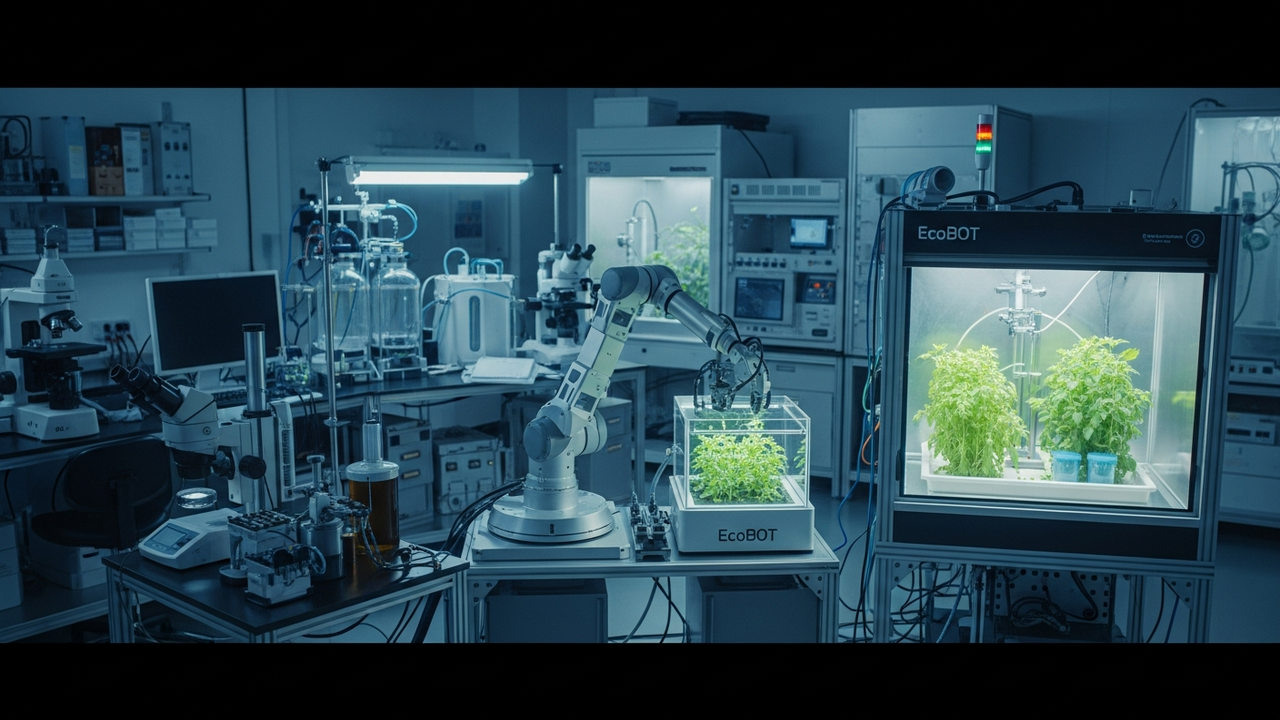
Lawrence Berkeley National Laboratory (Berkeley Lab) has developed “EcoBOT,” an autonomous laboratory designed to resolve long-standing reproducibility issues in plant-microbe interaction research and dramatically accelerate bioenergy studies. EcoBOT integrates robotic hardware, advanced imaging systems, and an adaptive modeling framework (gpCAM) to continuously monitor plant behavior, identify uncertainties, and autonomously guide the discovery cycle. This innovative system is poised to set new standards for automation in biological research and contribute significantly to clean energy production and sustainable agriculture.
Technical Details
EcoBOT is a sophisticated autonomous laboratory specifically engineered to address the complexity and inherent variability of biological experiments. Its main technological components include:
- Robotic Hardware: EcoBOT’s precision robotic systems autonomously execute physical tasks, including meticulous plant growth management, accurate water and nutrient delivery, and systematic sampling. This automation minimizes human variability and error, significantly enhancing experimental reproducibility. For instance, it can simultaneously subject numerous plants to diverse environmental conditions with high-fidelity manipulations.
- Advanced Imaging Systems: High-throughput, non-invasive imaging systems acquire detailed data on plant-microbe interactions, encompassing metrics such as plant growth, morphology, physiological states, and microbial colonization. Leveraging AI-based image analysis algorithms, EcoBOT quantitatively extracts critical information from these images, enabling real-time assessment of plant health and stress responses.
- Adaptive Modeling Framework (gpCAM): gpCAM (Gaussian Process-based Bayesian Optimization with Active Learning for Complex Systems) serves as the “brain” of EcoBOT. This sophisticated AI framework builds predictive models of plant-microbe interactions from the extensive collected data and rigorously quantifies experimental uncertainties. It then autonomously proposes the most informative next experimental conditions, thereby optimizing the entire experimental cycle. For example, gpCAM can efficiently identify optimal moisture conditions for specific microbial consortia to maximize plant growth using a minimal number of trials.
- Autonomous Discovery Cycle: EcoBOT fully automates and iterates through the entire scientific discovery process—from hypothesis generation and experimental execution to data collection, analysis, and the formulation of new hypotheses. This paradigm significantly shortens discovery cycles, which traditionally span weeks to months, thereby enabling the rapid acquisition of novel scientific insights.
These seamlessly integrated systems empower EcoBOT to study complex plant-microbe ecosystems with unprecedented accuracy, efficiency, and scale.
Strategic Significance & Outlook
The development of EcoBOT is poised to revolutionize plant-microbe interaction research and dramatically accelerate new discoveries within the bioenergy sector. This autonomous laboratory will efficiently identify optimal plant varieties and microbial consortia, driving critical advancements in biofuel production and soil improvement technologies. Looking ahead, systems akin to EcoBOT are anticipated to find broader application across biological research, fostering automation and efficiency in diverse biotechnology fields, including high-throughput pharmaceutical screening and cell culture optimization. This technological trajectory will accelerate scientific breakthroughs crucial for realizing a sustainable society.
Get our weekly technology intelligence — free
Receive an infographic that lets you judge at a glance whether each field’s analysis report is worth reading.
Subscribe Free — Weekly Tech Intelligence
By subscribing, you’ll receive Troy-Technical’s weekly technology intelligence newsletter.
- Your email and selected fields are used only to deliver the newsletter.
- We never share your information with third parties.
- You can unsubscribe anytime via the link in each email.
See our Privacy Policy for details.
Takes about a minute · Unsubscribe anytime