Report Overview
This article provides an overview of the ‘Global Hydrogen Review 2026’ market research report published by the International Energy Agency (IEA). The report offers an in-depth analysis of the latest trends in the global hydrogen market, production capacities, demand forecasts, and the key policy and technical challenges across major regions.
Key Research Findings
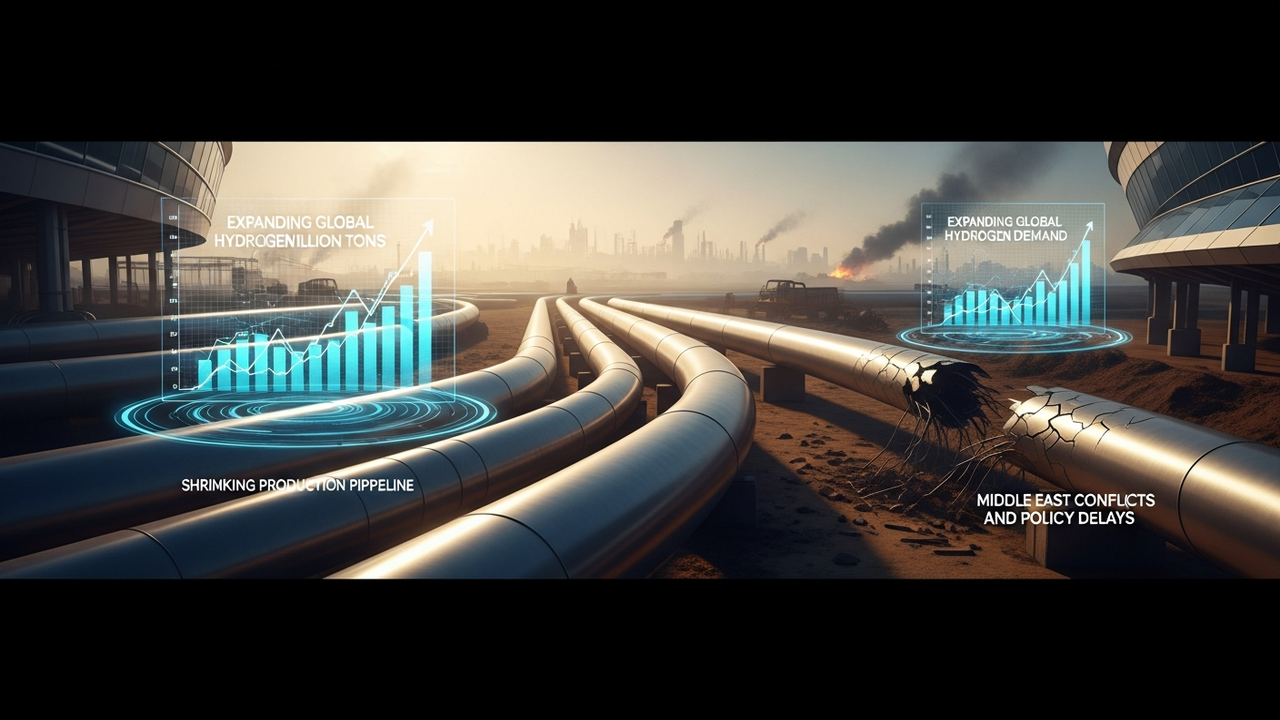
- Conflicts in the Middle East region are causing significant disruptions to the production and international trade flows of hydrogen-based products, exposing vulnerabilities in supply chains.
- Global hydrogen demand exceeded 100 million tons for the first time in 2025, underscoring hydrogen’s increasingly indispensable role in the energy transition.
- Low-emission hydrogen production (such as green hydrogen) increased by 20% year-on-year in 2025, reaching approximately 1 megaton (Mt). This suggests that commitments to decarbonization are yielding some tangible results.
- However, the pipeline of planned low-emission hydrogen projects by 2030 has contracted from previous forecasts, now totaling only 27 Mt. This reduction reflects an increase in investment decision delays and project cancellations.
- In China, the pace of electrolyzer deployment has decelerated, which is attributed to changes in domestic industrial policies and market conditions.
- Despite ambitious hydrogen strategies in Europe, delays in concrete policy implementation are hindering the advancement of large-scale projects, representing a major impediment to scaling up.
About the Publisher
The International Energy Agency (IEA) is an intergovernmental organization that provides analysis, recommendations, and data on global energy policy, aiming to ensure energy security, economic development, and environmental protection. Headquartered in Paris, it plays a central role in shaping a sustainable energy future.
Future Prospects
The ‘Global Hydrogen Review 2026’ emphasizes that the growth of the hydrogen economy remains highly dependent on policy clarity, investment incentives, and geopolitical stability. Specifically, the report points out that strengthening supply chains and fostering inter-regional cooperation are essential for the future sustainable development of the hydrogen market.
Source: https://renewablewatch.in/2026/07/17/global-hydrogen-review-2026-report/
Get our weekly technology intelligence — free
Receive an infographic that lets you judge at a glance whether each field’s analysis report is worth reading.
Subscribe Free — Weekly Tech Intelligence
By subscribing, you’ll receive Troy-Technical’s weekly technology intelligence newsletter.
- Your email and selected fields are used only to deliver the newsletter.
- We never share your information with third parties.
- You can unsubscribe anytime via the link in each email.
See our Privacy Policy for details.
Takes about a minute · Unsubscribe anytime








Comments