Background: Bridging the Gap in Atomistic Simulations
Understanding materials at the atomic scale is crucial, as microscopic behaviors directly dictate macroscopic properties. Historically, atomistic simulations have faced a trade-off: classical Molecular Dynamics (MD) offers computational speed but lacks quantum-mechanical accuracy, while Density Functional Theory (DFT) provides high fidelity at a prohibitive computational cost for large systems. Machine Learning Interatomic Potentials (MLIPs) have emerged as a transformative technology, striking an optimal balance between accuracy and efficiency. Positioned between classical MD and quantum mechanics-based first-principles calculations, MLIPs enable the simulation of large and complex atomic systems that were previously intractable. They are now indispensable tools for investigating critical phenomena such as ion transport in battery materials, complex catalytic reaction mechanisms, phase transition dynamics, and defect propagation. This comprehensive review serves as a vital guide for researchers navigating the selection and application of MLIPs, thereby accelerating the entire material discovery and design pipeline.
Key Findings: Foundation Models at the Frontier of MLIPs
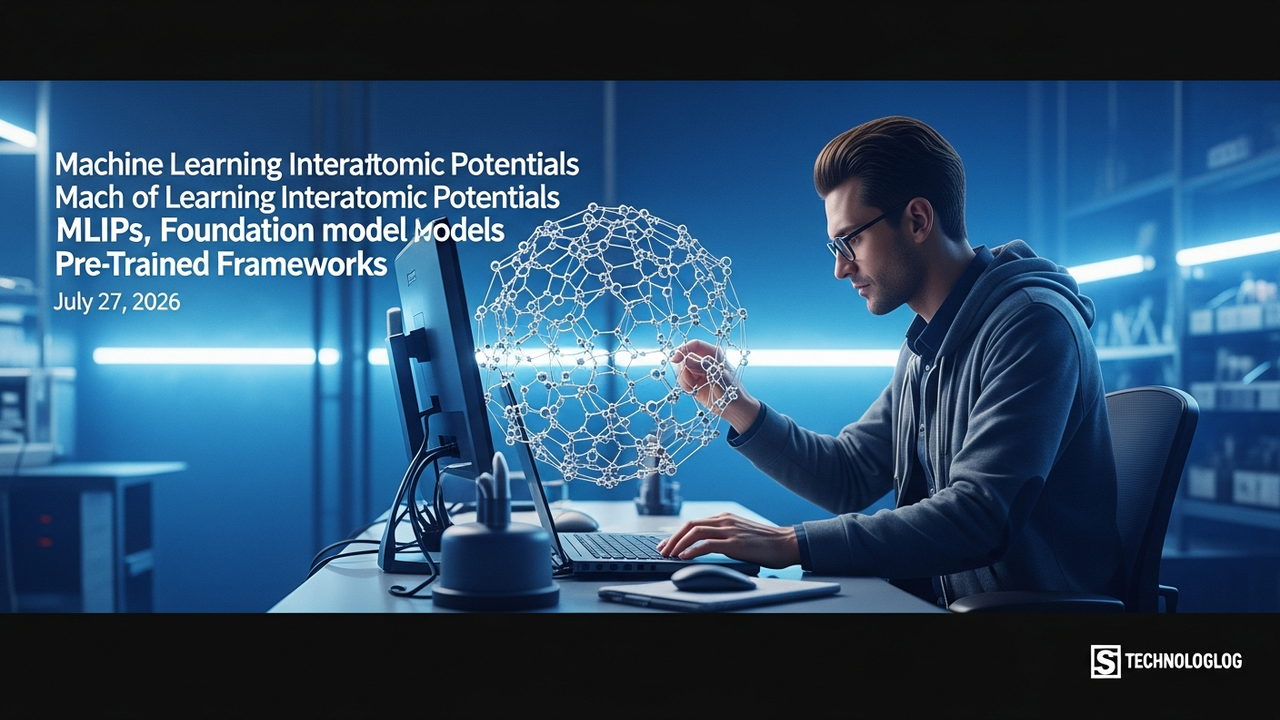
This exhaustive review offers a critical evaluation of Machine Learning Interatomic Potentials (MLIPs) across molecular and material simulations. It meticulously unpacks their theoretical underpinnings, surveys methodological breakthroughs, and explores their diverse applications. The review provides an in-depth assessment of prominent MLIP methodologies, including Neural Network Potentials (NNPs) and Graph Neural Networks (GNNs). Crucially, it emphasizes the profound impact of recent advancements in foundation models and pre-trained atomistic learning frameworks, identifying them as the new frontier in computational materials science that promise to redefine the field’s capabilities.
Technical Deep Dive: Advancements in Accuracy, Efficiency, and Transferability
MLIPs represent a paradigm shift, delivering accuracy on par with quantum mechanics-based first-principles calculations (like DFT) but at the significantly lower computational cost of classical Molecular Dynamics (MD). The review details a spectrum of MLIP construction methodologies, ranging from descriptor-based approaches—such as Gaussian Approximation Potentials (GAPs) and Spectral Neighbor Analysis Potentials (SNAPs)—to advanced data-driven Neural Network Potentials (NNPs) and Graph Neural Networks (GNNs). These sophisticated models are adept at efficiently characterizing complex atomic environments and precisely predicting interatomic interaction energies and forces.
A central theme of the review is the critical challenge of “transferability”—the ability of an MLIP to reliably perform in novel material systems or under physical conditions not present in its original training data. Recent breakthroughs in foundation models and pre-trained atomistic learning frameworks are poised to dramatically enhance this transferability. By enabling more generalized applications through task-specific fine-tuning, these innovations pave the way for unprecedented, large-scale material exploration and intricate process simulations to be executed within practical timeframes, accelerating the pace of scientific discovery.
Strategic Outlook: Towards Universal MLIPs and AI-Driven Materials Revolution
The field of MLIPs is in a state of rapid evolution, with future research converging on three primary objectives: refining model accuracy, bolstering computational efficiency, and, most crucially, vastly expanding their “generality.” The grand vision is the development of Universal MLIPs—models capable of accurately describing diverse material systems and performing reliably under extreme conditions. The ongoing advancements in foundation models and pre-trained frameworks are pivotal to realizing this ambition. By providing robust, adaptable platforms, they are enabling AI to permeate virtually every facet of materials science, promising to revolutionize the entire pipeline from novel material design, through synthesis and characterization, to ultimate practical application.
This technological innovation is poised to accelerate breakthroughs across a myriad of critical sectors, including the development of clean energy technologies, advanced medicine, and next-generation electronics, ushering in an era of unprecedented materials discovery and engineering.
Source: https://aimpjournal.com/index.php/aimp/article/view/6
Get our weekly technology intelligence — free
Receive an infographic that lets you judge at a glance whether each field’s analysis report is worth reading.
Subscribe Free — Weekly Tech Intelligence
By subscribing, you’ll receive Troy-Technical’s weekly technology intelligence newsletter.
- Your email and selected fields are used only to deliver the newsletter.
- We never share your information with third parties.
- You can unsubscribe anytime via the link in each email.
See our Privacy Policy for details.
Takes about a minute · Unsubscribe anytime