Background
Solving major 21st-century scientific and technological challenges, including climate change, energy security, and new drug development, necessitates the rapid discovery and development of novel materials. Traditional scientific research, however, often encounters bottlenecks such as complex experimental protocols, vast exploration spaces, and a heavy reliance on highly skilled human researchers. To overcome these limitations, the U.S. National Science Foundation (NSF) has championed national strategies like the Materials Genome Initiative (MGI), placing AI and automation at the core of scientific research. The current $380 million investment reflects national priorities to strengthen U.S. scientific and technological leadership and accelerate next-generation scientific discoveries, positioning the U.S. at the forefront of the accelerating global trend of AI-driven research.
Key Findings
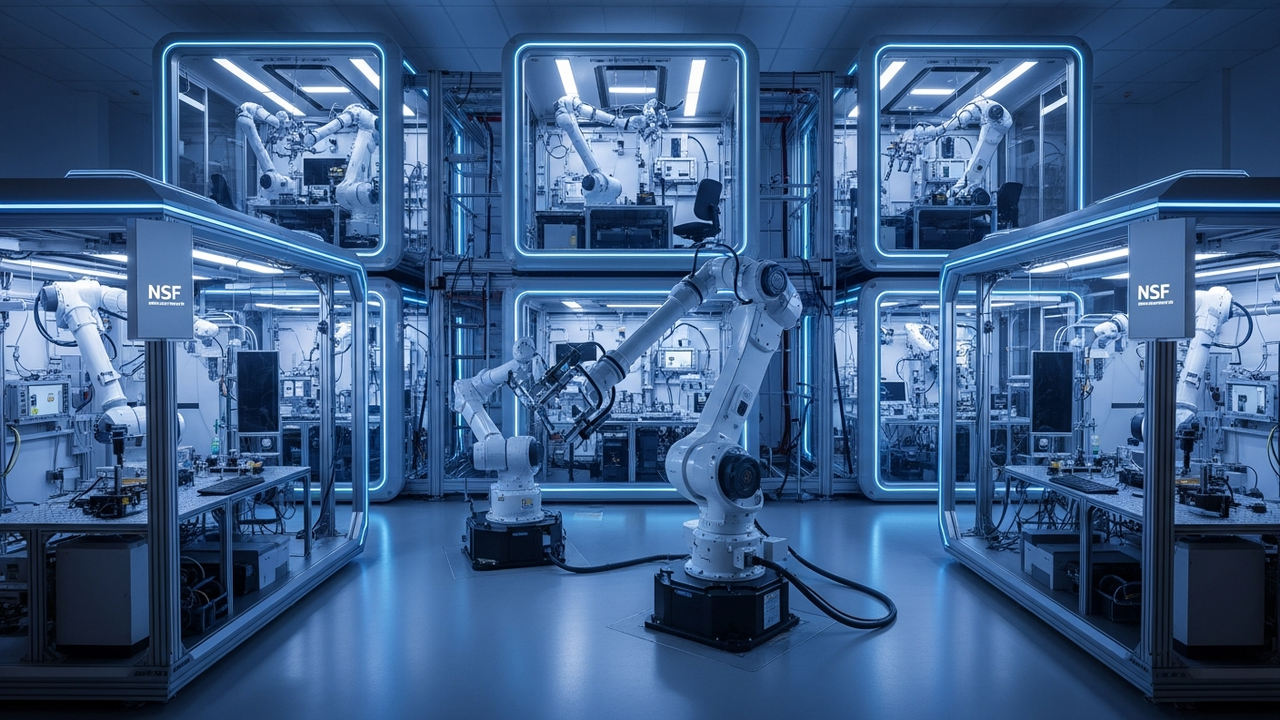
The U.S. National Science Foundation (NSF) has unveiled a monumental $380 million initiative to establish a nationwide network of ‘self-driving’ laboratories. This transformative program is designed to create systems where artificial intelligence (AI) autonomously designs experiments, and robotic arms execute them with precision. A pivotal component of this network is North Carolina State University’s ‘SPEED Lab,’ which received a $20 million grant for its development. These advanced laboratories are uniquely capable of learning from each completed experiment and autonomously designing new ones to maximize the probability of success, holding the potential to reduce the time from molecular discovery to achieving desired outcomes by over 100-fold.
Technical Details
The self-driving lab network integrates several core technological components to achieve its ambitious goals:
- AI-Driven Experimental Design: Advanced AI models, encompassing machine learning and large language models, analyze vast amounts of existing scientific knowledge, experimental data, and simulation results. This enables them to predict optimal experimental conditions and next research steps, significantly accelerating and optimizing the human-led hypothesis generation and validation cycle.
- Robotic Arms and Automated Systems: Following AI-designed experimental protocols, robotic arms and other automated instruments execute material synthesis, processing, and characterization with high precision and speed. This significantly enhances experimental reproducibility and minimizes human-induced errors, which are common in manual laboratory work.
- Closed-Loop Learning: Upon the completion of each experiment, results are fed back to the AI in real-time. This continuous feedback loop allows AI models to update their learning data, enabling them to become progressively ‘smarter.’ This iterative learning enhances the AI’s capability to explore complex material systems and elucidate difficult-to-predict phenomena, pushing the boundaries of scientific understanding.
- Networked Infrastructure: Research hubs across the nation will be interconnected via a robust, cloud-based platform. This infrastructure facilitates the seamless sharing of data, software, and experimental protocols, democratizing access to advanced research resources and fostering large-scale collaborative research efforts.
This integrated system dramatically shortens the timeline required from initial molecular discovery to the development of functional materials and the achievement of intended outcomes. For instance, processes that traditionally demanded months or even years—such as screening new drug candidates, optimizing clean energy materials, or developing advanced semiconductors—could potentially be completed in a matter of days or weeks. This acceleration directly translates to reduced R&D costs and a faster time-to-market, fundamentally altering the pace and economics of innovation across various industries.
Future Outlook
This self-driving lab network has the profound potential to fundamentally redefine the materials science discovery process. Individual hubs, such as North Carolina State University’s SPEED Lab, will each cultivate distinct specializations while collaborating seamlessly within the broader network to tackle overarching scientific challenges. In the future, critical research areas will also encompass aspects such as AI model safety, ethics, and the nuanced dynamics of human-AI collaboration. Should this pioneering initiative succeed, the transition from foundational laboratory research to impactful industrial application will be significantly accelerated, paving the way for unprecedented innovative products and technologies across critical sectors including clean energy, healthcare, defense, and information technology.
Get our weekly technology intelligence — free
Receive an infographic that lets you judge at a glance whether each field’s analysis report is worth reading.
Subscribe Free — Weekly Tech Intelligence
By subscribing, you’ll receive Troy-Technical’s weekly technology intelligence newsletter.
- Your email and selected fields are used only to deliver the newsletter.
- We never share your information with third parties.
- You can unsubscribe anytime via the link in each email.
See our Privacy Policy for details.
Takes about a minute · Unsubscribe anytime