Key Findings
Rice University has been awarded a substantial $19.9 million grant from the U.S. National Science Foundation (NSF) to launch the ‘READINESS’ project. This ambitious initiative aims to revolutionize the discovery and manufacturing of electronic and quantum materials by integrating artificial intelligence (AI), robotics, and cloud-based laboratory operations. The project’s primary goal is to accelerate materials development, significantly minimize iterative trial-and-error, and broaden access to advanced research infrastructure, thereby establishing an autonomous platform for materials science.
Technical Details
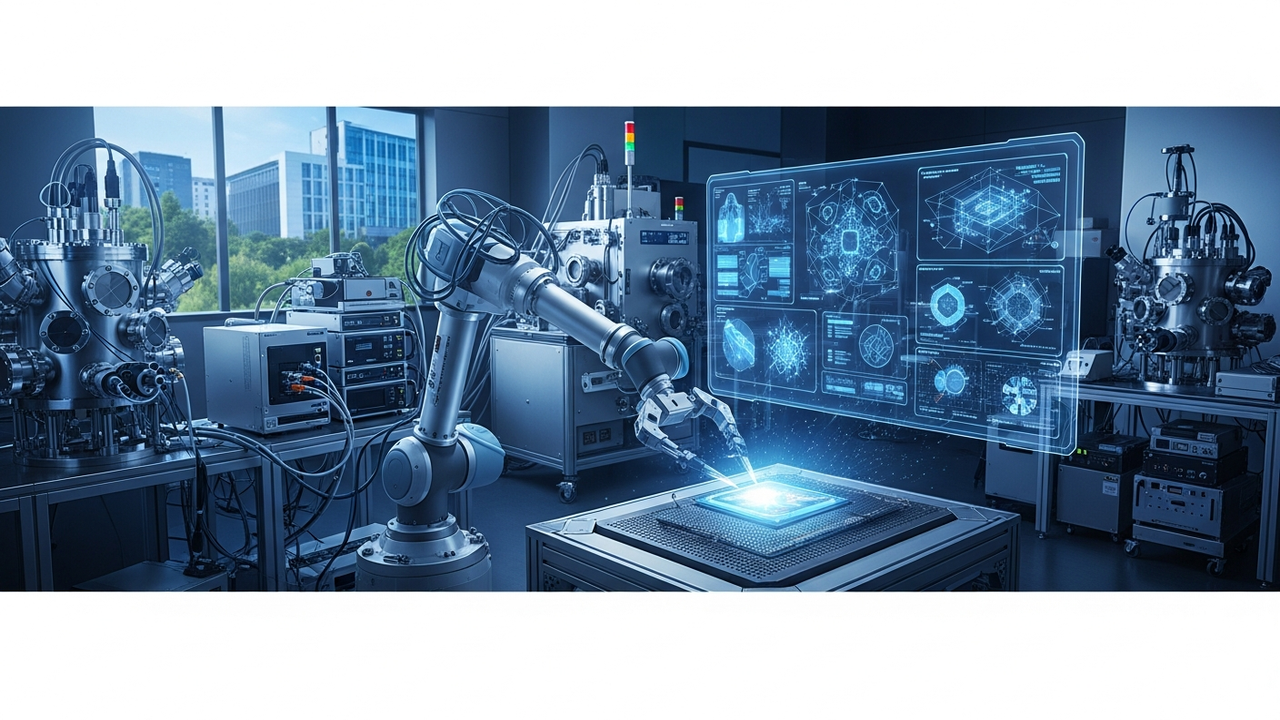
The READINESS project is designed around a self-driving laboratory concept, comprising integrated sophisticated components:
- Automated Synthesis and Robotic Systems: These systems will perform material synthesis, processing, and characterization with minimal human intervention, dramatically increasing experimental throughput and reproducibility. This automated workflow reduces manual errors and accelerates data generation crucial for AI model training.
- Advanced Material Characterization Tools: High-speed, high-precision tools will measure the physical, chemical, and electrical properties of newly developed materials, generating vast datasets that inform the AI.
- Digital Twins: A real-time digital replica of the physical experimental setup will simulate processes, predict outcomes, and optimize experimental parameters. This virtual environment reduces the need for physical experiments, optimizing resource utilization and speeding up the design cycle.
- AI Agents: Central to the autonomy, these machine learning algorithms will analyze historical experimental data and insights from the digital twin to autonomously recommend the next optimal experiments. This intelligent guidance streamlines the discovery pathway, allowing for faster identification of materials with desired properties.
This integrated approach is particularly critical for electronic and quantum materials, which demand precise control and exhibit complex properties. By shortening development cycles, READINESS is expected to accelerate the market introduction of new materials for advanced technologies. The remote-access platform will also democratize scientific discovery, offering researchers worldwide access to state-of-the-art facilities regardless of geographical location.
Background and Industry Context
Electronic and quantum materials are foundational to next-generation computing, communications, and energy technologies, making their accelerated discovery and manufacturing a national priority. Traditional materials development, often characterized by costly and time-consuming processes, has been a significant bottleneck, especially for the intricate control required for quantum materials. The NSF’s substantial investment underscores a strategic commitment to maintaining U.S. leadership in scientific and technological innovation and enhancing industrial competitiveness. Globally, the development of autonomous laboratories combining AI and robotics is at the forefront of materials science research, with nations vying for dominance in this transformative field.
Future Outlook
The READINESS project is poised to fundamentally transform the landscape of materials discovery. It is anticipated to foster new research communities and interdisciplinary collaborations. The high-quality, rich datasets generated will also fuel the development of even more advanced AI models, facilitating the design of increasingly complex materials and the elucidation of previously intractable phenomena. This initiative is expected to have a profound impact not only on academic research but also on industrial product development in sectors such as semiconductors, sensors, and quantum computing, ultimately invigorating the entire innovation ecosystem.
Get our weekly technology intelligence — free
Receive an infographic that lets you judge at a glance whether each field’s analysis report is worth reading.
Subscribe Free — Weekly Tech Intelligence
By subscribing, you’ll receive Troy-Technical’s weekly technology intelligence newsletter.
- Your email and selected fields are used only to deliver the newsletter.
- We never share your information with third parties.
- You can unsubscribe anytime via the link in each email.
See our Privacy Policy for details.
Takes about a minute · Unsubscribe anytime