Key Findings
VIVOLTA has highlighted that its EC-CLI electrospinning machine is revolutionizing nanofiber production across a wide array of industrial sectors, including filtration, energy storage, smart textiles, and agriculture. This technology, particularly in the context of biodegradable nanofiber seed coatings for agriculture, holds significant potential to contribute to sustainable farming practices by enabling precise control over the slow-release profiles of nutrients and crop protection agents, as well as their biodegradation rates.
Technical / Clinical Details
VIVOLTA’s EC-CLI electrospinning machine continuously produces ultra-fine nanofibers by electrospinning polymer solutions under high voltage. This process allows for the formation of nanofiber mats and membranes with diameters ranging from a few nanometers to several hundred nanometers, characterized by a high surface-area-to-volume ratio and excellent mechanical properties. A key feature of this machine is its precise control over process parameters, enabling the reproducible manufacturing of nanofibers with structures and properties tailored for specific applications, using various polymer materials and composite materials.
In specific application areas, the EC-CLI offers innovations such as:
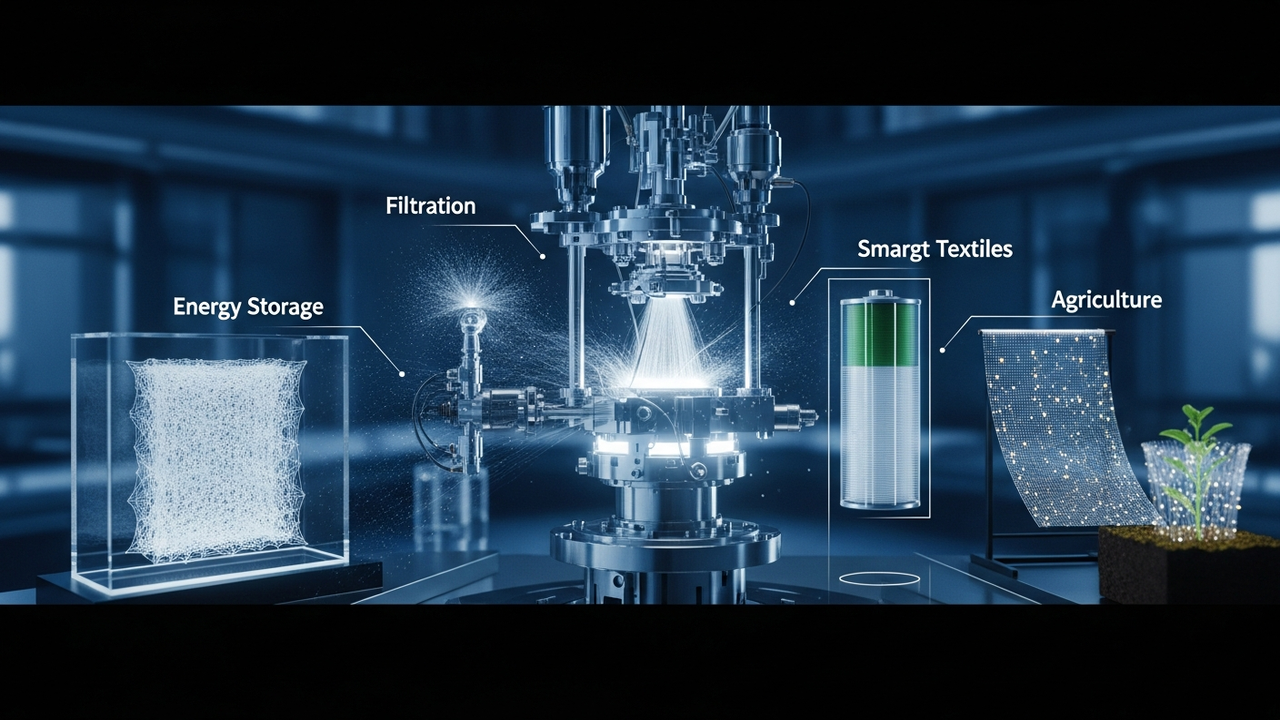
- Filtration: Nanofiber membranes with extremely fine pore sizes are utilized in advanced air and water filtration systems, efficiently capturing microparticles, bacteria, and viruses. This improves the performance of medical masks, air purifiers, and water treatment filters.
- Energy Storage: High-surface-area nanofibers are used as separators or electrode materials in lithium-ion batteries and as active materials in supercapacitors, contributing to improvements in energy density, charging speed, and cycle life.
- Smart Textiles: By incorporating nanofibers with conductive, sensing, or drug-release capabilities into fabrics, wearable sensors, medical textiles, and smart clothing can be developed.
- Agriculture: Particularly noteworthy are biodegradable nanofiber seed coatings manufactured from biodegradable polymers. These coatings can be designed to slowly release nutrients, water, and crop protection agents to seeds, contributing to improved germination rates, protection against pests and diseases, and water conservation. Precise control over release profiles and biodegradation rates enables optimal supply tailored to crop growth stages.
VIVOLTA focuses on solving persistent process challenges (e.g., controlling uniform fiber diameter, ease of scale-up) to help researchers achieve reproducible results faster, thereby promoting the widespread practical application of nanofiber technology.
Background & Context
Nanofiber technology is attracting attention across various industrial sectors due to its multi-functionality and applicability to diverse materials. The role of nanofibers is becoming increasingly important, especially with the growing demand for sustainable solutions to global challenges such as environmental issues, energy crises, and food security. Electrospinning is one of the most common and versatile methods for manufacturing nanofibers, and its technological maturity and application potential are expanding year by year. Advanced electrospinning machines provided by companies like VIVOLTA are essential for bridging the gap between research and development and industrial application.
Strategic Significance & Outlook
Nanofiber production technology using VIVOLTA’s EC-CLI electrospinning machine is expected to undergo further advancements. Future focus areas will likely include improved process automation, the exploration of new polymers and composite materials, and the development of more complex multi-layered structures and functional nanofibers. In agriculture, combined with advancements in precision farming, nanofiber coatings hold significant potential to contribute to increased crop productivity and reduced environmental impact. In the medical field, applications as tissue engineering scaffolds and drug delivery systems will further deepen. Through these technological innovations, VIVOLTA aims to contribute to the realization of a sustainable society and enhance the competitiveness of various industrial sectors. Progress in international regulations and standardization will also be crucial factors in promoting the widespread adoption of nanofiber technology.
Source: https://www.vivolta.com/electrospinning-machine/applications/
Get our weekly technology intelligence — free
Receive an infographic that lets you judge at a glance whether each field’s analysis report is worth reading.
Subscribe Free — Weekly Tech Intelligence
By subscribing, you’ll receive Troy-Technical’s weekly technology intelligence newsletter.
- Your email and selected fields are used only to deliver the newsletter.
- We never share your information with third parties.
- You can unsubscribe anytime via the link in each email.
See our Privacy Policy for details.
Takes about a minute · Unsubscribe anytime