Key Findings
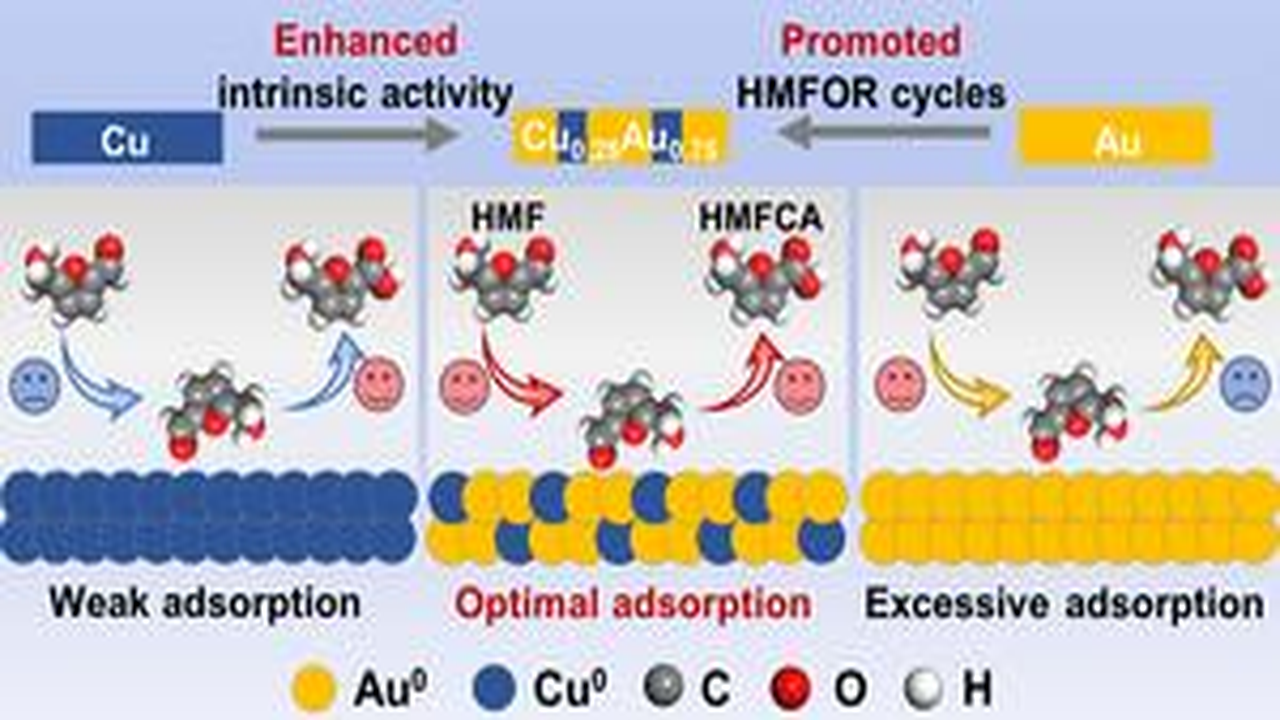
Researchers have successfully developed a groundbreaking CuAu alloy electrocatalyst capable of simultaneously achieving high-efficiency biomass upgrading and bipolar hydrogen production at an unprecedented ultralow voltage of just 0.45 V. This optimized Cu₀.₂₅Au₀.₇₅ catalyst demonstrated exceptional performance in the electrocatalytic oxidation of 5-hydroxymethylfurfural (HMF) to 5-hydroxymethyl-2-furancarboxylic acid (HMFCA), reaching a remarkable HMFCA yield of 94.5% and an extremely high Faradaic efficiency of 98.6%. This technology offers a dual benefit: producing high-value chemicals from renewable biomass resources while also generating green hydrogen sustainably.
Technical / Clinical Details
The developed CuAu alloy electrocatalyst achieves its high activity and selectivity through a synergistic effect between copper and gold. Specifically, the particular composition ratio of Cu₀.₂₅Au₀.₇₅ was shown to provide optimal catalytic sites for both HMF oxidation and the hydrogen evolution reaction (HER). Alloying enabled fine-tuning of the electronic states and atomic arrangements on the catalyst surface, optimizing the adsorption energy of reaction intermediates. This significantly enhanced the selectivity from HMF to HMFCA while efficiently promoting hydrogen generation via water splitting. Conventionally, HMFCA synthesis from HMF required high temperatures, high pressures, noble metal catalysts, or high voltages. The innovation lies in this new catalyst’s ability to drive the reaction under mild conditions and ultralow voltage, drastically reducing the overall energy consumption of the process and lowering its environmental footprint.
Background & Context
Achieving a sustainable society necessitates reducing reliance on fossil fuels and producing energy and chemicals from renewable resources, a pressing global challenge. Biomass, owing to its abundance and carbon-neutral properties, is gaining attention as a critical feedstock for future chemical and energy industries. However, processes for synthesizing biomass-derived chemicals and producing green hydrogen have historically faced challenges related to high energy costs and efficiency. Electrocatalytic technologies like this research are key to overcoming these hurdles and accelerating the transition to a biomass-based circular economy. HMF is an easily obtainable platform chemical from biomass, and HMFCA is a high-value compound with applications in pharmaceuticals, polymers, and fuel additives.
Strategic Significance & Outlook
The discovery of this CuAu alloy electrocatalyst will significantly impact both green hydrogen production and biomass upgrading sectors. Future research will likely focus on the catalyst’s long-term stability, scalability, and applicability to various types of biomass feedstocks. Furthermore, its potential for application to other biomass-derived platform molecules is anticipated. If commercialized, this technology could accelerate the decarbonization of the chemical industry, contribute to the widespread adoption of hydrogen as a sustainable energy source, and offer economic benefits by reducing the production cost of high-value chemicals. For researchers, engineers, and investors, such electrocatalytic materials will be a focal point in shaping the future of clean energy and sustainable chemistry.
Source: https://www.eurekalert.org/news-releases/1134959
Get our weekly technology intelligence — free
Receive an infographic that lets you judge at a glance whether each field’s analysis report is worth reading.
Subscribe Free — Weekly Tech Intelligence
By subscribing, you’ll receive Troy-Technical’s weekly technology intelligence newsletter.
- Your email and selected fields are used only to deliver the newsletter.
- We never share your information with third parties.
- You can unsubscribe anytime via the link in each email.
See our Privacy Policy for details.
Takes about a minute · Unsubscribe anytime