Key Findings
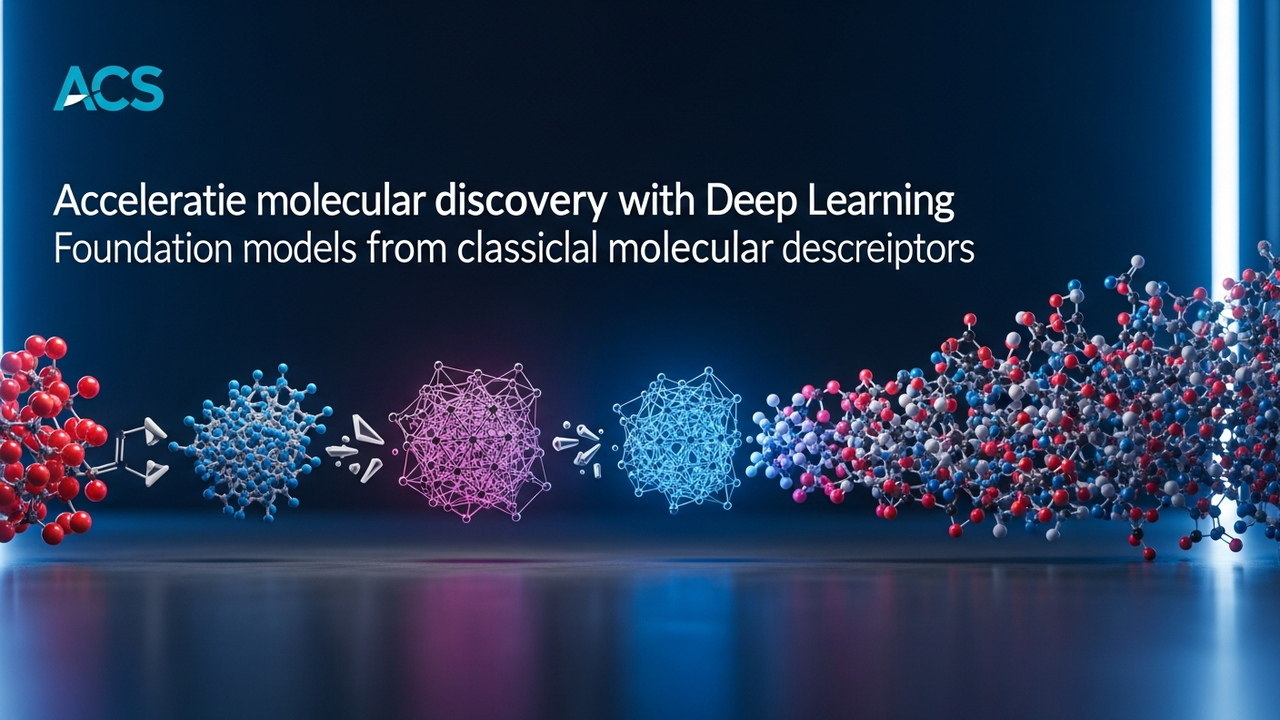
Research published in ACS Publications explores the development of deep learning foundation models tailored for low-data regimes (situations with limited available data) derived from classical molecular descriptors. By pre-training these models to predict such descriptors, they internalize a wealth of chemical knowledge, offering a rapid and reliable alternative to expensive experiments and simulations. This approach dramatically accelerates the discovery process for molecules with desired properties.
Technical / Clinical Details
This study leverages traditional molecular descriptors (e.g., physicochemical properties, structural features, fingerprints) as inputs for deep learning models. The foundation models are initially pre-trained on large datasets to predict the complex relationships between these descriptors. Through this pre-training phase, the models acquire extensive chemical knowledge regarding molecular structures and their corresponding properties. Subsequently, the models are fine-tuned using a small amount of target data for specific prediction tasks (e.g., solubility, toxicity, reactivity, material properties). This ‘pre-train and fine-tune’ approach enables high-accuracy predictions even with limited data, compared to training models from scratch. This technology is particularly effective for significantly reducing time and cost in fields like drug discovery and materials science, where costly synthesis or in vitro/in vivo testing is required, efficiently narrowing down promising candidate molecules.
Background & Context
In drug discovery and new material development, the search space for candidate molecules is vast, while experimental data collection is time-consuming and expensive. Especially in the development of drugs for rare diseases or specialized functional materials, a ‘low-data regime’ (where limited data is available) is often the norm. In such scenarios, predictive models utilizing AI and machine learning are key to enhancing research efficiency. Foundation models, capable of transferring knowledge learned from large general datasets to specific tasks, are gaining attention as powerful solutions to low-data regime problems. This technology stands at the forefront of AI-driven science, holding the potential to resolve R&D bottlenecks.
Strategic Significance & Outlook
Deep learning foundation models from classical molecular descriptors hold the potential to revolutionize the field of molecular discovery. The advancement of this technology will enable researchers to more rapidly identify molecules with desired pharmacological or material properties through fewer experiments. This will accelerate innovation across a wide range of fields, including the development of new therapeutics, the design of high-performance materials, and the optimization of environmentally friendly chemical processes. In the future, these foundation models are expected to evolve to predict more complex molecular systems and dynamic processes, further enhancing the speed and efficiency of scientific discovery. This serves as a powerful example of how AI, through the fusion of chemistry and materials science, can contribute to human health and welfare, and the realization of a sustainable society.
Get our weekly technology intelligence — free
Receive an infographic that lets you judge at a glance whether each field’s analysis report is worth reading.
Subscribe Free — Weekly Tech Intelligence
By subscribing, you’ll receive Troy-Technical’s weekly technology intelligence newsletter.
- Your email and selected fields are used only to deliver the newsletter.
- We never share your information with third parties.
- You can unsubscribe anytime via the link in each email.
See our Privacy Policy for details.
Takes about a minute · Unsubscribe anytime