Key Findings
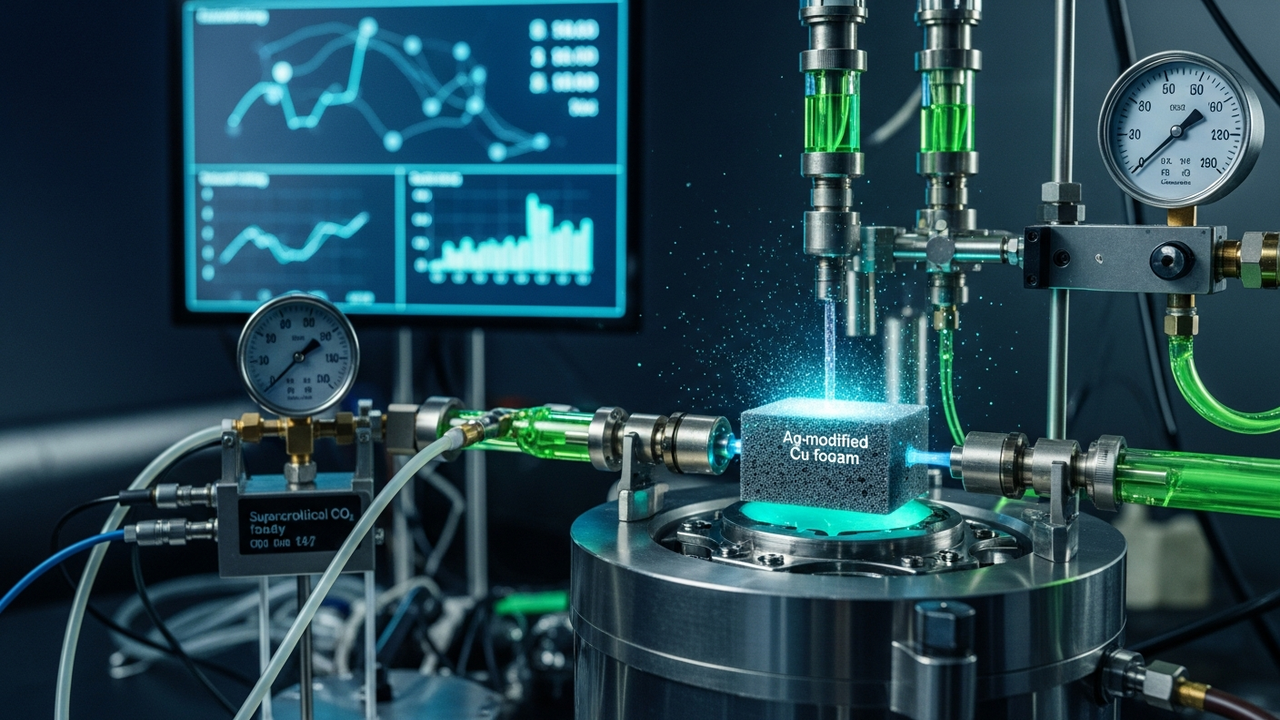
This research proposes a groundbreaking strategy for highly selective electrocatalytic CO2 reduction (eCO2RR) to methanol, utilizing supercritical CO2 (ScCO2) as both reactant and reaction medium in conjunction with an Ag-modified Cu foam (Ag/Cu foam) catalyst. Under optimized supercritical conditions (35°C, 8 MPa), the Ag/Cu foam catalyst achieved a remarkable Faradaic efficiency (FE) of 66.16% for methanol, substantially outperforming both pure Cu foam and systems operating under ambient conditions. This discovery paves a new pathway towards highly efficient CO2 valorization processes that convert CO2 into valuable chemicals.
Technical Details
Electrocatalytic CO2 reduction is a promising technology for converting CO2 into fuels and chemical feedstocks using renewable energy. However, achieving both high selectivity and high efficiency has remained a challenge. The ScCO2 employed in this study offers advantages over conventional gaseous CO2, including high solubility, low diffusion resistance, and a homogeneous reaction environment. This facilitates CO2 supply to the catalyst surface, thereby increasing reaction rates. The Ag/Cu foam catalyst leverages a synergistic effect: Ag promotes CO2 activation, while Cu has the ability to convert CO intermediates into methanol. Notably, under the supercritical CO2 environment, the structural stability of the Cu foam is maintained, and the dispersion of Ag nanoparticles is optimized, leading to an increase in catalytic active sites and highly efficient methanol production. Achieving high efficiency under relatively mild conditions of 35°C and 8 MPa represents a significant step towards the practical implementation of this process.
Background and Industry Context
As a climate change mitigation strategy, CO2 valorization technologies that capture and reuse atmospheric carbon dioxide (CO2) as fuel or chemical feedstock are urgently needed. Electrocatalytic CO2 reduction is gaining attention as a sustainable CO2 valorization technology because it can utilize renewable energy sources such as solar and wind power. However, it often suffers from low selectivity toward a single desired product (e.g., methanol, formic acid, CO) and insufficient energy efficiency. This research innovatively combines catalyst design with a novel reaction environment (supercritical fluid) to overcome these challenges, demonstrating groundbreaking high-selective conversion specifically to methanol, a valuable liquid fuel.
Strategic Significance and Outlook
This technology for methanol production from supercritical CO2 using an Ag-modified Cu foam catalyst has the potential to establish a new standard for CO2 valorization. Methanol can be directly used as fuel, as a basic chemical feedstock for the chemical industry, and as a hydrogen carrier; its high-efficiency production brings widespread economic and environmental benefits. Going forward, researchers will address challenges related to long-term catalyst stability, further improvements in Faradaic efficiency, and reactor scale-up. Furthermore, the principles of this supercritical CO2 electrocatalytic reaction are expected to be applied to other CO2 reduction products and extended to various nanocatalyst systems. If commercialized, this technology could realize large-scale processes for capturing CO2 from industrial emitters and converting it into high-value chemicals, contributing significantly to building a sustainable circular economy.
Get our weekly technology intelligence — free
Receive an infographic that lets you judge at a glance whether each field’s analysis report is worth reading.
Subscribe Free — Weekly Tech Intelligence
By subscribing, you’ll receive Troy-Technical’s weekly technology intelligence newsletter.
- Your email and selected fields are used only to deliver the newsletter.
- We never share your information with third parties.
- You can unsubscribe anytime via the link in each email.
See our Privacy Policy for details.
Takes about a minute · Unsubscribe anytime