Key Findings
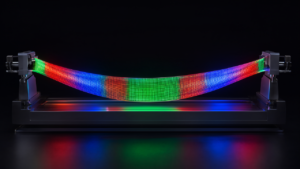
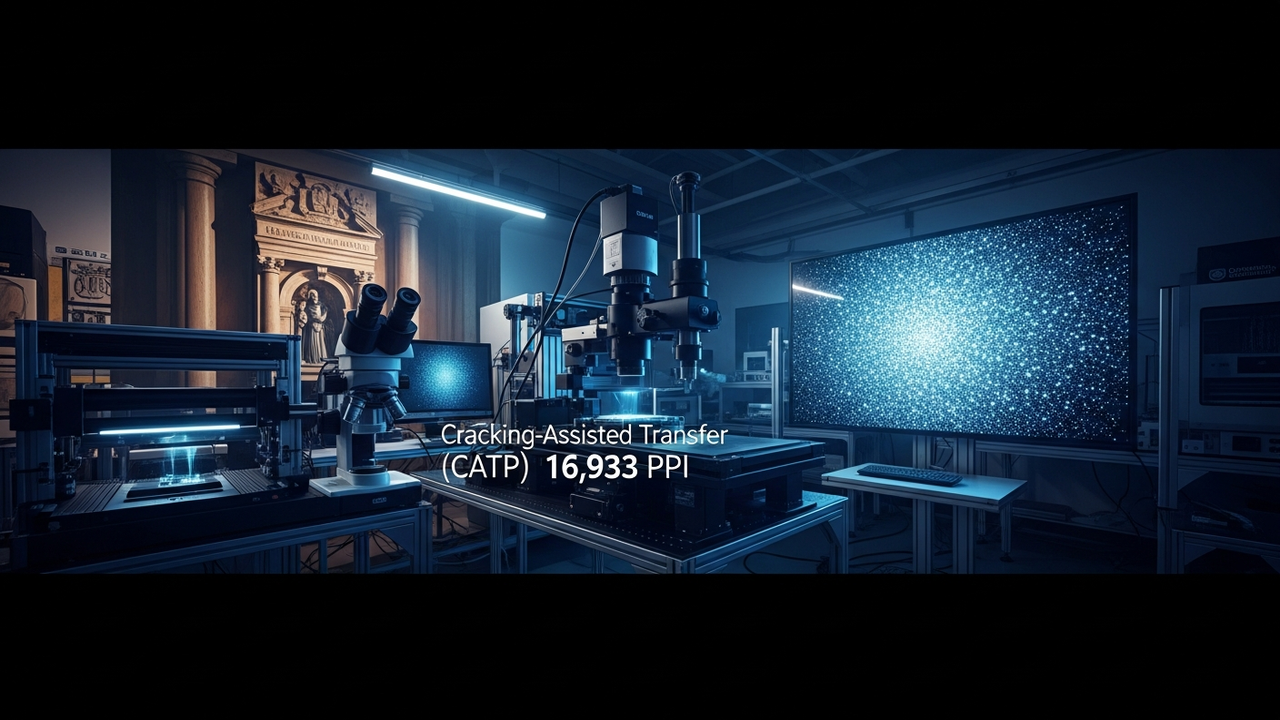
Researchers at the University of Cambridge have achieved a significant breakthrough in ultra-high-resolution quantum dot (QD) display manufacturing, poised to transform the future of augmented reality (AR) and virtual reality (VR). They developed an innovative technique called ‘Cracking-Assisted Transfer Printing’ (CATP), successfully patterning cadmium-free quantum dot pixels as minute as 600 x 900 nanometers. This enabled the demonstration of full-color QD-LED arrays larger than 4 inches with an astonishing resolution of 16,933 pixels per inch (PPI). This achievement promises unprecedented visual fidelity and color reproduction, drastically enhancing immersive user experiences.
Technical Details
The CATP process utilizes controlled cracking to precisely transfer inorganic colloidal quantum dots onto pixel arrays. Compared to conventional QD patterning techniques, CATP significantly boosts electroluminescent performance, yielding higher maximum brightness and extended operational lifetimes. The technology is compatible with thin-film transistor (TFT) backplanes, facilitating the fabrication of active-matrix, full-color QD-LED displays. The cadmium-free nature of the quantum dots represents a crucial environmental and health benefit. The research team has also indicated the scalability of this method for large-scale production, outlining a concrete path towards future commercialization.
Background and Industry Context
Quantum dots have been recognized as a leading candidate for next-generation display technology due to their superior color purity, energy efficiency, and long lifespan. However, technical hurdles in efficiently, uniformly, and large-scale patterning minute pixels have impeded widespread commercial adoption. Existing methods like photolithography and inkjet printing often degrade the delicate properties of quantum dots or face limitations in resolution and uniformity. The Cambridge University CATP technology addresses these challenges head-on, offering the potential to deliver hyper-realistic visual experiences, especially critical for high-pixel-density AR/VR headsets, which often struggle with ‘screen-door effects’ and pixelation.
Strategic Significance and Outlook
This breakthrough has the potential to fundamentally redefine display technology for AR/VR devices. By overcoming the limitations of current AR/VR headsets, CATP-enabled ultra-high-resolution displays can offer unparalleled immersion. Furthermore, this technology could profoundly impact other high-definition display markets, including smartphones, televisions, and wearables. The research team is pursuing further optimization and scalability enhancements, with prototypes expected within a few years and eventual integration into commercial products. This marks a significant step towards developing more vivid and energy-efficient next-generation products across the entire display industry.
Source: #
Get our weekly technology intelligence — free
Receive an infographic that lets you judge at a glance whether each field’s analysis report is worth reading.
Subscribe Free — Weekly Tech Intelligence
By subscribing, you’ll receive Troy-Technical’s weekly technology intelligence newsletter.
- Your email and selected fields are used only to deliver the newsletter.
- We never share your information with third parties.
- You can unsubscribe anytime via the link in each email.
See our Privacy Policy for details.
Takes about a minute · Unsubscribe anytime