Key Findings
An innovative closed-loop framework for the fully autonomous synthesis of promising materials predicted by computational science has been unveiled. This system tightly integrates the automated extraction of synthesis knowledge from literature using Large Language Models (LLMs), rapid thin-film characterization through high-throughput hyperspectral imaging, and multi-objective Bayesian optimization informed by experimental feedback. The framework’s effectiveness was demonstrated in the synthesis of thin films of the previously unreported perovskite compound Rb3BiI6, providing a powerful strategy to autonomously accelerate materials discovery through iterative learning.
Technical / Clinical Details
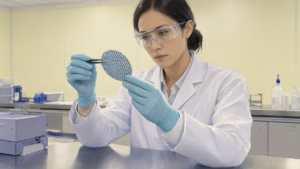
This closed-loop framework combines state-of-the-art AI and robotics. First, LLMs analyze vast academic literature in materials science to automatically extract critical knowledge regarding synthesis pathways and conditions for specific materials, significantly reducing the time researchers spend on manual literature review. Next, based on this knowledge and computational predictions, a robotic system performs initial synthesis experiments. The synthesized thin films are then rapidly and non-destructively evaluated for their composition, crystal structure, and optical properties using a high-throughput hyperspectral imaging system. This rapid evaluation is crucial for accelerating the learning loop. The collected data is fed into a multi-objective Bayesian optimization algorithm, which proposes the next optimal synthesis conditions or experimental parameters. This process iteratively continues until desired material properties are achieved. For Rb3BiI6 thin-film synthesis, the system demonstrated its ability to efficiently generate high-quality target materials from initial rough films within a few iterations, proving a dramatic reduction in development time and resources compared to traditional human-led trial-and-error processes.
Background & Context
Perovskite materials are highly regarded as next-generation functional materials due to their excellent performance in a wide range of fields, including solar cells, LEDs, catalysts, and sensors. However, the diverse chemical compositions and structures of perovskites make it extremely challenging to find their optimal synthesis conditions. Traditional materials synthesis research has been labor-intensive, time-consuming, and often characterized by low success rates. The advancements in AI and automated laboratories (autonomous labs) resolve this bottleneck, enabling faster and more efficient discovery and optimization of new materials. This closed-loop framework represents a significant step towards realizing the ‘Fifth Paradigm’ of materials science, where AI autonomously drives scientific discovery.
Strategic Significance & Outlook
The success of this closed-loop autonomous synthesis framework holds the potential to revolutionize R&D in materials science. In the future, this approach is expected to be applied to other complex material systems beyond perovskites, such as multi-element alloys and polymeric materials, thereby dramatically improving the speed and efficiency of new material development. This technology will enable the market introduction of innovative materials—essential for addressing global challenges in sustainable energy, environmental protection, and advanced electronics—at an unprecedented pace. It is expected to accelerate the realization of ‘smart labs’ where humans and AI collaborate, significantly expanding the frontiers of scientific discovery.
Source: https://arxiv.org/abs/2608.15928
Get our weekly technology intelligence — free
Receive an infographic that lets you judge at a glance whether each field’s analysis report is worth reading.
Subscribe Free — Weekly Tech Intelligence
By subscribing, you’ll receive Troy-Technical’s weekly technology intelligence newsletter.
- Your email and selected fields are used only to deliver the newsletter.
- We never share your information with third parties.
- You can unsubscribe anytime via the link in each email.
See our Privacy Policy for details.
Takes about a minute · Unsubscribe anytime