Background
Modern medicine is rapidly advancing towards more personalized, preventive, and accessible care models. Historically, diagnostic methods have relied on centralized laboratory facilities, which often entail lengthy processing times and significant logistical challenges, particularly in urgent medical scenarios or geographically remote regions. The critical importance of early detection for diseases such as cancer, cardiovascular conditions, and infectious diseases, directly impacting treatment success rates, has intensified the demand for rapid and precise diagnostic technologies. The synergistic convergence of single-cell analysis, microfluidics, biosensors, and AI offers powerful, multifaceted solutions to these pressing needs. As a result, diagnostic capabilities are expanding beyond traditional hospitals and research laboratories into local clinics, pharmacies, and even directly into patients’ homes, thereby accelerating the development of a decentralized healthcare ecosystem.
Key Findings
A comprehensive industry overview, dated September 7, 2026, unequivocally states that groundbreaking advancements in diagnostic technology are powered by four core domains: single-cell analysis, microfluidics, biosensors, and Artificial Intelligence (AI). The integrated application of these technologies is facilitating unprecedentedly rapid and precise disease detection, even at their incipient stages. These sophisticated tools are fundamentally reshaping the diagnostic paradigm by expanding the scope of investigable biological signals and enabling the interpretation of increasingly complex biomarker signatures. Furthermore, the overview underscores their profound significance in enabling decentralized and remote diagnostics, promising substantial improvements in patient care accessibility and operational efficiency.
Technical/Clinical Details
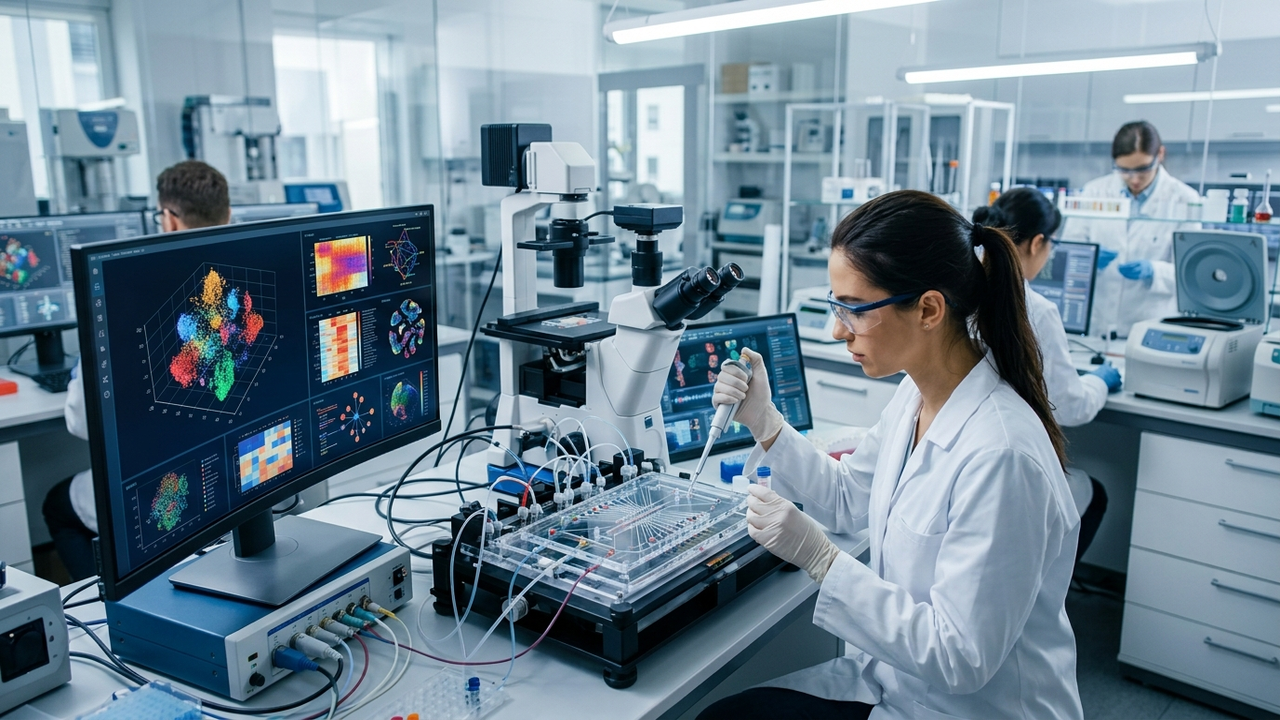
Single-cell analysis provides the capability to scrutinize gene expression, proteins, and metabolites at the resolution of individual cells, thereby enabling highly precise diagnostics that meticulously account for tissue heterogeneity. Microfluidics involves the precise manipulation of minute fluid volumes within microscopic channels, inherently reducing reagent consumption, significantly shortening analysis times, and achieving high-throughput processing. This technology facilitates efficient multi-analyte testing from minimal sample volumes, such as a single drop of blood, or enables highly effective cell separation and enrichment. Biosensors are sophisticated devices engineered for the highly sensitive, real-time detection of specific biomolecules (e.g., glucose, DNA, proteins, viruses), leveraging diverse transduction principles including electrochemical, optical, and piezoelectric mechanisms. Artificial Intelligence (AI) serves as the crucial analytical engine, processing the immense datasets generated by these three antecedent technologies. AI algorithms are adept at recognizing complex patterns and constructing robust diagnostic models capable of identifying subtle disease indicators that might escape human expert observation. For instance, AI can seamlessly integrate multi-dimensional data streams from biosensors with comprehensive patient clinical information to yield more accurate disease risk scores and refined prognostic predictions.
Strategic Significance & Outlook
The profound fusion of these innovative technologies is set to fundamentally reshape the future landscape of diagnostics. Looking ahead, we anticipate the seamless integration of multifunctional lab-on-a-chip devices with AI, enabling the real-time analysis of dozens, even hundreds, of biomarkers from remarkably small biological samples. This convergence will dramatically enhance personalized disease screening, facilitate earlier interventions, and provide more precise monitoring of treatment responses. Crucially, their integration with advanced telehealth platforms and wearable devices will empower patients to receive specialized diagnoses and continuous health monitoring remotely, from the convenience and comfort of their homes. However, the widespread adoption of these novel diagnostic tools hinges on several critical factors: the streamlining of approval processes by regulatory bodies, robust solutions for data privacy and security, and the adaptive evolution of healthcare system reimbursement models. These synergistic technologies are not merely incremental improvements; they are poised to fulfill the ambitious promise of precision medicine and become a central driving force in significantly elevating global health and well-being.
Get our weekly technology intelligence — free
Receive an infographic that lets you judge at a glance whether each field’s analysis report is worth reading.
Subscribe Free — Weekly Tech Intelligence
By subscribing, you’ll receive Troy-Technical’s weekly technology intelligence newsletter.
- Your email and selected fields are used only to deliver the newsletter.
- We never share your information with third parties.
- You can unsubscribe anytime via the link in each email.
See our Privacy Policy for details.
Takes about a minute · Unsubscribe anytime





Comments