Background
Early cancer detection is paramount for improving treatment success rates and patient prognosis. Conventional diagnostic technologies, however, frequently contend with limitations such as invasiveness, inadequate sensitivity, and high detection limits. Terahertz (THz) biosensing is garnering significant global attention as a next-generation diagnostic technology poised to overcome these challenges. Amidst the accelerating shift towards personalized medicine, there is an escalating demand for non-invasive and highly sensitive biomarker detection techniques. THz technology holds the potential to significantly enhance the accuracy of ‘liquid biopsies’ conducted from bodily fluids like blood and urine. Furthermore, its anticipated integration with 6G communication technologies is slated to become a critical component of future healthcare infrastructure, enabling ultra-fast transmission and analysis of vast medical datasets, thereby facilitating precise diagnostics and remote patient monitoring.
Key Findings
Terahertz (THz) biosensing has been identified as an exceptionally promising technology for early cancer detection and a broad spectrum of biomedical applications. Its non-destructive molecular fingerprinting capability offers distinct advantages over traditional diagnostic methods. A notable recent achievement is the successful detection of liver cancer biomarkers using a THz metamaterial biosensor, seamlessly integrated with microfluidics. This innovation underscores the technology’s considerable potential for further enhancement through the incorporation of Artificial Intelligence/Machine Learning (AI/ML) and next-generation 6G communication technologies.
Technical/Clinical Details
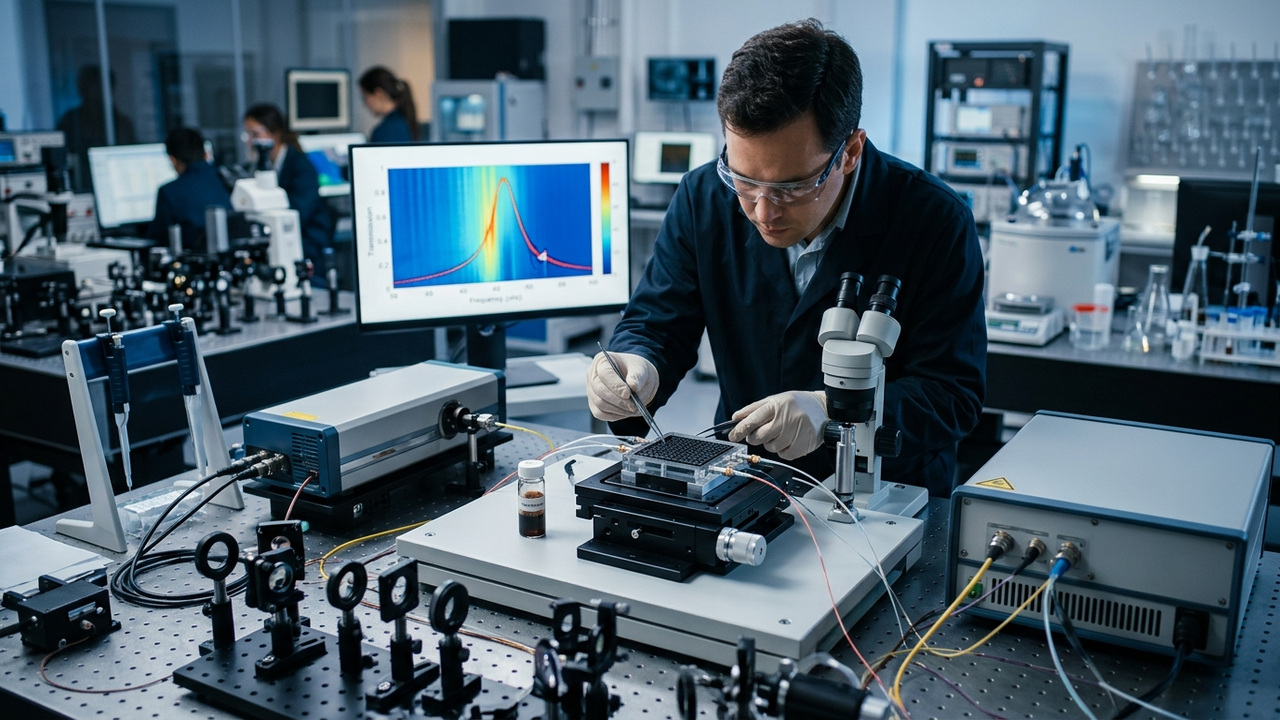
Terahertz waves, positioned within the electromagnetic spectrum between microwaves and infrared, possess unique properties ideal for detecting the vibrational and rotational transitions of biomolecules. This capability allows for the precise identification of specific molecular ‘fingerprints’ without inducing sample damage. The THz metamaterial biosensor described leverages engineered microstructures (metamaterials) to significantly enhance the interaction between THz waves and target analytes, thereby boosting detection sensitivity. For liver cancer biomarker detection, this sensor demonstrated the ability to capture specific molecular signals from trace biological samples, indicating the potential for early disease manifestation. The integration of microfluidic technology facilitates automated, miniaturized sample processing, leading to rapid and highly efficient analytical throughput. Moreover, the incorporation of AI/ML algorithms can effectively extract subtle, disease-specific patterns from complex THz spectral data, further augmenting diagnostic accuracy.
Strategic Significance and Outlook
The advancements in THz biosensing are poised to instigate a significant paradigm shift in disease diagnosis, particularly for early cancer detection. The successful identification of liver cancer biomarkers strongly indicates the broader applicability of this technology across various other cancer types and diseases. Looking ahead, these THz sensors are expected to evolve into miniaturized, portable devices, enabling advanced point-of-care (POCT) diagnostics and seamless home monitoring. Through the integration of AI/ML and 6G technologies, THz biosensing is positioned to become a cornerstone in delivering real-time, personalized health information, thereby accelerating the realization of precision and preventive medicine. Future research and development efforts are anticipated to concentrate on expanding biomarker applicability, reducing costs, and enhancing scalability for widespread adoption.
Get our weekly technology intelligence — free
Receive an infographic that lets you judge at a glance whether each field’s analysis report is worth reading.
Subscribe Free — Weekly Tech Intelligence
By subscribing, you’ll receive Troy-Technical’s weekly technology intelligence newsletter.
- Your email and selected fields are used only to deliver the newsletter.
- We never share your information with third parties.
- You can unsubscribe anytime via the link in each email.
See our Privacy Policy for details.
Takes about a minute · Unsubscribe anytime








Comments