Key Findings
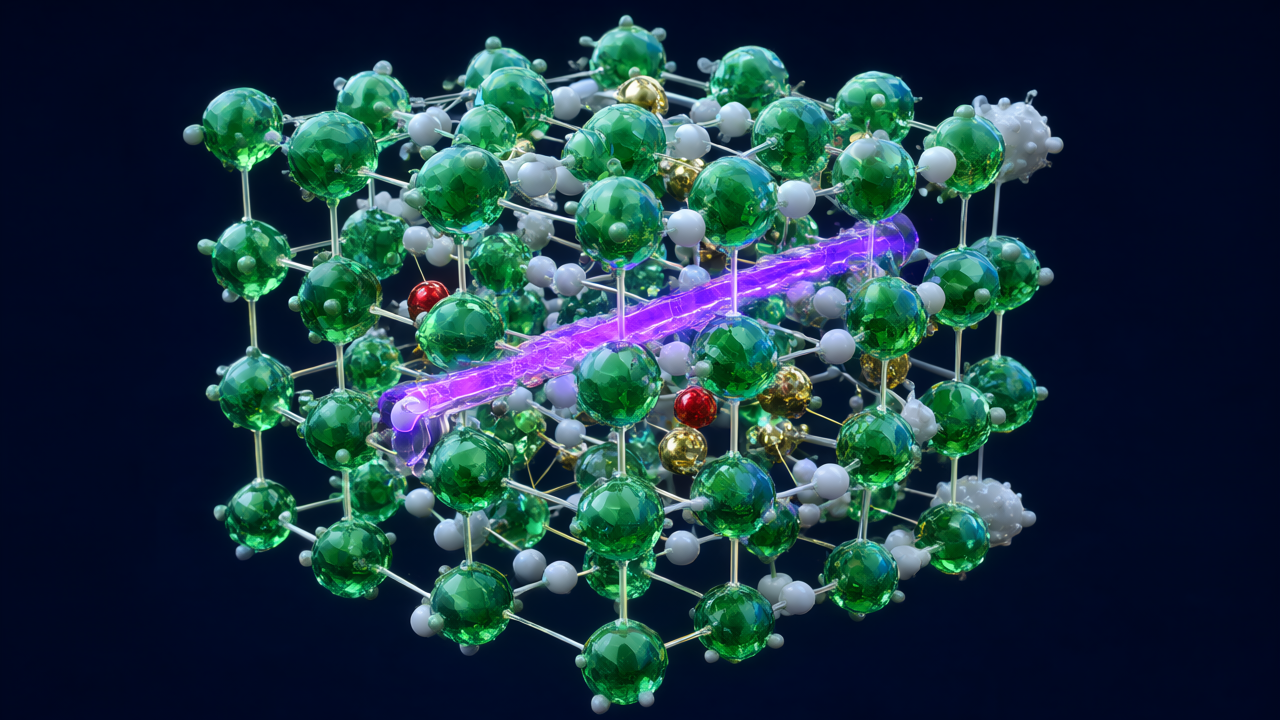
A research team has successfully developed a novel Al3+/O2- co-doping strategy for NaCl-based solid electrolytes, achieving a remarkable ionic conductivity of 2.7 × 10⁻⁴ S cm-1 at 30°C. This breakthrough transforms conventional NaCl into a highly efficient, fast-ion-conducting solid electrolyte, paving the way for advanced, low-cost sodium-ion solid-state batteries.
Technical / Clinical Details
The innovative co-doping mechanism effectively introduces a significant concentration of Na+ vacancies and creates a mixed anion environment within the NaCl lattice, which is critical for enhancing ionic mobility. This modified solid electrolyte exhibits a broad electrochemical stability window of 1.05 to 4.24 V versus Na2Sn, a crucial parameter for practical battery applications. All-solid-state cells constructed with this optimized material demonstrated excellent cycling stability, retaining 83% of their initial capacity after 100 cycles at a 0.3 C rate. This performance underscores the material’s potential to significantly improve the durability and reliability of sodium-ion solid-state battery technology.
Background & Context
The escalating concerns over lithium resource scarcity and cost have propelled research into alternative battery chemistries, with sodium-ion batteries emerging as a promising candidate for next-generation energy storage. However, existing sodium-ion solid electrolytes often suffer from inadequate performance or stability. The NaCl-based material presented in this study offers a compelling advantage due to its use of abundant and inexpensive raw materials, which could lead to substantial reductions in battery manufacturing costs. This cost-effectiveness is particularly attractive for large-scale energy storage systems, where economic viability is paramount.
Strategic Significance & Outlook
This Al3+/O2- co-doping strategy marks a significant advancement toward developing low-cost, dry-air-stable solid electrolytes, making the commercialization of safer, longer-lasting, and more environmentally friendly sodium-ion solid-state batteries more attainable. Future research will likely focus on further increasing ionic conductivity, optimizing interfacial stability, and exploring scalability for industrial production, thereby accelerating the deployment of this promising technology in various energy applications.
Source: https://www.oaepublish.com/articles/energymater.2026.211
Get our weekly technology intelligence — free
Receive an infographic that lets you judge at a glance whether each field’s analysis report is worth reading.
Subscribe Free — Weekly Tech Intelligence
By subscribing, you’ll receive Troy-Technical’s weekly technology intelligence newsletter.
- Your email and selected fields are used only to deliver the newsletter.
- We never share your information with third parties.
- You can unsubscribe anytime via the link in each email.
See our Privacy Policy for details.
Takes about a minute · Unsubscribe anytime






Comments