Key Findings
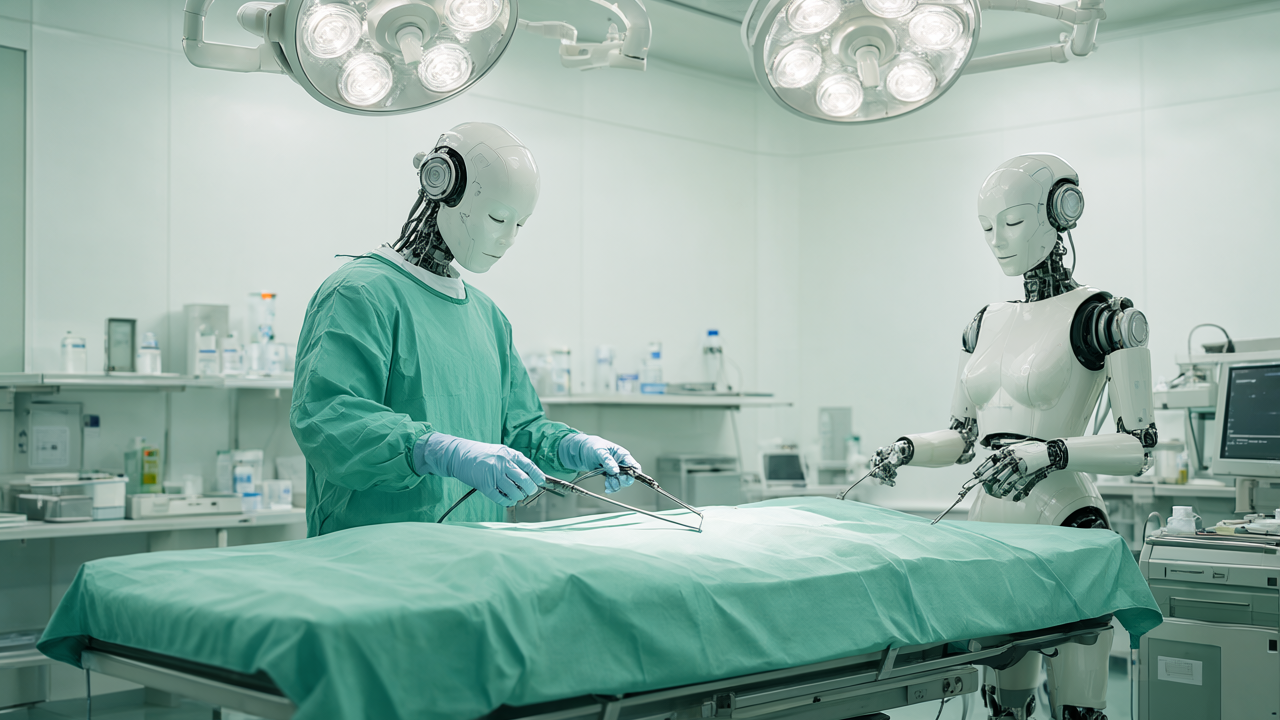
The Center for the Future of Surgery at UC San Diego has achieved a world-first by successfully performing a teleoperated gallbladder removal on a live pig, with an experienced surgeon remotely controlling Unitree G1 humanoid robots. This groundbreaking demonstration further included a collaborative surgery with two robots, highlighting the potential for expanding access to robotic surgery through more affordable humanoid platforms.
Technical / Clinical Details
In this demonstration, the surgeon precisely controlled the arms of the Unitree G1 humanoid robots remotely from a master console. The robots executed complex surgical maneuvers, such as grasping, incising, and suturing, with accuracy on living tissue. The system translates the surgeon’s fine hand movements into more stable, scaled motions by the robot, offering precision and stability beyond human capability. While established surgical robots (e.g., da Vinci system) have been in use for decades, this research uniquely focuses on leveraging more affordable and versatile humanoid platforms. However, several critical technical challenges remain before human application. These include the relatively short reach of the Unitree G1 robot arms for surgical purposes, overheating of joints during prolonged operation, and meeting stringent sterilization requirements, all of which must be resolved.
Background & Context
Robotic surgery has rapidly gained traction in modern surgical care due to its benefits of minimally invasiveness, high precision, and faster recovery. However, existing surgical robot systems are prohibitively expensive, limiting their adoption primarily to specialized hospitals. This has created a disparity in patient access to the benefits of robotic surgery. This pioneering attempt to apply relatively affordable humanoid robots like the Unitree G1 to the surgical field holds the potential to democratize access to robotic surgery, enabling advanced surgical care in a wider range of medical institutions and communities. This innovative approach also has the potential to contribute to reducing healthcare disparities.
Strategic Significance & Outlook
UC San Diego’s demonstration clearly indicates the potential for humanoid robots to serve as a new platform for surgical procedures in the future. Moving forward, the research team will focus on overcoming technical challenges such as adapting robot arms to surgical requirements, improving thermal management systems, and developing sterilizable materials and designs. Once these hurdles are addressed, humanoid robots are expected to facilitate remote surgery, disaster medicine, and create an environment where more specialized surgeons can access robotic surgery, ultimately providing safer and more efficient treatment to patients worldwide.
Source: https://www.cnet.com/videos/hands-on-with-first-humanoid-robot-surgeon/
Get our weekly technology intelligence — free
Receive an infographic that lets you judge at a glance whether each field’s analysis report is worth reading.
Subscribe Free — Weekly Tech Intelligence
By subscribing, you’ll receive Troy-Technical’s weekly technology intelligence newsletter.
- Your email and selected fields are used only to deliver the newsletter.
- We never share your information with third parties.
- You can unsubscribe anytime via the link in each email.
See our Privacy Policy for details.
Takes about a minute · Unsubscribe anytime