
Key Findings
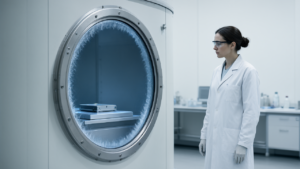
NASA researchers have successfully demonstrated prototype battery cells that operate in extreme thermal environments. During thermal vacuum testing at the Langley Research Center, cells functioned well up to 176 F (80 C) and down to minus 76 F (minus 60 C), with slightly reduced performance observed down to minus 80 C. Crucially, the batteries sustained no damage after exposure to temperature swings ranging from 212 F (100 C) to minus 274 F (minus 170 C).
Technical Details
The SPEARS project addresses the failure points of traditional lithium-ion batteries, which rely on liquid electrolytes that freeze in extreme cold, evaporate in a vacuum, or fail at high temperatures. SPEARS utilizes a solid ceramic- or polymer-based electrolyte, providing several technical advantages:
- Thermal Resilience: The solid electrolyte does not freeze, allowing the battery to survive the brutal cold of the Moon’s South Pole, where temperatures drop to minus 328 F (minus 200 C).
- Operational Recovery: While the batteries do not function at minus 274 F, they can be brought back to operational temperature using small heaters, reducing the need for heavy, continuous thermal management systems.
- Chemical Tunability: By varying electrode materials, the chemistry can be tuned for specific requirements such as energy, power, or durability depending on the application.
Background and Context
Led by the Glenn Research Center and supported by the Langley and Ames Research Centers, the SPEARS project began in 2026. It is funded through the Advanced Research and Technology division of the Research and Technology Mission Directorate. The project is currently focused on technology development, with Ames developing flight hardware, including electronics and test boards, to prepare for spaceflight testing.
Significance and Outlook
These batteries are critical for the Artemis campaign, powering everything from astronaut emergency kits and long-duration scientific instruments to rovers exploring dark lunar craters. Beyond space, the technology has potential spin-off applications for Earth-based portable power supplies, including automobiles, drones, and communication devices.
Get our weekly technology intelligence — free
Receive an infographic that lets you judge at a glance whether each field’s analysis report is worth reading.
Subscribe Free — Weekly Tech Intelligence
By subscribing, you’ll receive Troy-Technical’s weekly technology intelligence newsletter.
- Your email and selected fields are used only to deliver the newsletter.
- We never share your information with third parties.
- You can unsubscribe anytime via the link in each email.
See our Privacy Policy for details.
Takes about a minute · Unsubscribe anytime