


Key Findings
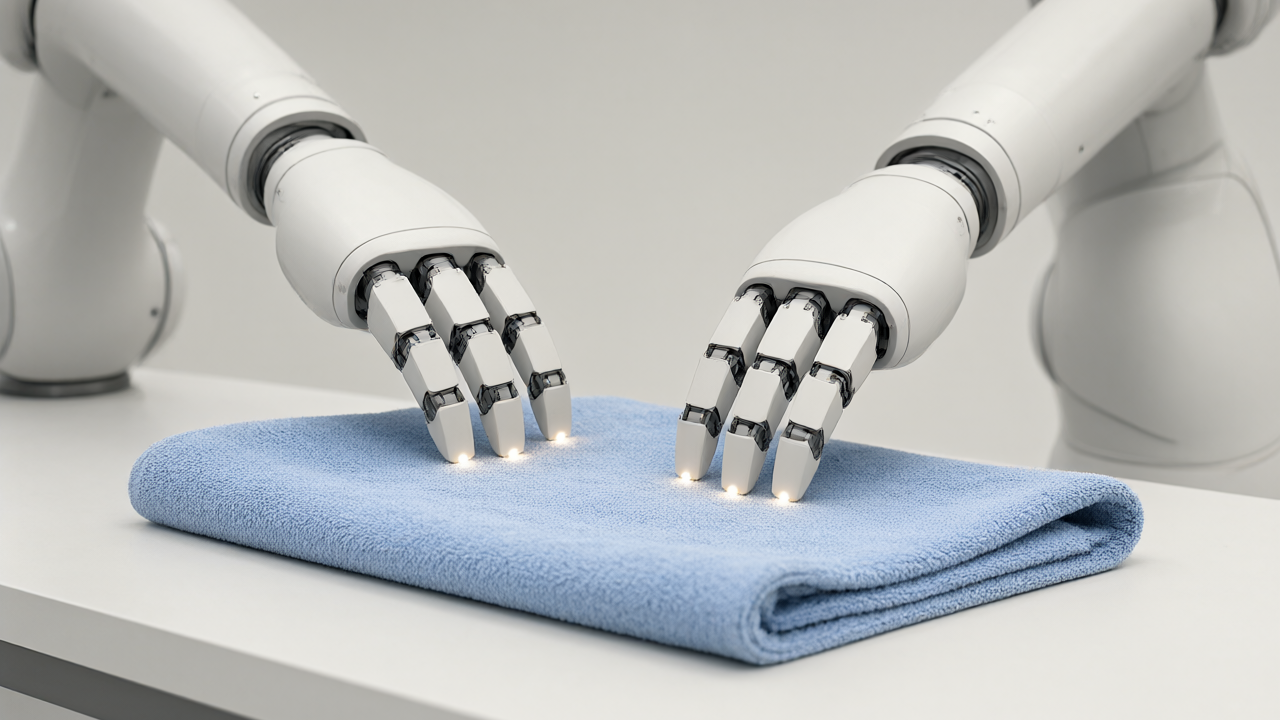
Panasonic Holdings, Panasonic R&D Company of America (PRDCA), and researchers from UC Berkeley, NVIDIA, Stanford University, Roma La Sapienza University, and ItalAI have developed “Tactile-Reactive Dexterous Manipulation” (T-Rex). This AI enables robots to perform complex bimanual tasks by integrating tactile feedback into a VLA model. In evaluations involving 12 types of tasks requiring delicate force control and the handling of soft objects, T-Rex achieved an average success rate of 65%, which is 30 percentage points higher than existing methods.
Technical Details
T-Rex utilizes a dual-module architecture to balance high-level planning with real-time adjustments:
- Action Generation Module: Processes vision and language data at approximately 5Hz to create the general framework of the movement.
- Action Correction Module: Processes tactile data at approximately 20Hz to capture contact states and perform fine-grained, real-time corrections.
The model was trained on a dataset consisting of over 100 hours of bimanual robot operation data, comprising more than 7,700 instances. This dataset combines 22 basic movements with over 200 types of daily household items. Each data point synchronizes natural language instructions, robot state and action, head and wrist camera footage, and force/deformation data from 10 fingertip tactile sensors.
Background & Context
The research findings are scheduled for presentation at the Conference on Robot Learning (CoRL), an international conference on robot learning held in Austin, USA, from November 9 to 12.
Significance & Outlook
Panasonic intends to apply this technology to industrial and logistics environments. Target applications include the insertion, removal, and tightening of parts in manufacturing, as well as the handling of fragile or flexible items in logistics. By enabling robots to perform tasks requiring precise force adjustments and contact state monitoring, the company seeks to reduce the burden on human workers and mitigate labor shortages.
Source: https://ai.watch.impress.co.jp/docs/news/2153977.html
Get our weekly technology intelligence — free
Receive an infographic that lets you judge at a glance whether each field’s analysis report is worth reading.
Subscribe Free — Weekly Tech Intelligence
By subscribing, you’ll receive Troy-Technical’s weekly technology intelligence newsletter.
- Your email and selected fields are used only to deliver the newsletter.
- We never share your information with third parties.
- You can unsubscribe anytime via the link in each email.
See our Privacy Policy for details.
Takes about a minute · Unsubscribe anytime