Key Findings
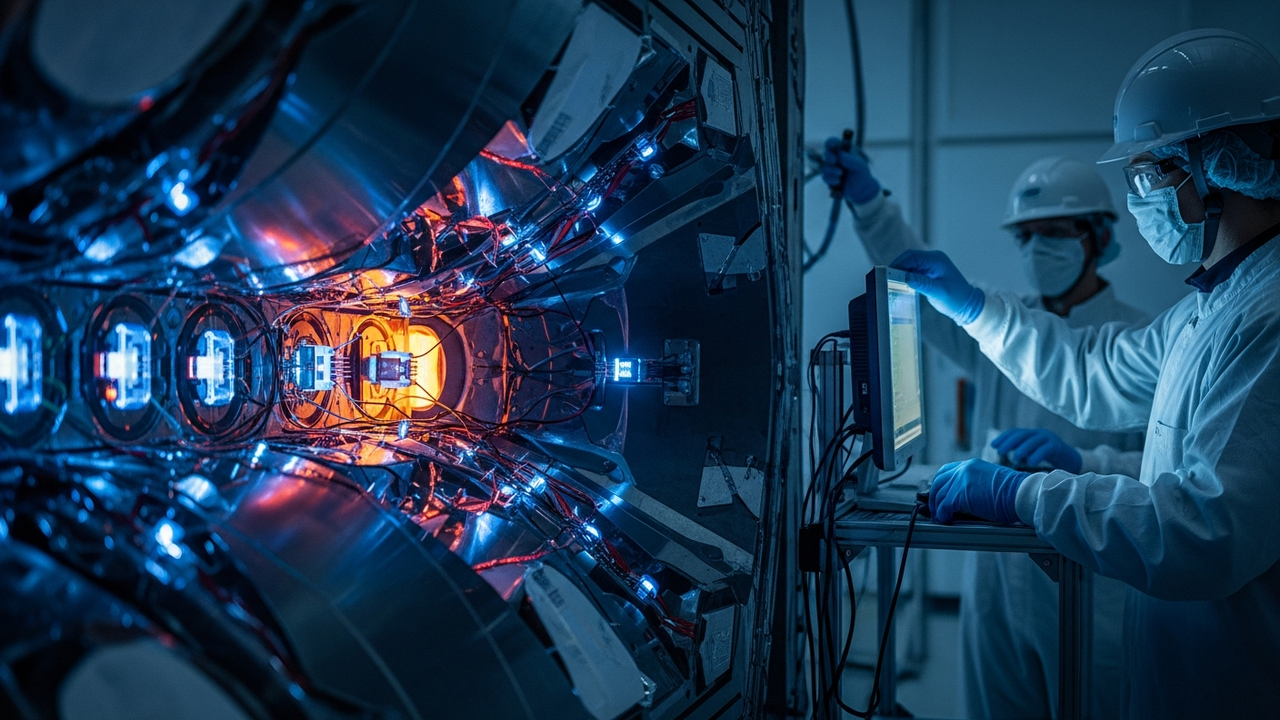
Researchers at the University of Maine are pioneering the development of specialized surface acoustic wave (SAW) resonator microchip sensors designed to monitor the structural integrity of future nuclear fusion reactors. This critical technology addresses a major hurdle in the commercialization of fusion energy: the need for sensors that can withstand and provide reliable data from environments characterized by extreme heat and radiation.
Technical / Clinical Details
The SAW resonator microchip sensors under development are engineered to function robustly under conditions significantly more intense than those found in conventional nuclear fission reactors, including exceptionally high temperatures and powerful radiation fluxes. These sensors are capable of detecting minute physical changes, such as strain, cracks, and temperature variations within the reactor’s structural components, providing early warnings of potential material degradation. Such real-time, high-fidelity monitoring is essential for enhancing reactor safety, optimizing operational lifespans, and mitigating the risks of unplanned downtime. The project leverages the University of Maine’s extensive prior research and expertise in developing sensors for harsh-environment applications, ensuring a strong foundation for this advanced technology.
Background & Context
Nuclear fusion promises a clean, virtually inexhaustible energy source, but its realization as a commercial power option faces numerous engineering and materials science challenges. A key aspect is the ability to continuously monitor the structural health of reactor components, which are subjected to unprecedented levels of thermal stress, neutron bombardment, and electromagnetic forces. Traditional sensor technologies are inadequate for these extreme conditions. The University of Maine’s research is supported by funding from the Hercules program, an initiative with the ambitious goal of achieving commercially-viable nuclear fusion power by 2028. This effort is vital for overcoming technological bottlenecks and accelerating the transition to a fusion-powered future.
Strategic Significance & Outlook
The successful development of these extreme-environment SAW sensors will be a game-changer for accelerating the commercial deployment of nuclear fusion. Reliable and durable sensors will not only reduce operational costs and enhance safety but also contribute significantly to the long-term stability and efficiency of fusion reactors. Beyond fusion, this advanced sensor technology holds potential for broader industrial applications in other high-temperature or high-radiation environments, such as space exploration, advanced engine design, and geothermal energy facilities. The University of Maine’s work is thus poised to be a foundational technology for future energy solutions and extreme-condition engineering, attracting considerable attention from both academic and industrial sectors.
Get our weekly technology intelligence — free
Receive an infographic that lets you judge at a glance whether each field’s analysis report is worth reading.
Subscribe Free — Weekly Tech Intelligence
By subscribing, you’ll receive Troy-Technical’s weekly technology intelligence newsletter.
- Your email and selected fields are used only to deliver the newsletter.
- We never share your information with third parties.
- You can unsubscribe anytime via the link in each email.
See our Privacy Policy for details.
Takes about a minute · Unsubscribe anytime






Comments