Key Findings
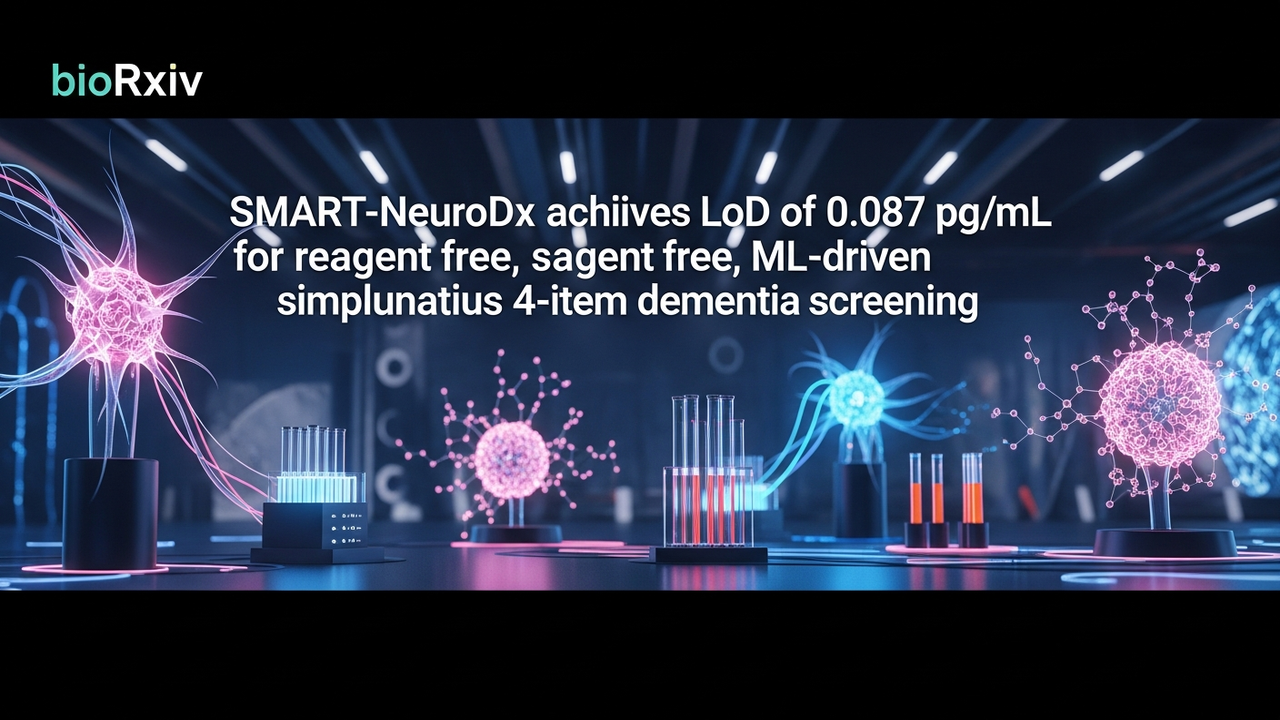
A preprint published on bioRxiv on July 23, 2026, introduces SMART-NeuroDx, an innovative reagent-free, machine-learning (ML)-driven multianalyte biosensor platform. This platform is designed for point-of-care (POCT) dementia screening, enabling the simultaneous, highly sensitive detection of four distinct neurodegeneration biomarkers on a single device. A key highlight is its capability to accurately quantify phosphorylated tau 217 (pTau217), a critical biomarker for Alzheimer’s disease, at sub-picogram levels (detection limit of 0.087 pg/mL) within an appropriate dynamic range.
Technical and Clinical Details
The SMART-NeuroDx platform utilizes electrochemical sensor technology based on an electrode array, where specific recognition probes for different biomarkers are immobilized on each electrode. This sensor measures electrochemical changes resulting from the binding of biomarkers in a sample (e.g., blood or cerebrospinal fluid). A distinctive feature is its ‘reagent-free’ design, which allows direct biomarker detection without the addition of reagents (e.g., enzymes, fluorescent dyes). This significantly simplifies the testing procedure, drastically reducing cost and analysis time. The detected voltammetric features are then analyzed by advanced machine learning models, specifically cross-validated Random Forest and XGBoost regressors, to translate them into accurate concentrations for each biomarker. This ML-driven readout system extracts subtle changes from complex biological signals, providing highly reliable diagnostic support.
Background and Industry Context
Dementia is a major global public health challenge with a growing patient population, where early and accurate diagnosis is critical for intervention to slow disease progression and for developing appropriate care plans. However, current dementia diagnostics heavily rely on expensive imaging (e.g., PET scans) and invasive cerebrospinal fluid (CSF) tests, which are burdensome for patients and unsuitable for widespread screening. POCT-enabled multianalyte biosensors like SMART-NeuroDx, which can easily measure multiple dementia biomarkers from blood samples, offer the potential to enable large-scale screening and early diagnosis, improving healthcare access and reducing costs.
Strategic Significance and Outlook
The SMART-NeuroDx platform holds significant promise for transforming the future of dementia diagnosis. Researchers are now expected to conduct large-scale validation studies in clinical environments to further evaluate its diagnostic accuracy and practical utility. In the future, this technology is anticipated to be adopted in primary care clinics, community healthcare facilities, and potentially as a self-screening tool for home use. Its multianalyte detection capability and advanced ML-driven data analysis could be applied not only for ultra-early detection of dementia but also for identifying disease subtypes, assessing progression, and monitoring treatment efficacy. This will contribute to advancing personalized dementia management and serves as a powerful tool for improving the quality of life for patients and their families.
Source: https://www.biorxiv.org/content/10.64898/2026.07.22.740043v1
Get our weekly technology intelligence — free
Receive an infographic that lets you judge at a glance whether each field’s analysis report is worth reading.
Subscribe Free — Weekly Tech Intelligence
By subscribing, you’ll receive Troy-Technical’s weekly technology intelligence newsletter.
- Your email and selected fields are used only to deliver the newsletter.
- We never share your information with third parties.
- You can unsubscribe anytime via the link in each email.
See our Privacy Policy for details.
Takes about a minute · Unsubscribe anytime








Comments