Key Findings
A research team from Hebei University of Geosciences and Shijiazhuang Railway University has successfully developed a flexible photoelectrochemical memristor that integrates perovskite quantum dots (QDs) and graphene oxide (GO), enabling advanced visual perception and processing capabilities even under dim lighting conditions. This innovative device achieved over a 10% improvement in recognition accuracy and a twofold increase in signal-to-noise ratio in low-light environments, marking a significant step towards realizing next-generation wearable neuromorphic vision systems.
Technical / Clinical Details
The novel memristor is constructed by sequentially stacking perovskite QD and graphene oxide layers on a flexible substrate. Perovskite QDs, known for their excellent light absorption properties and high photoluminescence quantum yield, efficiently detect weak light signals. Graphene oxide, with its high electrical conductivity and flexibility, ensures reliable signal transmission and mechanical stability of the device.
The core innovation of this device lies in its extended conductance range and superior noise suppression under low-light conditions. While conventional sensors struggle with weak signals becoming buried in noise in dim environments, this perovskite QD/GO memristor exhibits highly sensitive conductance changes even to faint light stimuli. This performance is attributed to the optimized charge separation and transport efficiency at the nanoscale interfaces. Specifically, evaluations in noisy, low-light images demonstrated an improvement in image recognition accuracy by over 10% and a doubling of the signal-to-noise ratio (SNR) compared to comparable devices. This high performance is based on neuromorphic computing principles, mimicking the adaptive capabilities of the human eye to efficiently process incoming light signals and distinguish useful information from noise.
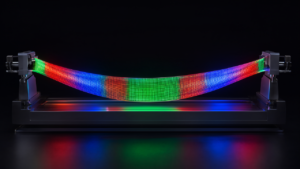
Its flexible design allows the device to be applied to curved or irregular surfaces, making it easily integrable into wearable devices and robotics. This opens possibilities for direct attachment to human skin, similar to biological tissues, or integration into robotic vision systems.
Background & Context
While current AI technology has seen remarkable advancements, much of it relies on high-performance processors that consume vast amounts of energy. Visual information processing, in particular, demands real-time capabilities and energy efficiency, leading to growing expectations for neuromorphic computing that can process information as efficiently as the human brain. However, high-precision visual recognition in dim environments remains a significant challenge across many application areas, including autonomous driving, surveillance systems, smart homes, and medical diagnostics. Perovskite quantum dots, owing to their excellent photoelectric properties, are attracting attention as key materials for next-generation optoelectronic devices, and their combination with graphene expands the potential for flexible, high-performance device realization.
Strategic Significance & Outlook
The success of this perovskite QD-based flexible photoelectrochemical memristor represents a groundbreaking advancement in enabling high-precision visual recognition under low-light conditions. Moving forward, the research team will likely aim to further increase the integration density of the device and incorporate more complex image processing and learning capabilities. Its application in wearable neuromorphic visual systems holds potential to enrich human lives in diverse fields, such as assistive devices for the visually impaired, smart glasses, and enhancing environmental perception for robots. Furthermore, this technology, which allows for high-efficiency information processing while minimizing energy consumption, is expected to significantly contribute to the development of AI edge devices and IoT sensors. Establishing long-term stability and mass production techniques will be the next crucial steps towards practical implementation.
Get our weekly technology intelligence — free
Receive an infographic that lets you judge at a glance whether each field’s analysis report is worth reading.
Subscribe Free — Weekly Tech Intelligence
By subscribing, you’ll receive Troy-Technical’s weekly technology intelligence newsletter.
- Your email and selected fields are used only to deliver the newsletter.
- We never share your information with third parties.
- You can unsubscribe anytime via the link in each email.
See our Privacy Policy for details.
Takes about a minute · Unsubscribe anytime