Key Findings: OMol25-Trained MLIPs Achieve DFT Accuracy in Na-Ion Battery Electrolyte Solvation Structure Prediction
In recent research, machine learning interatomic potentials (MLIPs) trained with the Open Molecules 2025 (OMol25) dataset have been demonstrated to predict the complex solvation structures of electrolytes for next-generation sodium-ion batteries (NIBs) with exceptionally high accuracy, and these predictions have been experimentally validated. This achievement surpasses the performance of existing MLIPs trained exclusively on inorganic materials and delivers a substantial increase in computational speed, opening new avenues for the development of high-performance NIBs electrolytes.
Technical & Clinical Details: Enhanced MLIP Performance Through Integrated Organic and Inorganic Data
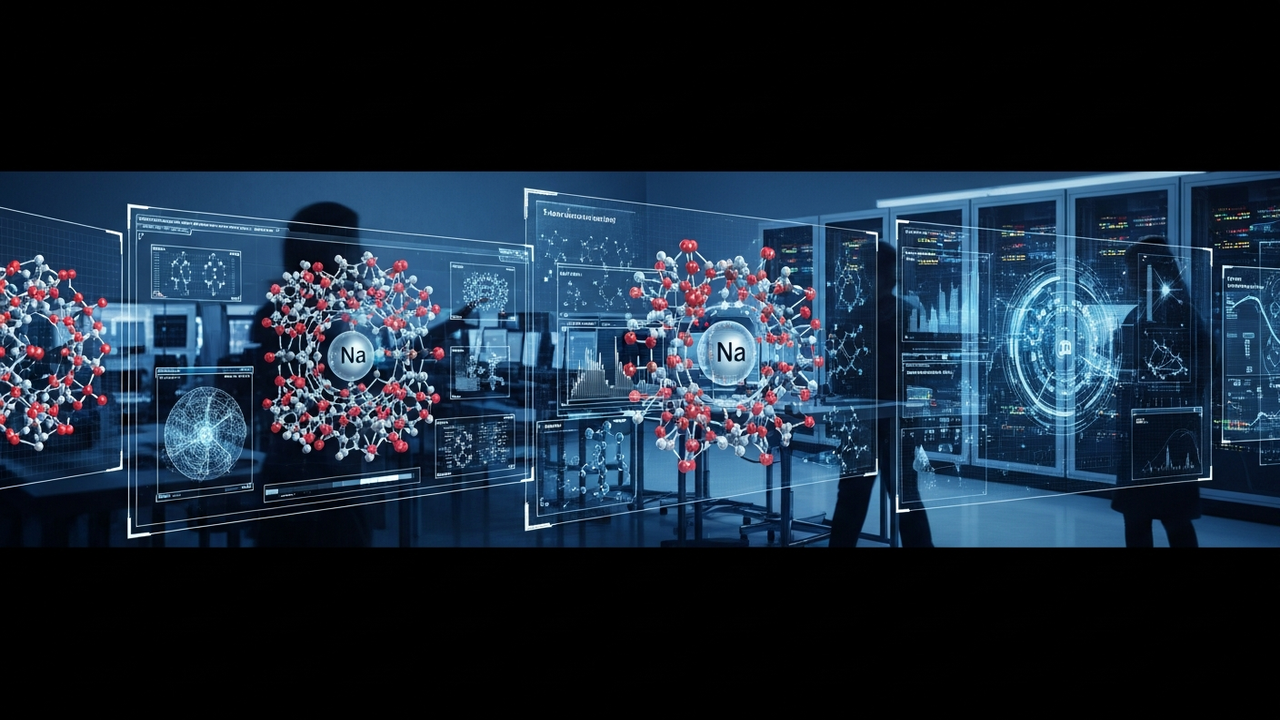
The OMol25 dataset covers a wide range of atomic environments, including both organic molecules and inorganic solids, aiming to overcome the limitations of traditional MLIPs trained on inorganic-specific datasets. Researchers utilized these OMol25-trained MLIPs to analyze in detail how sodium ions interact with solvent molecules and anions in the electrolyte and form local structures (solvation shells), achieving accuracy comparable to density functional theory (DFT) calculations. While DFT calculations are highly accurate, their computational cost is prohibitive for large systems or long molecular dynamics simulations. OMol25 MLIPs retain DFT accuracy while boosting computational speed by orders of magnitude, enabling detailed dynamic behavior simulations previously impossible. This technological advancement dramatically reduces the number of trial-and-error experiments in electrolyte design, shortening development cycles.
Background & Context: The Importance of Sodium-Ion Batteries and Electrolyte Development Challenges
Sodium-ion batteries are garnering significant attention as a promising alternative to lithium-ion batteries due to their use of sodium, an abundant and inexpensive resource compared to lithium. However, improving NIBs’ performance (especially energy density and cycle life) critically depends on developing stable electrode materials and high-performance electrolytes that form favorable interfaces with them. The solvation structure of electrolytes directly impacts ion mobility and electrode interface stability, making its accurate understanding and prediction key to electrolyte design. This research addresses this electrolyte development bottleneck by combining MLIPs with large-scale datasets.
Strategic Significance & Outlook: AI-Driven NIBs Electrolyte Design and the Realization of Next-Generation Batteries
The success of OMol25-trained MLIPs has the potential to establish a new standard for AI-driven electrolyte design. This technology enables rapid evaluation of solvation structures and transport properties across various combinations of electrolyte salts, solvents, and additives, thereby accelerating the development of higher-performance and safer NIBs. Furthermore, this approach could be applied to the design of electrolytes and solid-state electrolytes for other next-generation battery systems, such as all-solid-state batteries and multi-ion batteries, proving an essential tool for achieving sustainable energy storage technologies.
Get our weekly technology intelligence — free
Receive an infographic that lets you judge at a glance whether each field’s analysis report is worth reading.
Subscribe Free — Weekly Tech Intelligence
By subscribing, you’ll receive Troy-Technical’s weekly technology intelligence newsletter.
- Your email and selected fields are used only to deliver the newsletter.
- We never share your information with third parties.
- You can unsubscribe anytime via the link in each email.
See our Privacy Policy for details.
Takes about a minute · Unsubscribe anytime