Key Findings
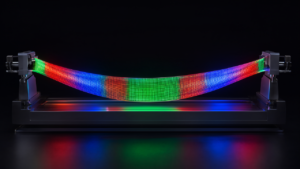
A research team at the University of Cambridge has developed a novel manufacturing technique that overcomes a long-standing fundamental barrier in the production of ultra-small quantum dot (QD) pixels. This innovative approach enabled the creation of incredibly small pixels, just 600×900 nanometers in size, using cadmium-free quantum dots. This resolution, equivalent to 16,933 pixels per inch, represents one of the highest resolution electroluminescent QD pixel arrays ever demonstrated, marking a significant breakthrough for enabling ultra-high-quality, hyper-realistic displays for future augmented reality (AR) and virtual reality (VR) applications.
Technical and Development Details
- Overcoming Fundamental Manufacturing Barriers: Previously, it has been extremely challenging to stably and densely manufacture fine quantum dot pixels. Specific technical hurdles included precisely patterning QD layers, preventing crosstalk between individual pixels, and maintaining high luminous efficiency. The Cambridge research developed new patterning and integration techniques that circumvent these challenges, making ultra-small QD pixel arrays a reality.
- Use of Cadmium-Free Quantum Dots: While some quantum dots contain toxic cadmium, this study utilized cadmium-free QDs, which have a lower environmental impact. This is critically important for applications in consumer products, addressing both safety and sustainability concerns.
- Ultra-High Resolution: The pixel size of 600×900 nanometers achieves an unprecedented resolution of 16,933 pixels per inch (approximately 6,600 pixels per millimeter). This pixel density is roughly 10 times that of current smartphone displays and about 3 times that of high-resolution VR headsets. Such ultra-high density completely eliminates the “screen-door effect” (where gaps between pixels are visible) in AR/VR devices, providing users with a completely immersive visual experience.
- Electroluminescence: This technology is based on electroluminescent QD pixels that emit light when electrically excited. This negates the need for backlights, enabling very thin form factors, high contrast ratios, and fast response times.
Background and Industry Context
AR/VR technology is a next-generation computing platform with promising applications in diverse fields, including entertainment, education, healthcare, and industrial training. However, the limitations of display technology have been a significant barrier to its widespread adoption. To deliver truly immersive experiences, ultra-high-resolution displays exceeding the resolution of the human eye (retinal resolution), wide fields of view, and high brightness and contrast are essential. This research offers a definitive solution to this challenge, potentially accelerating the commercialization and proliferation of AR/VR devices.Future Outlook
This breakthrough from the University of Cambridge opens a new frontier for AR/VR display technology. Future efforts will focus on further optimizing this manufacturing technique and validating its scalability. If mass production becomes feasible and manufacturing costs are reduced, these ultra-high-resolution QD displays could be incorporated into AR glasses and VR headsets within a few years. This would dramatically enhance the realism and immersion of AR/VR content, transforming user experiences. Furthermore, this technology holds potential for other micro-display applications, such as wearable devices, miniature projectors, and medical displays.
Get our weekly technology intelligence — free
Receive an infographic that lets you judge at a glance whether each field’s analysis report is worth reading.
Subscribe Free — Weekly Tech Intelligence
By subscribing, you’ll receive Troy-Technical’s weekly technology intelligence newsletter.
- Your email and selected fields are used only to deliver the newsletter.
- We never share your information with third parties.
- You can unsubscribe anytime via the link in each email.
See our Privacy Policy for details.
Takes about a minute · Unsubscribe anytime