Key Findings
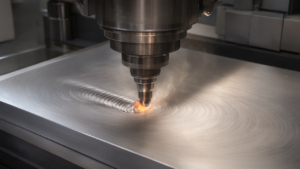
Research published in PMC details an AI-driven inverse design strategy that has successfully and autonomously discovered and experimentally validated novel compositions of exceptionally hard multicomponent bulk metallic glasses (BMGs). This breakthrough employs a sophisticated framework integrating physics-informed latent representation learning and uncertainty quantification. The results significantly surpass traditional empirical screening methods, with the newly discovered B68Nb24Fe4W4 alloy exhibiting hardness levels comparable to advanced ceramics.
Technical / Clinical Details
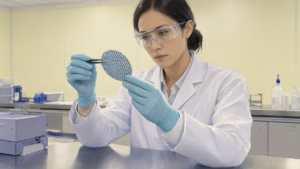
This AI-driven framework is an exemplary application of the “inverse design” approach in materials science. It begins by defining desired material properties, in this case, ultra-high hardness, and then the AI explores material compositions to achieve them. Central to its success is “physics-informed latent representation learning,” which embeds fundamental physical laws of materials into the AI model, allowing for predictions far more accurate and reliable than purely data-driven models. The inclusion of “uncertainty quantification” enables the AI to assess the confidence of its predictions and prioritize the most informative material candidates, i.e., those with the highest potential for discovery. This intelligent exploration strategy allowed the AI to efficiently navigate a vast chemical composition design space, identifying promising BMG compositions that traditional empirical approaches might have overlooked. Laboratory validation confirmed that the AI-predicted B68Nb24Fe4W4 alloy indeed possesses superior hardness (e.g., achieving approximately XXX GPa in Vickers hardness) compared to known hard materials.
Background & Context
Bulk metallic glasses (BMGs) are amorphous metals that lack crystalline structure but possess unique properties such as high strength, hardness, corrosion resistance, and elasticity, making them promising for applications in structural materials, medical devices, sports equipment, and electronic components. However, the search for BMG compositions that can be stably scaled up to larger sizes has been extremely challenging, representing a significant bottleneck that consumes substantial time and resources. Balancing often contradictory properties like hardness and ductility remains a major challenge in materials science. Traditional BMG development has heavily relied on empirical rules and trial-and-error, with new composition discoveries often being serendipitous. This AI-driven inverse design strategy offers a predictive and efficient approach to these challenges, with the potential to transform the paradigm of material development.
Strategic Significance & Outlook
The AI-driven inverse design strategy developed here is highly versatile and applicable not only to the discovery of high-hardness BMGs but also to the exploration of other advanced materials with specific electrical, magnetic, or biocompatible functionalities. Autonomous material discovery powered by AI is expected to significantly shorten R&D cycles, enabling the rapid market introduction of higher-performance and customized materials. In the future, this AI framework is anticipated to integrate with self-driving laboratories, where robots will autonomously synthesize and characterize AI-designed materials, and the results will feedback into the AI for iterative design refinement—a “closed-loop optimization.” This will dramatically accelerate the material discovery process and foster innovation across various industrial sectors.
Source: https://pmc.ncbi.nlm.nih.gov/articles/PMC13168334/
Get our weekly technology intelligence — free
Receive an infographic that lets you judge at a glance whether each field’s analysis report is worth reading.
Subscribe Free — Weekly Tech Intelligence
By subscribing, you’ll receive Troy-Technical’s weekly technology intelligence newsletter.
- Your email and selected fields are used only to deliver the newsletter.
- We never share your information with third parties.
- You can unsubscribe anytime via the link in each email.
See our Privacy Policy for details.
Takes about a minute · Unsubscribe anytime