Key Findings
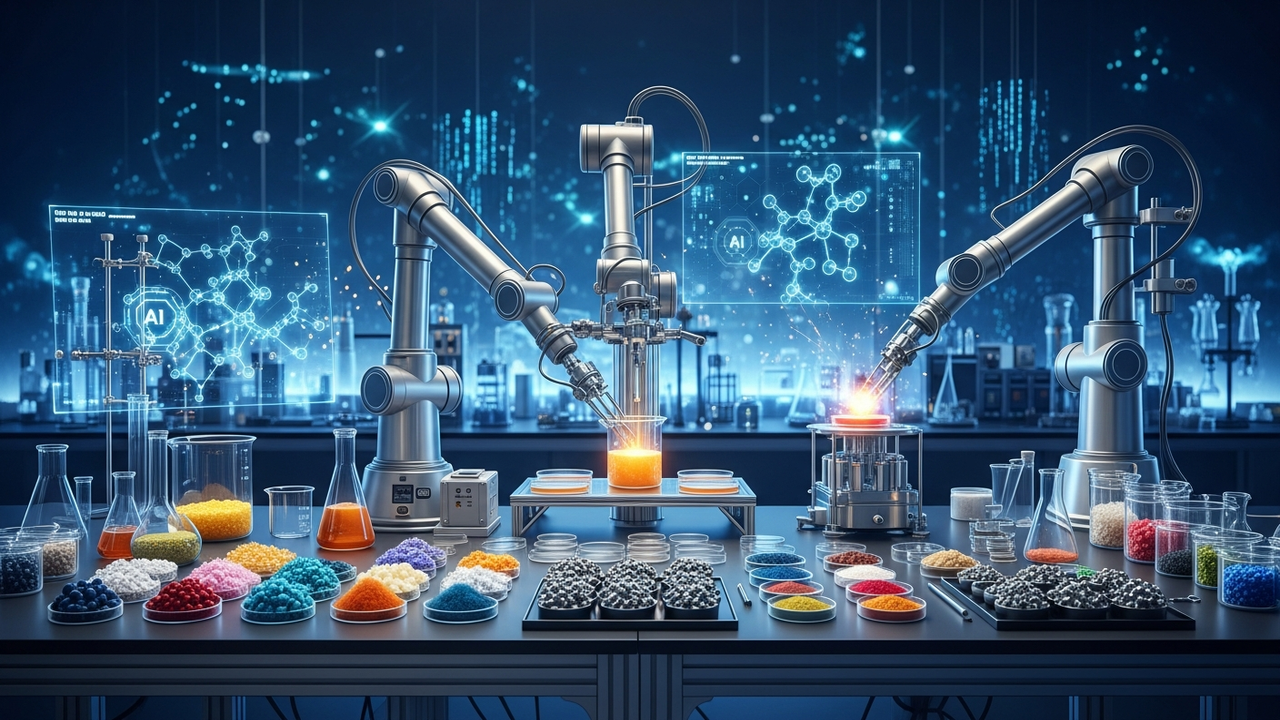
According to a report from OAE Publishing Inc., the innovative integration of large language models (LLMs) and AI agents is significantly advancing inorganic materials discovery, moving the process from mere prediction to actual experimental realization. This approach has already yielded notable results in systems like A-Lab, which successfully synthesized and realized 36 out of 57 candidate inorganic compounds within a short 17-day period through ML-guided robotic synthesis.
Technical / Clinical Details
Central to this breakthrough is a ‘closed-loop agent architecture’ where LLMs act as central orchestrators, coordinating a sequence of processes including literature mining, experimental design, execution, characterization, and iterative refinement. AI agents play a crucial role in translating promising candidate materials, identified computationally, into materials that can be experimentally synthesized and characterized in a physical lab environment. This integrated workflow allows researchers to explore material design spaces more efficiently and identify materials with unique compositions and structures that would be difficult to discover through traditional, trial-and-error methods. This technology has a particularly significant impact in areas such as photocatalysis, materials with specific crystal structures, and metal-organic frameworks (MOFs), substantially improving the speed and success rate of new material development.
Background & Context
Inorganic materials are fundamental components supporting diverse modern societal pillars, including energy, electronics, environment, and medicine. However, efficient materials discovery has been a long-standing challenge due to their vast compositional and structural diversity. Traditional materials science relied on experimental intuition and limited computational capabilities, requiring considerable time and resources for new material development. The integration of LLMs and AI agents fundamentally reshapes this scientific discovery process by resolving this bottleneck. Autonomous lab systems like A-Lab are now making this vision a reality.
Strategic Significance & Outlook
This closed-loop materials discovery system, combining LLMs and AI agents, holds the potential to become a dominant paradigm in future materials science research. It will enable researchers to design and synthesize more complex and multifunctional inorganic materials, leading to groundbreaking advancements in areas such as sustainable energy solutions, next-generation electronic devices, and advanced environmental remediation technologies. A-Lab’s success clearly demonstrates that autonomous labs are powerful tools for accelerating scientific discovery and delivering substantial economic value to industry.
Source: https://www.oaepublish.com/articles/cs.2026.35
Get our weekly technology intelligence — free
Receive an infographic that lets you judge at a glance whether each field’s analysis report is worth reading.
Subscribe Free — Weekly Tech Intelligence
By subscribing, you’ll receive Troy-Technical’s weekly technology intelligence newsletter.
- Your email and selected fields are used only to deliver the newsletter.
- We never share your information with third parties.
- You can unsubscribe anytime via the link in each email.
See our Privacy Policy for details.
Takes about a minute · Unsubscribe anytime