Key Findings
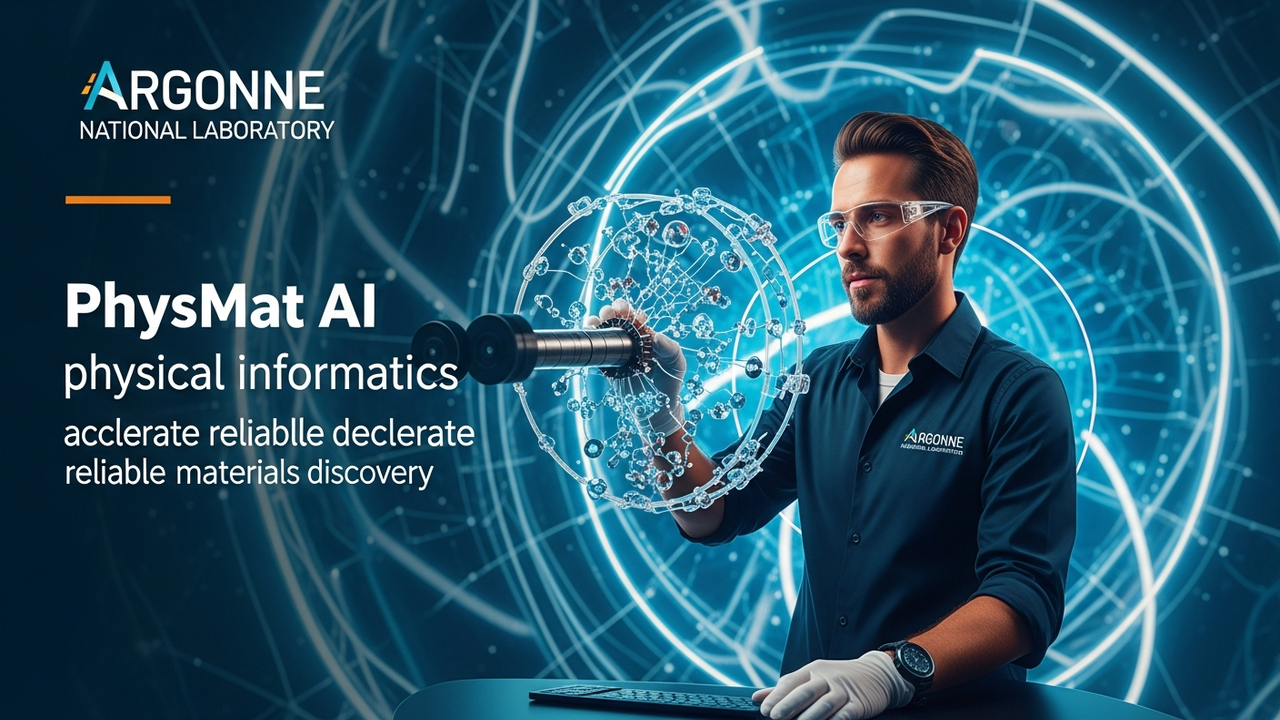
A paper published on arXiv proposes a new paradigm, ‘Physics-Grounded Materials AI (PhysMat AI),’ to significantly enhance the reliability and effectiveness of AI in the field of materials discovery. PhysMat AI deeply integrates fundamental physical knowledge of materials science into AI models, thereby overcoming fundamental challenges inherent in traditional purely data-driven AI, such as lack of interpretability, limited extrapolation capabilities, and inconsistency with physical laws.
Technical / Clinical Details
The core of the PhysMat AI framework lies in embedding physical knowledge into various stages of the AI’s learning and decision-making processes. Specifically, physical information is utilized in the following ways:
- Prior Knowledge: Fundamental physical laws of materials (e.g., thermodynamics, quantum mechanics) are incorporated into the AI model’s initial setup and architecture.
- Descriptors: Physically meaningful features (e.g., atomic radii, electronegativity, bond energies) are used when representing the physical and chemical properties of materials.
- Constraints: The AI is subjected to physical constraints during the exploration of the material design space, excluding physically impossible regions. This ensures that AI-generated material candidates always remain within physically realizable bounds.
- Validators: Mechanisms are incorporated to verify whether the material properties predicted by AI and the discovered mechanisms align with known physical laws.
- Infrastructure: AI is integrated with experimental facilities and computational simulation tools to build a closed-loop materials discovery cycle.
This approach is illustrated through representative examples in fields such as catalysts, solid-state electrolytes for solid-state batteries, and hydrogen storage materials. For instance, in solid electrolytes, physical insights into defect formation energies and ion diffusion pathways are integrated into AI models to balance high ionic conductivity with stability. This enables AI agents to go beyond mere pattern recognition, making more robust and explainable discoveries based on the underlying mechanisms of material properties.
Background & Context
The introduction of AI in materials discovery has garnered significant expectations due to its efficiency and speed, but it has faced challenges such as its black-box nature and difficulty in extrapolating to unknown regions outside the training data. There is also a risk of making predictions that violate physical laws. PhysMat AI addresses these challenges by merging scientific knowledge with AI capabilities to achieve more reliable, explainable, and generalized materials discovery. This will have ripple effects across all fields where AI reliability is crucial, such as drug development, energy, and electronics.
Strategic Significance & Outlook
The development of PhysMat AI has the potential to fundamentally change the paradigm of materials science research. As AI becomes capable of physically explaining ‘why a material is superior,’ researchers can more deeply understand AI’s proposals and use them to formulate further hypotheses. This is expected to make the materials discovery process more efficient and intelligent, accelerating the creation of new functional materials, sustainable energy technologies, and innovative devices. In the long term, this framework could become a core technology for autonomous laboratories, fundamentally altering the pace of scientific discovery.
Source: https://arxiv.org/abs/2608.06680
Get our weekly technology intelligence — free
Receive an infographic that lets you judge at a glance whether each field’s analysis report is worth reading.
Subscribe Free — Weekly Tech Intelligence
By subscribing, you’ll receive Troy-Technical’s weekly technology intelligence newsletter.
- Your email and selected fields are used only to deliver the newsletter.
- We never share your information with third parties.
- You can unsubscribe anytime via the link in each email.
See our Privacy Policy for details.
Takes about a minute · Unsubscribe anytime