Key Findings
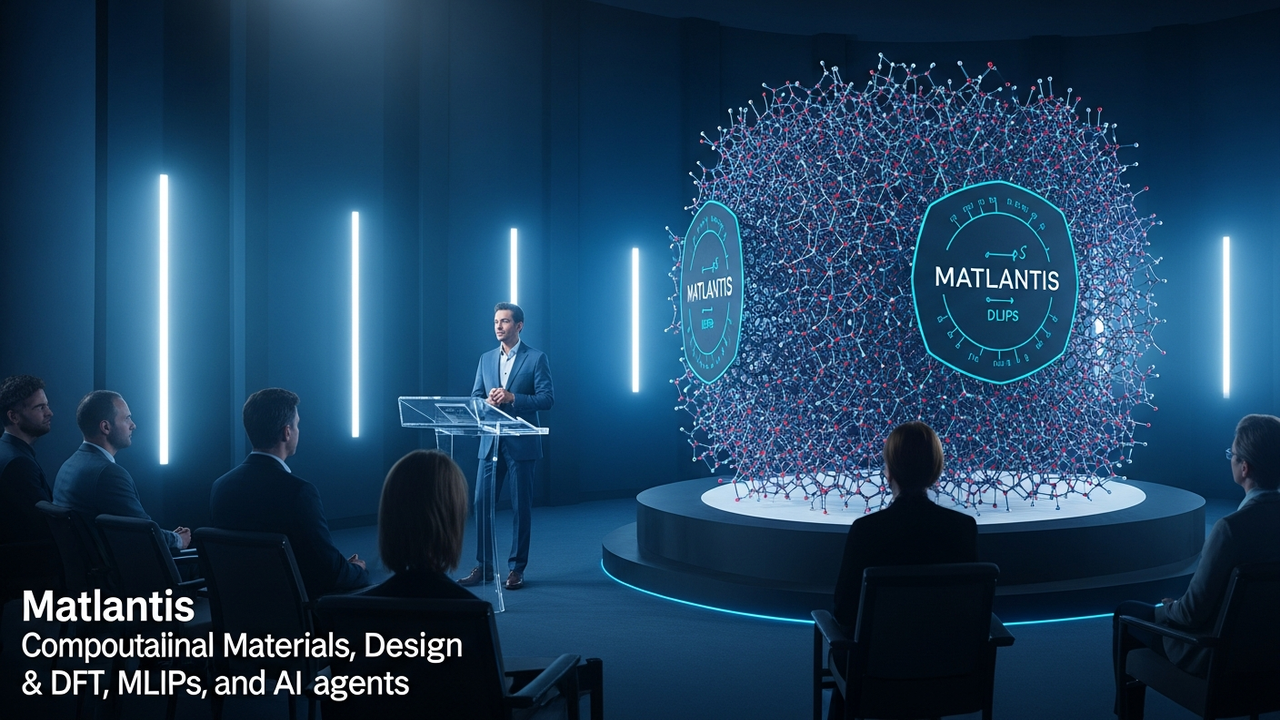
Matlantis is offering an on-demand webinar on an integrated approach to dramatically accelerate computational materials design. This approach combines cutting-edge technologies such as CALPHAD (CALculation of PHAse Diagrams), Density Functional Theory (DFT), Machine Learning Interatomic Potentials (MLIPs), and AI-assisted simulation workflows. This integrated framework opens new avenues for addressing complex materials problems.
Technical / Clinical Details
The webinar elaborates on how to leverage the synergy between different computational methods to solve challenges in materials science. Key technical elements include:
- CALPHAD (CALculation of PHAse Diagrams): A method for predicting phase equilibria and thermodynamic properties of multi-component alloy systems. It aids in evaluating material stability over a wide range of temperatures and compositions.
- Density Functional Theory (DFT): A quantum mechanical method for calculating the electronic structure and interatomic interactions of materials from first principles. It predicts material properties with high accuracy but faces challenges due to high computational cost.
- Machine Learning Interatomic Potentials (MLIPs): This technology uses a small amount of high-accuracy data from DFT calculations to train machine learning models that learn interatomic interactions. This allows large-scale atomistic simulations (e.g., molecular dynamics) to be performed with accuracy close to DFT but at much faster speeds, mitigating DFT’s computational cost issues.
- AI-Assisted Simulation Workflows: AI agents integrate tools like CALPHAD, DFT, and MLIPs to automate the execution of simulations, analysis of results, and decision-making for subsequent steps. This enables researchers to identify and optimize promising material candidates more rapidly.
This integrated framework effectively bridges the fields of thermodynamics, atomistic simulations, and machine learning, and can be applied to the design of various materials such as structural alloys (e.g., high-strength steel), functional oxides (e.g., dielectrics, ferroelectrics), and energy storage materials (e.g., battery electrodes). For instance, it efficiently facilitates the design of alloy compositions with specific mechanical properties or the discovery of oxides exhibiting high dielectric constants at particular temperatures.
Background & Context
Modern industries consistently demand higher-performance and more sustainable materials. However, traditional materials development processes have heavily relied on experimental trial-and-error, creating a bottleneck that consumes vast amounts of time and resources. Computational materials science has evolved as a powerful tool to address this challenge, but each method has its own strengths and weaknesses. Matlantis’s proposed integration of multiple technologies compensates for these weaknesses, dramatically improving the efficiency of materials discovery and design.
Strategic Significance & Outlook
This computational materials design platform, integrating CALPHAD, DFT, MLIPs, and AI agents, has the potential to become a new standard in materials R&D. This approach is expected to lead to significant reductions in development timelines, cost savings, and the discovery of materials previously considered impossible. In the future, this technology is anticipated to form the core of autonomous laboratories (Self-Driving Labs), constructing a closed-loop system that automates the entire process from material design to synthesis and characterization, thereby fundamentally transforming the innovation cycle across materials science.
Source: https://matlantis.com/ja/resources/event-seminar/ondemand-prof-zhong/
Get our weekly technology intelligence — free
Receive an infographic that lets you judge at a glance whether each field’s analysis report is worth reading.
Subscribe Free — Weekly Tech Intelligence
By subscribing, you’ll receive Troy-Technical’s weekly technology intelligence newsletter.
- Your email and selected fields are used only to deliver the newsletter.
- We never share your information with third parties.
- You can unsubscribe anytime via the link in each email.
See our Privacy Policy for details.
Takes about a minute · Unsubscribe anytime