Key Findings
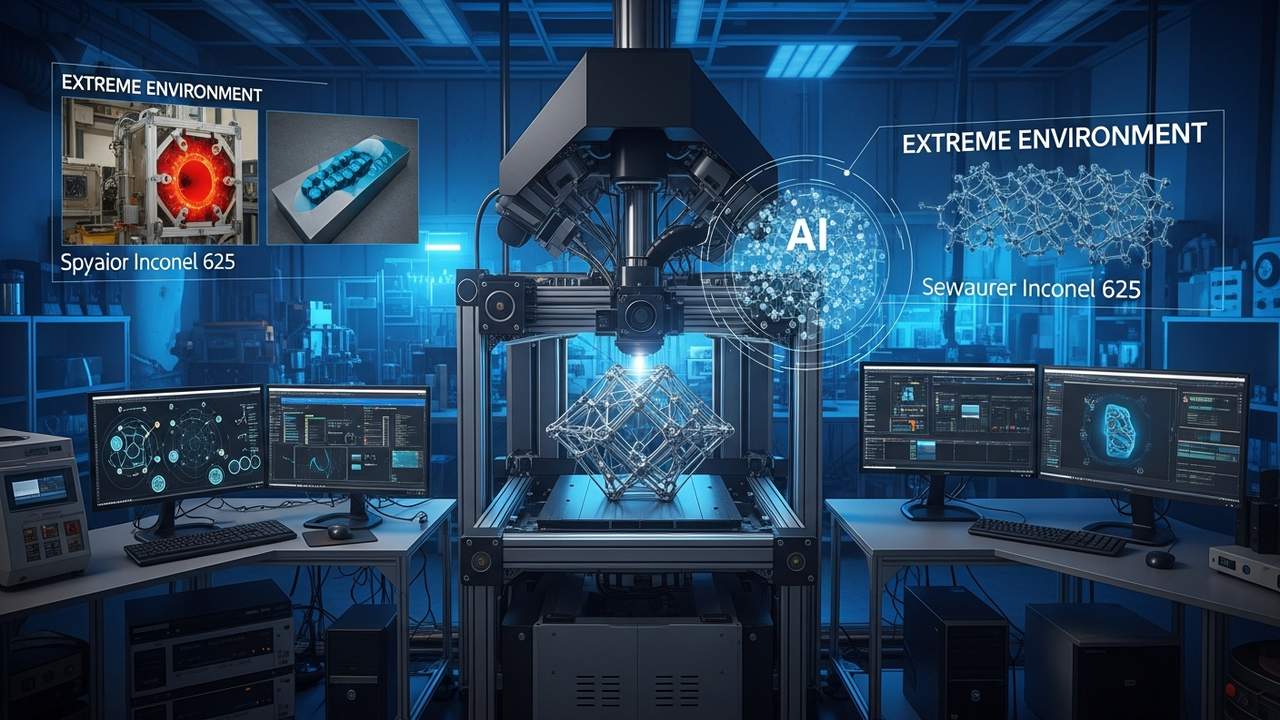
A research team at the University of Toronto has successfully discovered new metal alloys that exhibit superior strength and performance under extreme conditions by integrating artificial intelligence (AI) with robotic-assisted manufacturing. This innovative approach has identified alloys particularly suited for 3D metal printing, holding the potential to develop custom components for demanding industrial applications such as jet engines and nuclear power plants that outperform existing high-performance materials like Inconel 625.
Technical / Clinical Details
The team first utilized AI algorithms to predict promising alloy candidates from a vast compositional space. Subsequently, robotic-assisted manufacturing systems were employed to rapidly synthesize and thoroughly characterize these candidate materials. This closed-loop system dramatically accelerates the material discovery cycle compared to traditional trial-and-error methods. The combination with 3D metal printing technology offers unprecedented flexibility in designing and fabricating complex-shaped components, speeding up the practical implementation of new materials. This is expected to lead to significant improvements in the reliability and lifespan of components operating under harsh conditions of high temperature, high pressure, and corrosion.
Background & Context
Industries such as aerospace, energy, and defense constantly seek materials capable of functioning reliably in extreme environments. Conventional material development processes have historically been slow, costly, and heavily reliant on empirical methods. While Inconel 625 is a well-established high-performance alloy, the potential for further incremental improvements through traditional means has become limited. The synergy of AI and automated manufacturing, often termed ‘materials informatics,’ offers a pathway to overcome these challenges and fundamentally transform the material design paradigm, paving the way for safer and more efficient infrastructure and products.
Strategic Significance & Outlook
The newly discovered alloys are not only expected to contribute to the development of more energy-efficient jet engines and safer nuclear power facilities but also have broad applications in areas such as extreme-environment sensors and defense technologies. The integration of AI and robotic manufacturing is poised to become a standard methodology in future materials science research, pushing the boundaries of discovery speed, cost-effectiveness, and performance limits. This research represents a critical step towards the rapid commercialization of high-performance materials and will serve as a catalyst for innovation across the manufacturing sector.
Get our weekly technology intelligence — free
Receive an infographic that lets you judge at a glance whether each field’s analysis report is worth reading.
Subscribe Free — Weekly Tech Intelligence
By subscribing, you’ll receive Troy-Technical’s weekly technology intelligence newsletter.
- Your email and selected fields are used only to deliver the newsletter.
- We never share your information with third parties.
- You can unsubscribe anytime via the link in each email.
See our Privacy Policy for details.
Takes about a minute · Unsubscribe anytime