Key Findings
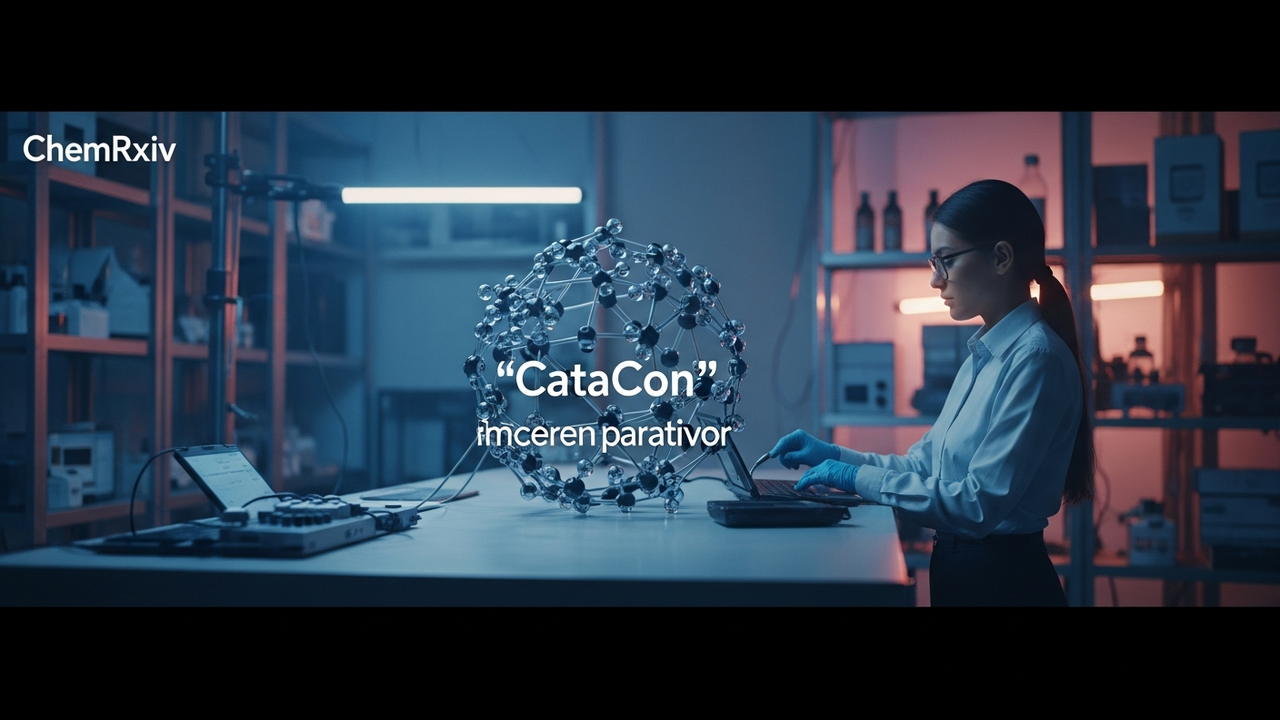
A new research paper published on ChemRxiv presents ‘CataCon,’ a groundbreaking contrastive graph representation learning framework specifically designed for catalyst prediction. CataCon leverages the GraphSAGE algorithm to generate robust molecular graph embeddings for reactants, products, and candidate catalysts, thereby comprehensively capturing their structural features and significantly improving the accuracy of catalytic reaction predictions.
Technical / Clinical Details
CataCon represents molecules as graphs composed of nodes and edges, applying Graph Neural Networks (GNNs) like GraphSAGE to learn low-dimensional embeddings (feature vectors) of these graphs. The contrastive learning approach trains the model such that embeddings of relevant molecular pairs (e.g., reactants and products on the same reaction path, or an active catalyst with its reactants) are close to each other, while irrelevant pairs are pushed apart. This enhances the model’s ability to discern subtle structural similarities and differences critical to catalytic reactions. The learned embeddings can then be used as input to select optimal catalysts for new reactions or predict which reactions a specific catalyst will promote. This approach provides deep insights into atomic-level interactions and electronic structures of catalysts, strengthening the ability to predict their performance and selectivity.
Background & Context
Catalysts play an indispensable role in the chemical industry, energy production, and environmental protection. However, the discovery and optimization of new catalysts have historically been extremely time-consuming and costly processes, involving extensive experimentation and trial-and-error. There is a strong demand for efficient and highly selective catalysts, particularly in the fields of energy transition (e.g., hydrogen production, CO2 conversion) and green chemistry (e.g., waste upcycling, environmentally friendly synthesis routes). Advances in AI and machine learning, especially in graph representation learning, open new avenues for predicting molecular structures and reactivity, potentially resolving bottlenecks in catalyst development.
Strategic Significance & Outlook
AI-driven frameworks like CataCon hold the potential to profoundly transform the future of catalyst development. This technology will enable researchers to design and discover high-performance catalysts more rapidly and efficiently. Consequently, it will accelerate improvements in energy efficiency, reduction of greenhouse gas emissions, and the development of more sustainable chemical processes. In the future, CataCon is expected to be extended to other datasets and complex reaction systems, serving as a foundation for inverse catalyst design (designing catalyst structures from desired functions). This will fundamentally alter the pace of innovation in the energy, chemical, and environmental sectors, becoming an indispensable technology for achieving a sustainable society.
Source: https://pmc.ncbi.nlm.nih.gov/articles/PMC13371356/
Get our weekly technology intelligence — free
Receive an infographic that lets you judge at a glance whether each field’s analysis report is worth reading.
Subscribe Free — Weekly Tech Intelligence
By subscribing, you’ll receive Troy-Technical’s weekly technology intelligence newsletter.
- Your email and selected fields are used only to deliver the newsletter.
- We never share your information with third parties.
- You can unsubscribe anytime via the link in each email.
See our Privacy Policy for details.
Takes about a minute · Unsubscribe anytime