Key Findings
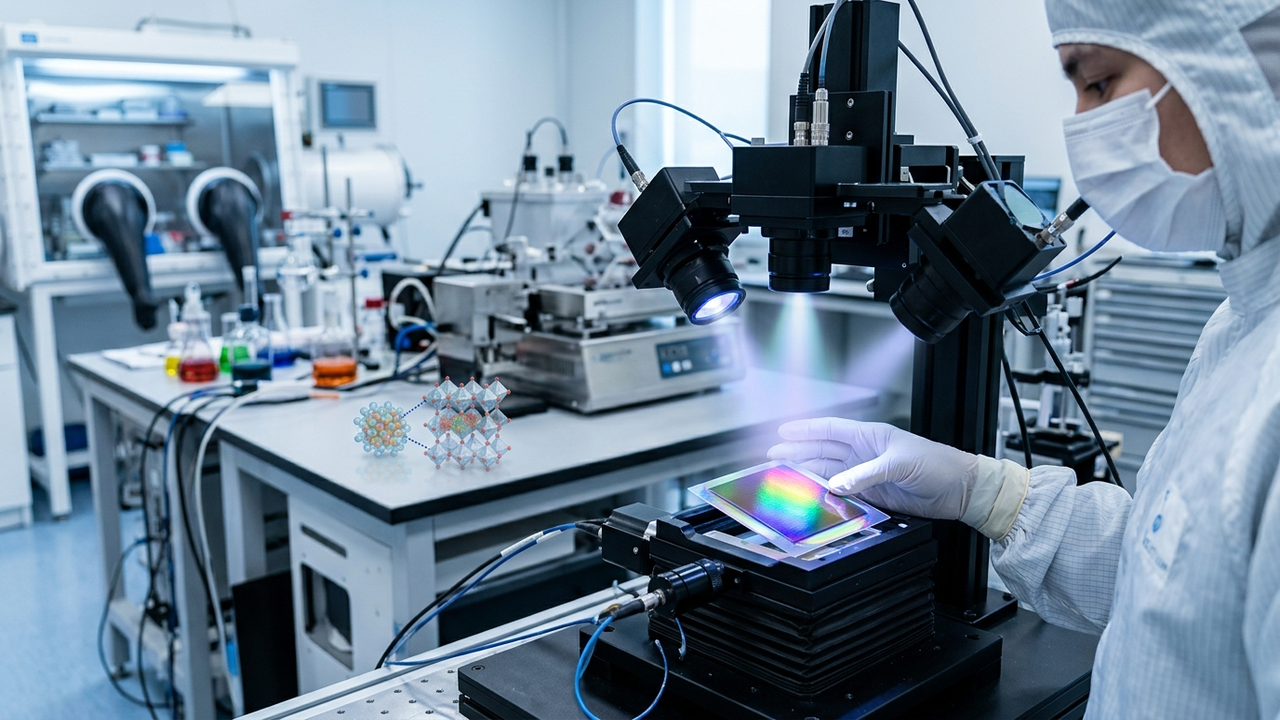
UbiQD has announced a significant advancement in quantum dot (QD) technology, demonstrating its capability to dramatically enhance the efficiency of next-generation perovskite solar cells (PSCs). QD-based PSCs have achieved an impressive energy conversion efficiency of up to 21.32%, with potential photon conversion rates reaching as high as 66%. This technological leap holds the potential to fundamentally transform the cost-effectiveness and performance landscape of solar power generation.
Technical / Clinical Details
This groundbreaking improvement in efficiency is attributed to a unique method called ‘Pulsed Laser Irradiation in Colloids’ (PLIC). PLIC effectively repairs crystallographic defects present in the perovskite layer and simultaneously optimizes charge transport pathways when integrating 2-10 nanometer QDs into the perovskite material. Quantum dots inherently possess properties like upconversion, converting low-energy photons into high-energy carriers, and multiple exciton generation (MEG), where one absorbed photon generates multiple electron-hole pairs. These properties enable QDs to push beyond theoretical efficiency limits. The PLIC technique is crucial for maximizing these inherent QD advantages, thereby boosting the overall performance of PSCs.
Background & Context
Perovskite solar cells are one of the most highly anticipated technologies in the solar energy industry, promising high efficiencies comparable to or even exceeding silicon-based cells, but at a significantly lower cost. However, challenges related to stability and efficiency degradation due to manufacturing defects have hindered their widespread adoption. UbiQD’s quantum dot technology offers a concrete solution to these challenges, particularly concerning efficiency. This advancement carries profound implications for accelerating the transition to renewable energy and further promoting the global adoption of solar power.
Strategic Significance & Outlook
The integration of this quantum dot technology is expected to accelerate the commercialization of PSCs and facilitate their seamless integration into existing solar module manufacturing lines. The combination of high energy conversion efficiency and potential cost reductions will bolster the competitiveness of PSCs in a broader market. UbiQD is likely to continue its focus on further developing this technology, aiming to enhance the stability and long-term performance of quantum dot solar cells. In the long term, diverse applications are anticipated, including building-integrated photovoltaics (BIPV), flexible solar cells, and even aerospace applications, marking a significant step towards more sustainable energy solutions.
Get our weekly technology intelligence — free
Receive an infographic that lets you judge at a glance whether each field’s analysis report is worth reading.
Subscribe Free — Weekly Tech Intelligence
By subscribing, you’ll receive Troy-Technical’s weekly technology intelligence newsletter.
- Your email and selected fields are used only to deliver the newsletter.
- We never share your information with third parties.
- You can unsubscribe anytime via the link in each email.
See our Privacy Policy for details.
Takes about a minute · Unsubscribe anytime