Key Findings
A team of scientists at the California Institute of Technology (Caltech) has achieved a significant breakthrough in integrated photonics, developing ultra-low-loss optical pathways on silicon chips. Utilizing nanoscale germano-silicate waveguides, they have demonstrated light transmission efficiency comparable to fiber optics in the visible wavelength range. This innovation overcomes long-standing challenges in silicon photonics regarding optical losses, poised to dramatically enhance the performance of next-generation integrated optical circuits (PICs).
Technical / Clinical Details
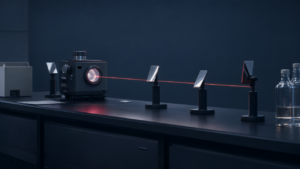
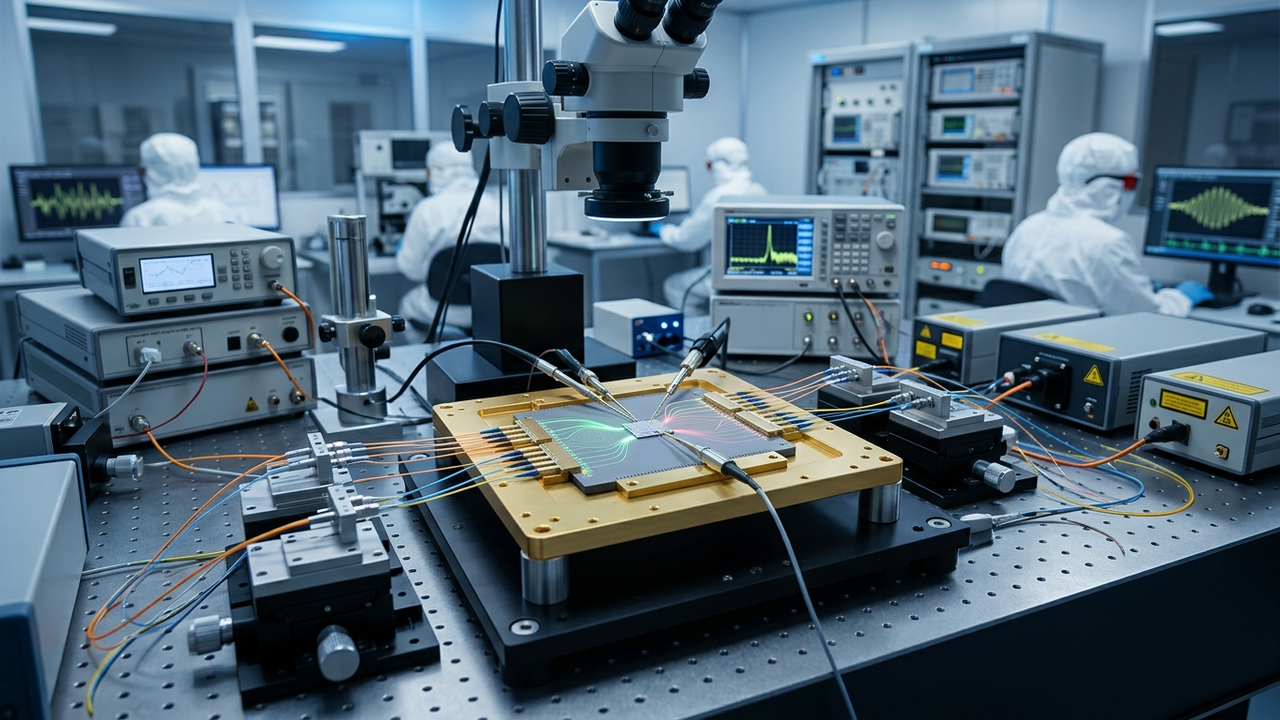
The developed germano-silicate waveguides are fabricated on silicon substrates using a specialized chemical vapor deposition (CVD) method. This material exhibits exceptionally low optical absorption and scattering properties in the visible spectrum. Through precise nanoscale structural control, light signals can propagate with remarkable efficiency. The research team successfully shaped these waveguides into spiral configurations to maximize optical path length within a confined chip area while minimizing losses. Conventional silicon waveguides suffered from significant light losses in the visible range, limiting their performance. The combination of germano-silicate material and sophisticated nanofabrication techniques has now removed this critical barrier.
Background & Context
Silicon photonics is a crucial technology for high-speed and energy-efficient data processing and transmission, essential for modern computing and sensing applications. However, existing silicon platforms are primarily optimized for near-infrared light, leading to limited performance in the visible light spectrum, which is utilized by a wider range of applications. Fields such as high-power lasers, atomic sensors, and quantum computing have a strong demand for low-loss optical pathways in visible light. Caltech’s breakthrough addresses this technological gap, establishing a foundation for silicon photonics to expand into more diverse optical technology domains.
Strategic Significance & Outlook
This ultra-low-loss germano-silicate waveguide technology enables a myriad of innovative applications. It is expected to lead to the realization of more powerful and stable lasers, the development of miniaturized high-precision atomic sensors and clocks, and the integration into quantum systems to allow for long-distance, high-fidelity optical interactions between quantum bits. Furthermore, it will significantly improve the energy efficiency of optical interconnects in data centers, contributing to reduced power consumption. In the future, integrated optical circuits are anticipated to resolve bottlenecks in AI chips and high-performance computing, becoming a core technology accelerating the continued evolution of information technology.
Source: https://www.sciencedaily.com/releases/2026/08/260814235905.htm
Get our weekly technology intelligence — free
Receive an infographic that lets you judge at a glance whether each field’s analysis report is worth reading.
Subscribe Free — Weekly Tech Intelligence
By subscribing, you’ll receive Troy-Technical’s weekly technology intelligence newsletter.
- Your email and selected fields are used only to deliver the newsletter.
- We never share your information with third parties.
- You can unsubscribe anytime via the link in each email.
See our Privacy Policy for details.
Takes about a minute · Unsubscribe anytime