Background
Global warming and escalating energy costs are primary drivers behind the surging electricity consumption associated with air conditioning systems in buildings. Peak electricity demand, particularly during summer months, frequently results in power shortages and increased greenhouse gas emissions across numerous regions. Conventional cooling technologies, such as air conditioners, are inherently energy-intensive, and their widespread deployment exacerbates environmental challenges. Consequently, extensive global research and development efforts are focused on creating passive cooling materials capable of cooling buildings without electrical power. This latest Spanish research represents one of the most promising advancements in the field, overcoming limitations of existing passive cooling technologies and marking a critical step towards truly sustainable architecture.
Key Findings
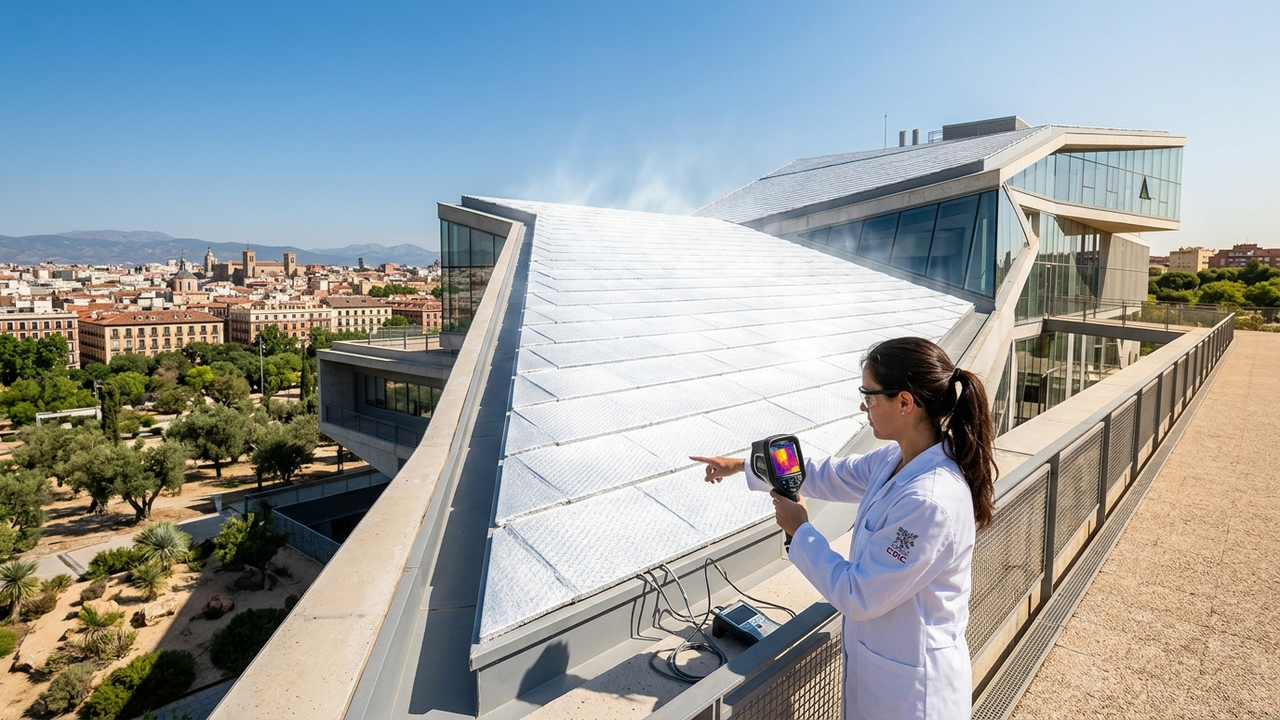
A team of scientists at Spain’s CSIC research center has developed a groundbreaking nanomaterial capable of cooling building surfaces by over 10°C without any electrical input. Field tests conducted in Madrid demonstrated that surfaces coated with this material remained up to 13°C cooler than uncoated counterparts under identical environmental conditions. This innovative passive cooling technology offers immense potential for reducing global energy consumption and substantially contributing to climate change mitigation efforts.
Technical Details
The developed nanomaterial is a multi-layered composite meticulously engineered to simultaneously achieve intense reflection of solar radiation and efficient thermal emission into the atmosphere. Specifically, it exhibits near-complete reflection of light in key wavelengths (particularly near-infrared) while effectively radiating heat within the atmospheric window (8-13 micrometers). This dual action enables the coated surface to maintain a temperature below the ambient air, leveraging a radiative cooling mechanism that requires no external power. This offers a truly maintenance-free and sustainable cooling solution. The nanoscale architecture of the material is precisely tailored to control these specific optical properties, with ongoing development focused on achieving a form factor that allows for easy application, similar to conventional paint.
Strategic Significance & Outlook
This electricity-free cooling nanomaterial possesses immense market potential owing to its broad spectrum of applications. Beyond its primary use for coating roofs and exterior walls of residential and commercial buildings, it is envisioned for deployment on vehicle surfaces, for cooling electronic devices, and even for enhancing the efficiency of solar panels—effectively, any domain where thermal management presents a significant challenge. Widespread adoption of this technology could substantially mitigate urban heat island effects, dramatically reduce large-scale electricity consumption, and consequently lead to a significant decrease in carbon dioxide emissions, thereby contributing profoundly to the realization of a sustainable society. The immediate future will focus on establishing scalable production techniques for commercialization and conducting rigorous long-term performance evaluations across diverse climatic conditions.
Get our weekly technology intelligence — free
Receive an infographic that lets you judge at a glance whether each field’s analysis report is worth reading.
Subscribe Free — Weekly Tech Intelligence
By subscribing, you’ll receive Troy-Technical’s weekly technology intelligence newsletter.
- Your email and selected fields are used only to deliver the newsletter.
- We never share your information with third parties.
- You can unsubscribe anytime via the link in each email.
See our Privacy Policy for details.
Takes about a minute · Unsubscribe anytime